Liz Truss and Kwasi Kwarteng will meet the head of the UK's independent fiscal watchdog today amid the fall-out from the government's mini-budget.
The talks with the Office for Budget Responsibility (OBR) come after a week of economic turmoil following last Friday's announcements, which saw the pound plunge, mortgages rocked and pension funds needing to be saved.
It is highly unusual for a PM to attend an OBR meeting - which is usually held between the independent watchdog and the chancellor to discuss upcoming economic forecasts - but the Treasury has denied that this is an emergency measure.
The OBR was set up by the government in 2010 to provide independent analysis of the UK's public finances.
Financial Secretary to the Treasury Andrew Griffith said it was "a very good idea" for the meeting to take place, but former Bank of England deputy governor Sir Charles Bean told Sky News "there is an element of closing the stable door after the horse has bolted".
Please use Chrome browser for a more accessible video player
1:38
Senior Tory blames mini-budget for turmoil
The news came hours after the Treasury Select Committee, made up of MPs from all parties, demanded that the chancellor release a full economic forecast from the OBR by the end of October.
More on Conservatives
Related Topics:
He is also being urged to bring forward his medium-term budget from 23 November.
Mr Griffith hinted to Sky News that a report could come sooner, saying the independent OBR has "got to be given the freedom and ability to do that".
Advertisement
But, he added: "That's a decision for them. It's not for me or anyone else to dictate that to them."
Ms Truss and Mr Kwarteng have said they are still committed to their policies - and argue that a £45bn package of tax cuts is the "right plan" for the economy.
But Labour's shadow business secretary Jonathan Reynolds said the mini-budget was "without question one of the biggest unforced errors in policymaking in this country's history".
He reiterated the demand of his and other opposition parties to recall parliament and reverse the fiscal measures.
No independent OBR forecast accompanied last week's announcements - but the watchdog said it had prepared a draft for the new chancellor on his first day in office.
The absence of this forecast reportedly contributed to concerns in the City.
Mr Griffith insisted a forecast last Friday would not have been able to "reflect [the] economic growth in their numbers" that he claimed would come from government policies, as the measures would have been "finalised in the hours before the chancellor stood up".
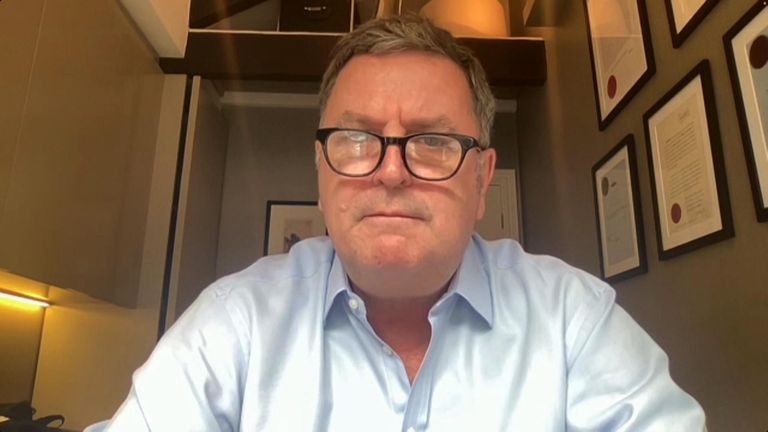
But Mel Stride, Conservative chair of the Treasury Select Committee, had said in his letter to the chancellor it is "hard to conclude other than that an absence of a forecast has in some part driven the lack of confidence in markets".
He added: "Some have formed the unfortunate impression that the government may be seeking to avoid scrutiny, possibly on account of expecting the OBR forecast to be unsupportive of the achievement of the economic outcomes the government expects from the Growth Plan, including 2.5% trend growth in the medium term."
Sir Charles agreed, saying the lack of forecast was "clearly one of the factors that is contributing to the market turmoil".
Please use Chrome browser for a more accessible video player
2:07
Chancellor 'sticking with growth plan'
Mr Kwarteng had said the forecast would be released on 23 November - but after last Friday's mini-budget caused economic turmoil, the committee discovered the chancellor will be getting an initial OBR forecast on 7 October.
They asked him to publish "without delay" the initial economic and fiscal forecast the OBR provided to him when he started the job a few weeks ago.
A reply from the chancellor has been requested for no later than Monday.
Mr Stride also expressed frustration in his letter at having pressed Mr Kwarteng and his predecessor Nadhim Zahawi to publish an OBR forecast before the mini-budget and said the OBR had assured him on 26 August that it could produce a forecast to that timescale and had already been working on it for a month.
"The OBR was standing by ready to provide a meaningful forecast alongside the 23 September statement had the Treasury requested it. No such request was received," Mr Stride said.
Mr Stride said he was pleased to see the OBR meeting happening.
"The PM and the chancellor must use this meeting as a reset moment - an opportunity to urgently bring forward the OBR forecast incorporating credible new fiscal rules and a plan which the OBR assesses as having a good chance of meeting them.
"Then we can all take a deep breath and start to move forward with greater confidence."
The senior Tory told Sky News' Daily Podcast earlier on Thursday: "Many colleagues are very concerned, and I think that's totally unsurprising.
"I mean, I can speak for myself. I'm on the record as saying that I think if we're not very careful, then our position as being the party of sound money and economic responsibility, fiscal responsibility, may be in jeopardy."
Mr Stride added that he did not think it was incompetence that caused the current problems and suspects "some of those involved have been taken slightly by surprise how quickly the markets turned" but he thinks publishing an OBR forecast would be central to calming the markets by "demonstrating credibility".
A YouGov poll for The Times shows Labour has opened up a massive 33-point lead over the Conservatives.
Tory MP Sir Charles Walker admitted his party would be "wiped out" if an election was called tomorrow - and "would cease to exist as a functioning political party".
Mr Griffith tried to urge calm within his party, telling Sky News: "This is a difficult time for all developed economies and for all governments. This is a government that's taken decisive steps to deal with the immediate energy crisis."
But former Bank of England top brass Sir Charles took issue with the government's focus on energy bills and the war in Ukraine, saying: "If all the government had announced last Friday was the energy price guarantee... I don't think there would have been a problem with there not being an accompanying forecast because those support measures are intended to be temporary and will be self-terminating when wholesale energy prices fall back.
"The thing that created the problem, in my view, was the fact alongside that the chancellor chose to announce the rolling back of National Insurance increases and the slated increase in corporate taxes... and those are intended to be permanent, so they potentially have implications for the sustainability of the public finances."
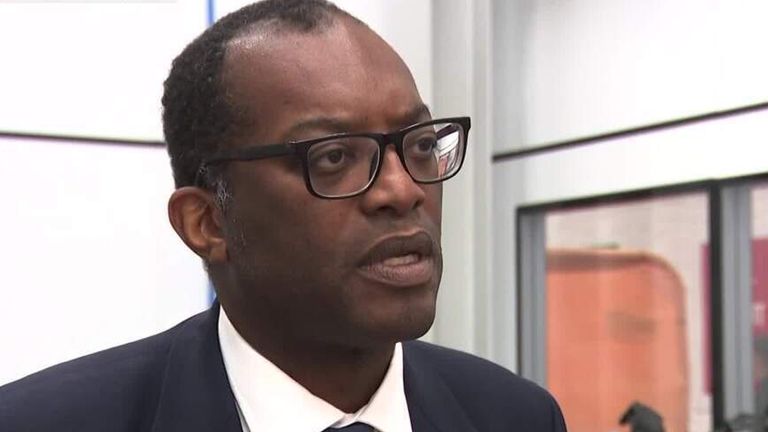
Chancellor Kwasi Kwarteng has insisted the government is focusing on "delivering the growth plan" and "protecting people right across the country" despite a week of market turmoil.
The chancellor, who announced his mini-budget last Friday, said without the government's plans it could not generate the income and tax revenue needed to pay for the public services "we want to see".
He said the mini-budget was "absolutely essential" for growth when asked if the plans have been a major economic disaster as the pound plummeted and the Bank of England had to step in to stop a run on pension funds.
Asked what he would say to people whose mortgage interest rates have risen dramatically, with many offers cancelled, Mr Kwarteng said: "We're absolutely protecting people right across the country".
The chancellor said the government's energy intervention is "saving thousands of pounds a year" and tax cuts will mean more of people's incomes in their pockets.
"We're very, very focused on making sure that the cost of living pressures can be withstood by ordinary people up and down this country," he added.
More on Kwasi Kwarteng
Related Topics:
He said it would be "premature" of him to decide now on whether to keep the Johnson government's promise to put up benefits in April by this month's rate of inflation - which is 10%.
"But we are absolutely focused on making sure that the most vulnerable in our society are protected through what could be a challenging time," he said.
Advertisement
The chancellor added that the government is committed to the triple pensions lock, which means state pensions will increase in line with whichever is highest of: consumer price inflation, average wage growth or 2.5%.
Please use Chrome browser for a more accessible video player
1:15
Truss: Right to 'take decisive action'
'I understand your concern'
He echoed Prime Minister Liz Truss' insistence the mini-budget was necessary to help people and businesses facing soaring living costs.
Earlier today, Ms Truss said the government's tax-cutting measures are the "right plan" in the face of rising energy bills and said they will get the economy growing.
Mr Kwarteng today sent a message to Conservative MPs trying to allay their concerns after many failed to be reassured by a phone call from him on Wednesday.
"I understand your concern. We are one team and need to remain focused," the message seen by Sky News says.
"There is immense global market volatility - not just a UK issue - being driven by war, COVID hangover, and a super strong USD all other major currencies are wrestling with (see Japan this week; Euro down).
"The path we were on was unsustainable - we couldn't simply continue to raise taxes."
He then said he understood the government needs to be "credible with markets" and promised to show markets the plan is "sound, credible and will work to drive growth".
One of the reasons for the negative reaction to the mini-budget is that the markets had no idea what was going to happen and there was no independent Office for Budget Responsibility (OBR) report alongside it.
Mr Kwarteng ended the message by calling on his colleagues' support "as the only people who win if we divide is the Labour Party".
Liz Truss has insisted that her government has the “right plan” for the economy as she spoke publicly for the first time since her chancellor’s mini-budget threw the markets into turmoil.
The prime minister said she needed to take “urgent action to get our economy growing” on a round of combative interviews with regional BBC radio stations. She said had taken “controversial, difficult decisions” but added: “I’m prepared to do that as prime minister because what’s important to me is that we get our economy moving.”
She admitted “we’re facing very, very difficult economic times”, but insisted those pressures were global and caused by Russia’s invasion of Ukraine. “And of course a lot of the measures that we’ve announced won’t happen overnight, and then we won’t see the growth overnight,” she said. “But what’s important is that we’re putting this country on a better trajectory for the long term. Of course there were elements of controversy, as there always are.”
Kwasi Kwarteng arrives in Darlington where he was meeting local businesses today. The chancellor’s mini-budget on Friday was followed by turmoil on the financial markets
OWEN HUMPHREYS/PA
She rejected calls for a U-turn, insisting her plan was the right one. In an interview on BBC television, she said: “We are facing a global economic crisis brought about by Putin’s war and what was right was Britain took decisive action to help people get through what is going to be a difficult winter.”
The Bank of England announced a £65 billion emergency intervention to avert an economic crisis in the aftermath of the government’s mini-budget. In a highly unusual move that economists warned could fuel inflation, the central bank pledged to buy billions of pounds of government debt to prevent people’s pensions being put at risk.
Yields on government bonds were rising this morning as the pound and equity markets weakened. Rising yields are linked to increases in the cost of mortgage payments and government borrowing.
It warned of a “material risk” to Britain’s financial stability after Kwasi Kwarteng’s tax-cutting measures. Conservative MPs, including some cabinet ministers, expressed concern about the government’s handling of the economy amid calls for the chancellor to abandon his plans to abolish the 45p rate of income tax.
The Bank intervened after warnings from pension funds that they could be hours from having to make major fire sales of assets at knock-down prices, putting promised pensions in jeopardy. Kwarteng’s measures were affecting the trade in gilts, a government bond that is used to service pension funds.
The prime minister has rejected calls from some Tory MPs to dismiss the chancellor.
11 minutes ago
4.00pm
Radio interference throws PM’s message
Rima Ahmed of BBC Radio Leeds put Liz Truss on the spot this morning
After a week of market turmoil in the wake of Friday’s mini-budget, the prime minister was determined to land two messages (writes Oliver Wright).
The first was that the UK’s present economic travails were the result of a “global” crisis caused by “Putin’s war”. The second was to hammer home government support for families through the energy price cap. That was until Rima Ahmed, BBC Radio Leeds presenter, asked: “Since your chancellor Kwasi Kwarteng’s mini-budget, the pound has dropped to a record low, the IMF has said that you should re-evaluate your policies and the Bank of England has had to spend £65 billion to prop up the markets because of what they describe as a ‘material risk’. Where’ve you been?”
After a long pause, Truss replied: “Well, I think we’ve got to remember the situation we were facing this winter. We were facing a situation where people could have had to pay energy bills of up to £6,000, where inflation was increasing and where we were looking at an economic slowdown which would have had a huge impact right across the country, including in places like Leeds”
Truss ‘misleading public’ with £2,500 fuel bill claim
Liz Truss has been challenged over her assertion that households will pay no more than £2,500
TIMES PHOTOGRAPHER JACK HILL
Liz Truss repeatedly sought to turn attention away from market turmoil and back to the government’s promise to freeze energy bills, during her round of interviews today (Chris Smyth writes).
But the prime minister has been accused of repeatedly misleading listeners about the nature of her policy after wrongly claiming on several radio stations that “nobody is paying fuel bills of more than £2,500”.
The confusion arises because the “energy price guarantee” she introduced, like the previous energy price cap, neither caps nor guarantees bills. Instead it is a cap on the unit price of gas and electricity: those who use more, pay more, but those who use less, pay less.
The £2,500 figure refers to the average household and some will may far more: the government’s own estimates show that people living in a detached house will pay around £3,300 under the energy price guarantee. But those living in purpose built flats will pay £1,750. In one BBC interview she did refer to a “typical fuel bill”.
The claims have infuriated the fact-checking organisation Full Fact, which had already urged Truss to correct the record after she made the same claim on CNN on Sunday.
Will Moy, its chief executive, said: “We wrote to the prime minister about getting this wrong only yesterday. The government’s energy plans will affect every household in Britain this winter. And yet Liz Truss has repeatedly misled listeners this morning”.
He said that Truss “must now publicly correct her mistake to make sure people are not misled about their energy prices and hit with unexpected and unaffordable energy bills this winter”.
1 hour ago
3.10pm
PM backs Whitehall efficiency drive
Liz Truss has said there are “plenty of areas” where government savings could be made as ministers are told to balance the books.
The prime minister defended the position, telling broadcasters: “It is absolutely right that we always need to get value for taxpayers’ money. Every pound we take from somebody is a pound we could be spending on their future, on what they need to support themselves.”
Philp is set to write to departments telling them to make efficiency savings, despite Truss saying during the Conservative leadership race that was was “not planning public service reductions”.
Speaking today, Truss said: “There are always ways that we can organise things more efficiently. What I want to make sure is that taxpayer money is focused on frontline services, on getting our GP appointments, making sure people can see a doctor, making sure we deliver on our road projects, all of those things people rely on us for.
“There are plenty of areas the government can become more efficient.”
2 hours ago
2.10pm
Pensions will be protected under triple lock
Older people saw their pensions rise way below inflation in April but the government has promised to restore the triple lock protection
GETTY IMAGES
People on benefits face seeing their payments squeezed next year but Liz Truss is pledging to protect pensioners (Chris Smyth writes).
Ministers are reviewing the commitment made under Boris Johnson to increase benefits in line with inflation next year as they scramble for departmental savings to reassure financial markets spooked by last week’s mini-budget.
Chris Philp, chief secretary to the Treasury, said increasing benefits by less than inflation was “under consideration”.
However, government sources stressed that pensioners will see their incomes rise with inflation, currently at 10 per cent, as the prime minister sticks with a pledge to keep the triple lock designed to protect the value of state pensions.
In April benefits were increased by 3.1 per cent when inflation was 9 per cent, but Johnson’s government promised the squeeze would be corrected next year. Benefits are typically increased in April by the consumer prices index measure of inflation the previous September.
In May Rishi Sunak, as chancellor, said that “benefits will be uprated by this September’s consumer prices index”, saying this would represent “a very significant increase in benefits next year”. Last month CPI stood at 9.9 per cent.
However, Truss’s team now say that it would be “irresponsible not to consider the options” and “everything is on the table”. They stress that no decision has yet been taken, with formal discussions on benefits due to begin once September’s inflation figures are received next month.
Philp, the chief secretary to the Treasury, told ITV’s Peston that Sunak’s commitment was “under consideration and I’m obviously not going to make policy announcements . . . on live TV, it’s going to be considered in the normal way.”
But government sources insisted that this review did not apply to the triple lock promise that state pensions rise with the highest of inflation, average earnings or 2.5 per cent. Government sources stressed today that “we’re sticking to the triple lock” after Truss said during the leadership campaign that she was fully committed to the pledge.
3 hours ago
1.10pm
Gloom in City as FTSE 250 dives 330 points
The Bank of England intervened in an attempt to stabilise the markets yesterday
AMER GHAZZAL/ALAMY
The brief rally inspired by the Bank of England’s £65 billion bailout of the gilt market appears to have run out of steam. Less than 24 hours after Threadneedle Street fired up the money-printing presses, one veteran City trader told The Times they had “rarely seen sentiment so bad” (Simon Freeman writes).
While the dollar-dominated FTSE 100 fell by about 1 per cent, to dip back under 7000 points, it was on the more domestically focused FTSE 250 that the loss of confidence is most stark.
A drop of 330 points, or 1.9 per cent, sent the mid-cap index below 17,000 — a figure not reached since the day in November 2020 when Pfizer and BioNTech announced successful trials of the first western Covid-19 vaccine. Retailers, housebuilders and hospitality groups were all in the red.
The pound, too, gave up yesterday’s gains, with sterling trading down by as much as 0.9 per cent to $1.076 against a resurgent dollar. It was off a fraction against the euro at €1.11.
Borrowing costs have crept back up, with the yield on the 30-year gilt edging above 4 per cent, having posted its steepest drop on record on Wednesday. The benchmark ten-year gilt yield rose 15 basis points this morning to 4.15 per cent, after falling by almost 50 basis points yesterday.
Russ Mould, investment director at the trading platform AJ Bell, said: “The main priority is bringing inflation under control, yet the government’s actions in its mini-budget serve to make inflation even worse, given they’ve sent the pound tumbling.
“That will make it even more expensive to buy goods and services from abroad, leading to the prospect of even greater interest rates hikes in the future. Liz Truss implies that painful decisions need to be taken, but for many people the current situation is a catastrophe already.”
3 hours ago
12.20pm
Can Truss and Kwarteng weather the storm?
Conservative MPs reeling from tumult in the markets fear Britain could endure months of financial chaos. However, supporters of the approach taken by Truss and Kwarteng argue the markets will settle and the government will be rewarded with growth for holding its nerve (Henry Zeffman writes).
The prospects for the new government, not to mention the financial security of millions, depend on who is right. Possible scenarios range from markets failing to regain confidence, triggering emergency action on interest rates by the Bank, to Truss and Kwarteng being vindicated as the economy stabilises next year. Either way, their political futures and that of the Conservative government hinge on what plays out.
5 hours ago
10.50am
Tread carefully from now, economist urges ministers
Gerard Lyons, who has advised Liz Truss, had warned that the government should not “spook” the financial markets
JEFF GILBERT/REX FEATURES
Ministers need to “tread very carefully from here”, one of Liz Truss’s favourite economists has warned. Gerard Lyons, who has advised Truss on her economic policy, told Times Radio that the priority needed to be “initially to stabilise markets and expectations as much as possible”.
He said he was “not privy” to what was in the mini-budget before it was announced. “What I’ve been saying in the previous few weeks, privately and publicly, was they needed to be aware of the febrile state of markets, they needed not to spook financial markets and needed to keep financial markets on side,” he said.
“In financial terms, you can’t just reverse things and expect them to get back to where they were.”
Truss told the BBC she would not be reversing the plans. The prime minister insisted that a rise in interest rates was a “global phenomenon” and she believed in “sound money”.
She said: “You don’t get a growing and productive economy by putting taxes up, that’s a reality.”
Truss also suggested food would become cheaper due to the energy bills package announced last week “because farmers, people that produce food, have energy going into their production”.
5 hours ago
10.15am
Fracking will be safe, Truss insists
A fracking exploration site in Lancashire, an area likely to be most affected by the government’s decision to lift the ban on the practice
PA
Any fracking that takes place “will be safe”, Liz Truss insisted, but she was unable to spell out what “local consent” for the drilling of shale gas would mean.
Speaking on BBC Radio Lancashire, the prime minister defended lifting of the ban on fracking. But asked if she had visited a fracking site in Lancashire, where there has been fierce opposition to the practice, she said she was not familiar with a site where there had been controversy.
Truss said: “Fracking is carried out perfectly safely in various parts of the world.”
She took a tough stance on wanting “more homegrown energy” in the UK during the interview broadcast to one of the areas likely to be most affected.
Truss said she would not have used the word “Luddites” to describe those against fracking, a phrase Jacob Rees-Mogg, the business secretary, used in the Commons. She said: “I wouldn’t have expressed it like that. I am of the view that we need to have local consent to proceed with projects like fracking.”
But asked what that meant, she said: “Well, the energy secretary will be laying out in more detail exactly what that looks like.” Told by Graham Liver, the presenter, that it sounded like she didn’t know, she added: “There are various detailed issues to be worked through.”
Truss was also tackled about immigration on BBC Radio Kent. Asked if she would stick to the Rwanda policy, she said: “We are and what we will make sure is that UK courts can’t be overruled by the European Court of Human Rights.
“So we are able to deal with a small boats crisis and the home secretary is determined to get on with that.”
6 hours ago
9.50am
Bond yields rise and pound down
Andrew Bailey, governor of the Bank of England, which moved to stabilise the economy yesterday
YUI MOK/GETTY IMAGES
Yields on government bonds were rising this morning as the pound and equity markets weakened, a day after the Bank of England began an emergency £65 billion bailout intended to stabilise the economy (Simon Freeman writes).
Thirty-year gilt yields, which had surged to 5 per cent in recent days threatening a fire sale by major pension funds, were back above 4.1 per cent. Yields on these long-dated bonds, which rise when bond prices fall, dropped sharply to 3.9 per cent after yesterday’s intervention by the Bank.
Two-year gilt yields, which had fallen back to 4.2 per cent yesterday afternoon, rose by 60 basis points to 4.8 per cent. Rising yields are linked to increases in the cost of mortgage payments and government borrowing.
The pound leapt by the most since mid-June immediately after the Bank’s announcement, having reached a record low of $1.0327 on Monday. It was back down against the dollar this morning, falling 1 per cent to $1.0776. The euro also weakened against the dollar to $0.96.
The sell-off in debt markets was mirrored on London’s main indices, where the FTSE 100 was down by 160 points, or 2.3 per cent, to within a whisker of 6850, plunging towards the 18-month low reached earlier this week.
Barratt suffered the worst hit among housebuilders, with its shares down by 11 per cent to 331p amid fears in the property market. A downbeat forecast from Next, considered a bellwether for the high street, sent its own stock down by 10 per cent to 4795p and sent shivers through other big retailers with Sports Direct-owner Frasers Group and Sainsbury’s dropping by about 5 per cent.
On the FTSE 250, whose companies more closely track the UK economy, was down by 425 points, or 2.5 per cent, at 16890. Builders and retailers including Asos, Marks & Spencer and WH Smith saw more than 5 per cent wiped from their market values.
7 hours ago
9.10am
PM denies acting like ‘reverse Robin Hood’
Liz Truss said it “simply isn’t true” that the government was acting like a “reverse Robin Hood”. Speaking to BBC Radio Nottingham, the prime minister said the biggest part of the measures announced in the mini-budget last week was help with energy bills.
But throughout her regional broadcast round Truss was faced with questions and clips from listeners which outlined how they were struggling with the cost of living.
Questions for the prime minister from BBC Radio Kent listeners raised by the show’s presenter included: “What on earth were you thinking?”, “How can we ever trust the Conservatives with our economy again?” and “Are you ashamed of what you’ve done?”.
Truss said: “It’s important that we as a government took decisive action to do what we can to grow the economy but also help people with their energy bills, which is the biggest part of the economic package.”
She said: “For too long the debate in this country has been about distribution, rather than how we grow our economy.”
Questioned about the fairness of her plans, Truss said: “It’s not fair to have a recession, it’s not fair to have a town where you’re not getting the investment, it’s not fair if we don’t get high-paying jobs in the future because we’ve got the highest tax burden in 70 years. That’s what’s not fair.”
Asked whether there was evidence of where cutting taxes for the better off would help inequality, she said: “There is plenty of evidence that if you have very high taxes, they lead to lower growth. There is plenty of evidence of that.”
8 hours ago
8.10am
No crisis, says minister
Chris Philp refuses to apologise for the financial turmoil
Chris Philp, chief secretary to the Treasury, denied there was a crisis in the economy. He refused to apologise for the fallout from the government’s mini-budget, and said he would not “get into this post-facto racking-over” of the plans.
Philp stood by his boss Kwasi Kwarteng, the chancellor, and said he should not resign. He told Sky News that government departments would need to find efficiency savings and stick to existing spending limits.
“The efficiency and prioritisation exercise is designed to firstly make absolutely sure we stick to those spending limits and secondly make sure that we are prioritising expenditure, not on anything that is wasteful, but on things that really deliver frontline public services and drive economic growth,” he added.
“We are going to stick rigidly to those spending limits because it is important to be financially responsible.”
8 hours ago
8.10am
Truss at odds with Bank, says Carney
Mark Carney said the mini-budget had added to the turmoil
TIMES PHOTOGRAPHER RICHARD POHLE
The government is “undercutting” its own economic institutions, the former governor of the Bank of England said this morning as he accused ministers of working at “cross purposes” with the central bank.
Mark Carney, who was governor from 2013 to 2020, said the chancellor’s mini-budget last week contained “unfunded spending and unfunded tax cuts” and had exacerbated turmoil during a turbulent time for the global economy.
Speaking to the BBC, Carney said going ahead with it without the assessment of the independent Office for Budget Responsibility would always lead to serious consequences, especially at a time when inflation is high.
“Unfortunately having a partial budget, in these circumstances — tough global economy, tough financial market position, working at cross purposes with the Bank — has led to quite dramatic moves in financial markets,” he said.
“The message of financial markets is that there is a limit to unfunded spending and unfunded tax cuts in this environment and the price is much higher borrowing costs for the government and mortgage holders and borrowers across the country.”
Carney said the government’s plan should have been subjected to “independent and dare I say expert scrutiny”.
He said: “The message of financial markets is that there is a limit to unfunded spending and unfunded tax cuts in this environment, and the price of those is much higher borrowing costs for the government and for mortgage holders and borrowers up and down the country.”
But he said: “This is an economic crisis. It is a crisis, or a challenge, that can be addressed by policymakers if they choose to address it.”
8 hours ago
8.00am
‘Every major economy affected by issues’
Andrew Griffith said the government was protecting households from global issues
AMER GHAZZAL/ALAMY
Andrew Griffith, the financial secretary to the Treasury, rejected the argument that the fall in the value of the pound and the rising cost of government borrowing had resulted from investors losing confidence in ministers’ handling of the economy. Asked if the government was to blame for the turmoil on the markets, he told Sky News: “We are seeing the same impact of Putin’s war in Ukraine cascading through things like the cost of energy, some of the supply-side implications of that. That’s impacting every major economy where you’re seeing interest rates going up as well.”
When pressed on whether the UK economy was suffering more than other countries, he said: “Every major economy is dealing with exactly these issues.”
Griffith added: “We think they are the right plans because those plans make our economy competitive. That is what is going to allow consumers to benefit. In the meantime, we are protecting every household and every business from the biggest macro shock out there at the moment, which is the cost of energy.”
Barristers will be asked to vote on whether to end strike action after fresh proposals from government.
The Ministry of Justice (MoJ) said its proposals to end the strike offered a further investment of £54m, including fee increases for legal aid work.
The Criminal Bar Association (CBA), which represents barristers, said "constructive talks had accelerated" and proposals would be balloted on.
Walkouts first started in April causing delays to cases in England and Wales.
In a statement released on Thursday, a spokesperson for the CBA said: "The members of the CBA will be balloted on suspending action on the basis of an interim package."
The spokesperson added that the CBA leadership had been clear any "material improvement" in proposals put forward from government which met its six balloted demands would be put to the membership to vote on.
The CBA has been calling for a 25% rise in legal aid fees for representing defendants who cannot otherwise afford lawyers.
Barristers are due to receive a 15% fee rise from the end of September, meaning they will earn £7,000 more per year.
There have been concerns the proposed pay rise would not be made effective immediately and apply only to new cases. The MoJ has since said it would apply to the "vast majority of cases currently in the crown court".
Brandon Lewis, the new justice secretary, described the proposals his department had put forward as "generous" and called on CBA members to end strike action.
"My priority in these discussions has been to ensure that victims aren't forced to wait longer to see justice done," he said.
PA Media
Thousands of workers across different industries have taken, or considered taking, strike action this year.
Railway unions are in a continuing dispute with the government and railway companies over pay, job cuts and changes to terms and conditions. Refuse workers, Royal Mail workers and workers at container ports also walked out over the summer.
Dogs experience their world through smell. And their highly sensitive scent-detection abilities are already used to detect drugs, explosives, and illnesses, including certain cancers, diabetes and even Covid.
"We had lots of evidence that dogs can pick up smells from humans that are associated with certain medical conditions or disease - but we don't have much evidence that they can smell differences in our psychological state," lead researcher Clara Wilson said.
Victoria Gill
The 36 human volunteers reported their stress levels before and after completing a difficult maths problem.
Each can contained a sample of their sweat or breath from before or - as long as their blood pressure and heart rate had also increased - after.
And if the dogs, Treo, Fingal, Soot and Winnie, stood still or sat in front of the "stressed" sample, they were rewarded with a favourite dog treat.
A number of Conservative MPs claimed on Wednesday that UK chancellor Kwasi Kwarteng cannot survive the market turmoil unleashed by his new economic plan, with one former cabinet minister saying “I think he’s dead”.
Tory MPs were despairing after another day of market chaos, with the Bank of England announcing plans to buy government bonds, effectively to defend the economy from Kwarteng’s own policy.
Some MPs claimed that UK prime minister Liz Truss was trying to distance herself from Kwarteng’s economic strategy, even though she was instrumental in devising the plan of debt-funded tax cuts worth £45bn.
Truss has not made a public statement since the market turmoil began and there have been tensions between the prime minister and Kwarteng over how to handle it. Kwarteng’s allies said the chancellor would not quit.
But one former cabinet minister told the Financial Times that Kwarteng could not survive the fallout: “I think he’s dead, but in the Tory party death can take many forms. It can take a long time.”
Another Tory MP, who is a member of the government, said: “Liz has a pretty quick choice to make: either she bullets her chancellor and changes course, or she could lose her premiership within a month.
“She will struggle to get any legislation through parliament unless she changes course because we won’t vote for it. We won’t ever get to vote on this package because the markets will destroy it first.”
MPs have to vote on a finance bill in order to implement parts of the fiscal package, although no date has yet been set, but ill-feeling could also spill over into wider ill-discipline during other contentious votes.
Truss will be loath to lose her chancellor, who is an old friend. Both she and Kwarteng have insisted that they will stick to the course they have set out of tax cuts and supply-side reforms intended to boost growth.
Kwarteng’s allies declined to comment on the criticism being aimed at him and the chancellor was on Wednesday holding talks with banks about future City of London reforms, a sign that he sees business continuing as usual.
Most Tory MPs remain disciplined and are refusing to criticise the government publicly, not least since the party chose a new leader only three weeks ago.
Kwarteng told City leaders on Tuesday he was “confident” his policies would work and was preparing to roll out new supply-side reforms, including on City regulation, childcare and digital technology.
“We don’t want blue on blue attacks at a moment like this,” said one senior Tory MP.
If Truss were to remove her chancellor, it would leave her exposed and be a clear political admission of economic incompetence. But some Conservative MPs claim that Truss is subtly trying to distance herself from the unfolding chaos.
They say that in a briefing note to Tory MPs, the £150bn state energy support plan was described as “the prime minister’s energy package”, while the controversial tax-cutting “mini” Budget was described as “the chancellor’s growth plan”.
Truss and Kwarteng disagreed on Monday on whether the Treasury and BoE should issue statements to reassure the markets, Tory insiders said. They added that 10 Downing Street was much more relaxed about the market chaos than the Treasury and wanted to ride out the storm.
Ultimately, the BoE announced it would “not hesitate” to raise interest rates and Kwarteng released a statement saying he would produce a debt-cutting plan on November 23. However, senior City figures warned the chancellor on Wednesday that date was too far away.
Allies of Truss insisted that she fully supported Kwarteng and his growth plan, describing talk of tensions as “nonsense”. One said: “They’re in lockstep.”
Truss herself is feeling the heat. One member of the 1922 backbench committee of Conservative MPs speculated that at least 10 letters of no confidence had gone in already.
“Next week at conference they need to show they can dig us out of this hole or it’s terminal for her,” the MP said, referring to the upcoming Tory party conference in Birmingham. “They’ve behaved like an Oxbridge debating society, it’s just idiotic.”
A former minister said that “MPs won’t stand idly by” if Labour maintained a large poll lead. This week YouGov gave the opposition party a record 17-point lead over the Conservatives.
But one veteran Tory MP advised caution. “People aren’t stopping to think for a second about how ludicrous that would look, how we would be the laughing stock of the world if we tried to get rid of her now,” he said.
Rishi Sunak, the former chancellor and Tory leadership contender who predicted market chaos if Truss pursued unfunded tax cuts, is not expected to attend the party’s conference.
But his former supporters are starting to criticise the new administration. Mel Stride, Tory chair of the Commons Treasury committee, said he could not understand why Kwarteng promised “more to come” on tax cuts, even as markets recoiled from the borrowing required to fund the first batch.
Some Tory grandees have defended Kwarteng against criticism from the IMF. Lord David Frost, former Brexit secretary, said the IMF was wedded to policies that led to slow growth and weak productivity.
Lord Daniel Hannan, writing for the website ConservativeHome, said the sterling sell-off was not caused by unfunded tax cuts, but by a “belief that this Budget has made a Labour victory more likely”.
Tory-supporting media outlets have sought others to blame. “Fury at the City slickers betting against UK plc,” was the Daily Mail’s front-page headline on Tuesday.
Some Tory MPs believe Truss could make a start by reversing one of the most contentious tax cuts in last week’s package: the abolition of the 45p additional income tax rate for earnings of more than £150,000.
Cabinet sources said the plan was not revealed to them before Kwarteng announced it. Kwarteng’s allies declined to comment on the topic. One Tory MP from a northern seat said: “We all wanted tax cuts, but no one on 150k a year has ever complained to me about their 45 per cent tax rate.”
The Bank of England took emergency action on Wednesday, unleashing a £65bn bond-buying programme aimed at stemming a spiralling crisis in government debt markets.
The central bank warned of a “material risk to UK financial stability” from turmoil in the UK government bond market, which was sparked by chancellor Kwasi Kwarteng’s tax cuts and borrowing plan last week.
The BoE suspended a programme to sell gilts — part of an effort to get surging inflation under control — and instead pledged to buy long-dated bonds at a rate of £5bn a day for the next 13 weekdays.
Economists warned that the injection of billions of pounds of newly minted money into the economy could fuel inflation. “This move will be inflationary at a time of already high inflation,” said Daniel Mahoney, UK economist at Handelsbanken.
The BoE also raised the prospect of a “tightening of financing conditions and a reduction of the flow of credit to the real economy”.
UK government bond markets recovered sharply after the announcement but the pound fell, down 0.8 per cent against the dollar in afternoon trading in London on Wednesday to $1.064.
At a meeting with the chancellor earlier on Wednesday, bankers urged Kwarteng not to wait until a planned statement on November 23 to take action to calm the markets. One person at the meeting, which included Citi, Bank of America, UBS, JPMorgan, Deutsche Bank and Standard Chartered, said that date was too far away.
Another banker said: “The message from our side of the table was: ‘Whatever you do, keep on informing the markets. We have orderly markets today, but lord knows we don’t want to see panic tomorrow.’”
Following the Bank’s intervention, Labour leader Sir Keir Starmer called for parliament to be recalled and for Kwarteng to abandon his plans.
The BoE took the emergency measure after Kwarteng’s fiscal package last week sent the pound tumbling and set off historic falls in gilt prices.
That market turmoil heaped pressure on pension funds to sell bonds to stave off concerns about solvency. Thousands of such groups had faced urgent demands for additional cash from investment managers to meet margin calls after the collapse in UK government bond prices blew a hole in strategies to protect them against inflation and interest-rate risks.
The BoE said its action was designed to restore order. “The Bank will carry out temporary purchases of long-dated UK government bonds from 28 September,” it said. “The purchases will be carried out on whatever scale is necessary to effect this outcome,” it added, saying the Treasury would underwrite any losses.
The Bank maintains that its willingness to act sends a strong signal to financial markets and that sellers of long-dated UK gilts run the risk of another sizeable intervention.
The BoE’s Financial Policy Committee welcomed the “plans for temporary and targeted purchases in the gilt market on financial stability grounds at an urgent pace”.
After the announcement, 30-year gilt yields, which earlier on Wednesday touched a 20-year high above 5 per cent, fell 1 percentage point to 4 per cent — their biggest drop for any single day on record, according to Tradeweb data. Yields fall when prices rise. Ten-year yields slipped to 4.1 per cent from 4.59 per cent.
The BoE said its action would be “strictly time-limited” and came after market participants said there was a “proper shit show” happening in government bond markets.
The Treasury blamed “significant volatility” in “global financial markets” rather than the chancellor’s unfunded tax cuts last week.
“The chancellor is committed to the Bank of England’s independence. The government will continue to work closely with the Bank in support of its financial stability and inflation objectives,” the Treasury said.
But Gerard Lyons, who has been advising Liz Truss, Britain’s new prime minister, on economic strategy, said on Wednesday he had urged Kwarteng to keep financial markets and affordability in mind before cutting taxes.
Lyons told the Financial Times that ministers “mustn’t say anything further to exacerbate the situation” and should stress parts of the government’s growth plan that did not involve unfunded tax cuts.
He criticised the chancellor’s decision to wait before announcing his wider plans to stabilise public finances. “I don’t understand why we have to wait until late November,” Lyons said.
The BoE’s intervention followed days of intense pressure on the UK pension schemes that manage savings for millions of Britons. Over the long term, higher yields are helpful for pension schemes as they help them to harvest higher returns. But in the short term, the collapse in UK bond prices has hammered the so-called liability-driven investment (LDI) strategies that many use to shield themselves from adverse moves in inflation.
Between £1tn and £1.5tn of the liabilities held by final salary pension funds are covered by LDI strategies, which are backed by collateral such as equities, corporate bonds and gilts. But the value of those gilts has cratered, leaving pension schemes racing to sell assets to top up stashes of collateral. Some schemes have sold government bonds to meet those demands, creating a vicious circle of bond price declines.
“It is the speed of the rises,” said Dan Mikulskis, investment partner at LCP, an actuarial consultant advising pension schemes. “You have had multiple record moves in yields on successive days, you have had a year’s worth of yield rises in just a few days. The size of [collateral] buffers has been based on historical moves in gilt yields.”
Simon Bentley, head of solutions at Columbia Threadneedle, an LDI provider, said there appeared to have been “no real consideration” by the government of the impact of its tax cut and borrowing plan on the different parts of the market.
“It would appear the government was unaware or did not do enough research to understand the impact on pension funds and pension members in the UK, with these developments potentially impacting many, many people,” he added.
Additional reporting by Katie Martin, Josephine Cumbo, Chris Flood and Tommy Stubbington