Kamis, 27 Mei 2021

Covid-19: Up to 75% of new UK cases could be Indian variant - Matt Hancock - BBC News

Up to three quarters of new UK Covid cases could be of the Indian variant, Health Secretary Matt Hancock has said.

Public Health England data shows cases of the variant have risen by 3,535 to 6,959 since last week.

Mr Hancock told a Downing Street briefing that the government had always expected cases to rise as restrictions were eased.

But he said it was "critical" to monitor the link between cases and hospitalisations.

On Thursday, a further 3,542 coronavirus cases and 10 deaths within 28 days of a positive test were reported in the UK.

It is the second day in a row the number of new Covid cases has topped 3,000 - the first time infections have reached this level since mid-April.

Over the last seven days, cases are up 20.5% compared with the week before.

'Remain vigilant'

Mr Hancock told the briefing on Thursday: "The latest estimates are that more than half and potentially as many as three-quarters of all new cases are now of this variant.

"As we set out our roadmap we always expected cases to rise - we must remain vigilant."

Mr Hancock said the increase in cases was still focused in hotspots.

The PHE data found the worst-affected areas continue to be Bolton, Bedford, and Blackburn with Darwen, which have seen 1,354, 366 and 361 confirmed cases, respectively.

PHE added, however, that there are small numbers of cases of the variant in most parts of the country.

But the health secretary said there were "early signs" rates in Bolton are starting to "cap out".

If surge testing and vaccinations are effective against the Indian variant in Bolton, this could be used as a model to prevent local lockdowns, he said.

Mr Hancock said vaccines were "severing the link between cases and hospitalisations and deaths from coronavirus".

But he urged people to get both doses, saying that of the 49 people in hospital with Covid in Bolton only five had received two vaccinations.

Dr Jenny Harries, chief executive of the UK Health Security Agency, told the briefing that many of the outbreaks were centred on "focal points", such as community centres, schools or faith buildings.

She added: "The cases actually do look as though they are starting to plateau out but the spill-over into community transmission in local areas is an important one."

She said it was "on the cusp at the moment" over whether rising cases reflected the variant taking off or whether there was a rise because more cases were being hunted for and detected by public health experts.

Increasing cases numbers were not "generally translating into increased cases of hospitalisation and definitely not into deaths," she said.

"So the key message there is... if we can hold it while the vaccination programme gets rolled out, we stand a much better chance of getting through this session."


2px presentational grey line
Analysis box by Nick Triggle, health correspondent

The Indian variant is clearly becoming dominant in the UK, replacing the Kent variant that caused the deadly winter surge.

The figures quoted by the health secretary are skewed by the fact that the testing of positive cases for variants is heavily targeted towards areas where the variant is known to be spreading.

The bigger question, though, is to what extent the rise of this variant matters.

Overall, cases are going up - but this was expected at this stage of the easing because of the green light for indoor mixing.

A more infectious variant - as this one seems to be - will put even more upward pressure on infections.

So it comes down to two things - how much more infectious it is, and to what extent the vaccination programme has weakened the link between cases and hospitalisations - given over half of adults are still waiting for their second dose and a quarter have not had their first.

A very rapid surge in infections has the potential to cause real problems as it will allow the virus to find those that are still at risk.

There are plenty of reasons to hope that will not happen given how well advanced the vaccine programme is, how low infection levels are (we have one of lowest rates in Europe) and the arrival of warmer weather which should mean more time outdoors.

But as always with this virus nothing can be taken for granted.

2px presentational grey line

It comes after Prime Minister Boris Johnson said England "may need to wait" for the lifting of all Covid restrictions, which is currently planned for 21 June.

The PM said he saw nothing "currently in the data" to suggest the government would have to delay unlocking.

But he added there were signs of an increase in the number of cases of the Indian variant.

Mr Johnson said it was important to understand to what extent the vaccine programme "interrupts the link" between infection, hospitalisation, serious illness and death.

Government scientists had always made clear that infection levels would increase as restrictions eased, particularly the resumption of indoor mixing.

But epidemiologist Prof Neil Ferguson, whose modelling was crucial to the decision to go into the first lockdown in March 2020, said the Indian variant meant the reopening of society was now "in the balance".

He told the BBC: "The key issue as to whether we can go forward is: will the surge caused by the Indian variant... be more than has been already planned into the relaxation measures?"

On 21 June, the government hopes to move to the final stage of its roadmap for lifting lockdown.

Step four would see all legal limits on social contact removed, nightclubs would reopen, and restrictions on large events and performances would be lifted.

Scientists advising the government are currently studying all relevant data since the last set of lockdown relaxations on 17 May.

Around the BBC iPlayer banner
Around the BBC iPlayer footer

Adblock test (Why?)


https://news.google.com/__i/rss/rd/articles/CBMiJGh0dHBzOi8vd3d3LmJiYy5jb20vbmV3cy91ay01NzI3NTI3NtIBKGh0dHBzOi8vd3d3LmJiYy5jb20vbmV3cy91ay01NzI3NTI3Ni5hbXA?oc=5

2021-05-27 19:33:47Z
52781621449187

PM’s office summoned Hancock last May to explain care homes 'negligence' - ITV News

The health secretary Matt Hancock today insisted he promised the prime minister and his former chief aide Dominic Cummings only that all elderly and vulnerable patients would be tested for Covid on discharge to a care home when there was adequate testing capacity, and not with immediate effect. This is Hancock’s defence to Cummings’s charge that he lied to him and the PM when promising to test patients prior to them going to a care home. But I understand Cummings has documentary evidence that as late as May last year he and the PM feared they had been misled by Hancock about how he would protect the elderly in care homes, and that he was guilty of “negligence”.


ITV News Political Editor Robert Peston explains how 'if MPs think Matt Hancock has been fast and loose with the truth then that is a big problem'

Cummings says Hancock made an unconditional promise not to send potentially infected patients into care homes. The problem for Hancock is - I understand - that Dominic Cummings has documents showing Matt Hancock was summoned by the prime minister’s office to 10 Downing Street on 3 May, for a meeting on 4 May, to explain whether he had misled Cummings, the PM and the then cabinet secretary Mark Sedwill on testing patients before discharge into care homes and also about further testing of residents and staff in care homes.

A source says there was a fear in Downing Street that Mr Hancock’s “negligence” had “killed people in care homes” (a charge which the Department of Health has denied). The term “negligence” is used in the documents. Downing Street officials asked for information from the Department of Health to understand what had gone wrong. Cummings was and is convinced Hancock had misled him and the PM about how he was planning to keep infected patients out of care homes - where there have been more than 40,000 deaths involving Covid19 according to the Office for National Statistics.


Listen to the Calling Peston podcast

Hancock however said at a press conference today that it was only possible to test those leaving hospitals when he had hit the target he had set of hitting 100,000 tests per day by the end of April. But Cummings says the precise opposite is true, that Hancock’s obsession with hitting the testing target distracted from the imperative of protecting the elderly and vulnerable in care homes. He also argues that Hancock’s fixation on that target was counter-productive to expanding testing capacity in a more sustainable way. Cummings told MPs yesterday that an SAS commanding officer Alex Cooper had been drafted in to expand testing capacity, but that Hancock’s 100,000 target undermined Cooper’s work. I asked the Department of Health for a comment on the Downing Street care homes meeting. They have so far declined to give one. Hancock said all these issues would eventually be examined by the promised public inquiry.

UPDATE 9:45pm I have now had this non-committal response from a source close to the health secretary. It does not add to our sum of knowledge. “We do not recognise this at all. The Health Secretary has had many meetings with the PM across a range of issues throughout the pandemic as you would expect“.


Adblock test (Why?)


https://news.google.com/__i/rss/rd/articles/CBMicmh0dHBzOi8vd3d3Lml0di5jb20vbmV3cy8yMDIxLTA1LTI3L3Btcy1vZmZpY2Utc3VtbW9uZWQtaGFuY29jay1sYXN0LW1heS10by1leHBsYWluLXBvc3NpYmxlLWNhcmUtaG9tZXMtbmVnbGlnZW5jZdIBAA?oc=5

2021-05-27 21:53:43Z
52781612298031

PM’s office summoned Hancock last May to explain care homes 'negligence' - ITV News

[unable to retrieve full-text content]

PM’s office summoned Hancock last May to explain care homes 'negligence'  ITV NewsView Full coverage on Google News
https://news.google.com/__i/rss/rd/articles/CBMicmh0dHBzOi8vd3d3Lml0di5jb20vbmV3cy8yMDIxLTA1LTI3L3Btcy1vZmZpY2Utc3VtbW9uZWQtaGFuY29jay1sYXN0LW1heS10by1leHBsYWluLXBvc3NpYmxlLWNhcmUtaG9tZXMtbmVnbGlnZW5jZdIBAA?oc=5

2021-05-27 18:58:05Z
CBMicmh0dHBzOi8vd3d3Lml0di5jb20vbmV3cy8yMDIxLTA1LTI3L3Btcy1vZmZpY2Utc3VtbW9uZWQtaGFuY29jay1sYXN0LW1heS10by1leHBsYWluLXBvc3NpYmxlLWNhcmUtaG9tZXMtbmVnbGlnZW5jZdIBAA

Covid-19: Up to 75% of new UK cases could be Indian variant - Matt Hancock - BBC News

Up to three quarters of new UK Covid cases could be of the Indian variant, Health Secretary Matt Hancock has said.

Public Health England data shows cases of the variant have risen by 3,535 to 6,959 since last week.

Mr Hancock told a Downing Street briefing that the government had always expected cases to rise as restrictions were eased.

But he said it was "critical" to monitor the link between cases and hospitalisations.

On Thursday, a further 3,542 coronavirus cases and 10 deaths within 28 days of a positive test were reported in the UK.

It is the second day in a row the number of new Covid cases has topped 3,000 - the first time infections have reached this level since mid-April.

Over the last seven days, cases are up 20.5% compared with the week before.

'Remain vigilant'

Mr Hancock told the briefing on Thursday: "The latest estimates are that more than half and potentially as many as three-quarters of all new cases are now of this variant.

"As we set out our roadmap we always expected cases to rise - we must remain vigilant."

Mr Hancock said the increase in cases was still focused in hotspots.

The PHE data found the worst-affected areas continue to be Bolton, Bedford, and Blackburn with Darwen, which have seen 1,354, 366 and 361 confirmed cases, respectively.

PHE added, however, that there are small numbers of cases of the variant in most parts of the country.

Mr Hancock said there was surge testing and vaccinations in the eight hotspot areas, and there was also increased testing in places where cases were lower but rising.

The health secretary urged people to get both vaccine doses, saying all of the evidence showed it was the best way to protect yourself, loved ones and the wider community.

Of the 49 people in hospital with Covid in Bolton only five had received both doses, he said.

Mr Hancock added that vaccines were "severing the link between cases and hospitalisations and deaths from coronavirus".

Dr Jenny Harries, chief executive of the UK Health Security Agency, said public health experts were "actively going out and finding cases so we do expect cases to rise", and that cases were expected to go up through increased socialising.

She told the briefing that when looking at patterns of cases, such as in London, "we've seen a bit of community transmission and then it's closed down again".

She said it was "on the cusp at the moment" over whether rising cases reflected the variant taking off or whether there was a rise because more cases were being hunted for and detected.

"On the good news, of course, we are not seeing that generally translating into increased cases of hospitalisation and definitely not into deaths," she said.

"So the key message there is... if we can hold it while the vaccination programme gets rolled out, we stand a much better chance of getting through this session."

2px presentational grey line
Analysis box by Nick Triggle, health correspondent

The Indian variant is clearly becoming dominant in the UK, replacing the Kent variant that caused the deadly winter surge.

The figures quoted by the health secretary are skewed by the fact that the testing of positive cases for variants is heavily targeted towards areas where the variant is known to be spreading.

The bigger question, though, is to what extent the rise of this variant matters.

Overall, cases are going up - but this was expected at this stage of the easing because of the green light for indoor mixing.

A more infectious variant - as this one seems to be - will put even more upward pressure on infections.

So it comes down to two things - how much more infectious it is and to what extent the vaccination programme has weakened the link between cases and hospitalisations given over half of adults are still waiting for their second dose and a quarter have not had their first.

A very rapid surge in infections has the potential to cause real problems as it will allow the virus to find those that are still at risk.

There are plenty of reasons to hope that will not happen given how well advanced the vaccine programme is, how low infection levels are (we have one of lowest rates in Europe) and the arrival of warmer weather which should mean more time outdoors.

But as always with this virus nothing can be taken for granted.

2px presentational grey line

It comes after Prime Minister Boris Johnson said England "may need to wait" for the lifting of all Covid restrictions, which is currently planned for 21 June.

The PM said he saw nothing "currently in the data" to suggest the government would have to delay unlocking.

But he added there were signs of an increase in the number of cases of the Indian variant.

Mr Johnson said it was important to understand to what extent the vaccine programme "interrupts the link" between infection, hospitalisation, serious illness and death.

Government scientists had always made clear that infection levels would increase as restrictions eased, particularly the resumption of indoor mixing.

But epidemiologist Prof Neil Ferguson, whose modelling was crucial to the decision to go into the first lockdown in March 2020, said the Indian variant meant the reopening of society was now "in the balance".

He told the BBC: "The key issue as to whether we can go forward is: will the surge caused by the Indian variant... be more than has been already planned into the relaxation measures?"

On 21 June, the government hopes to move to the final stage of its roadmap for lifting lockdown.

Step four would see all legal limits on social contact removed, nightclubs would reopen, and restrictions on large events and performances would be lifted.

Scientists advising the government are currently studying all relevant data since the last set of lockdown relaxations on 17 May.

Around the BBC iPlayer banner
Around the BBC iPlayer footer

Adblock test (Why?)


https://news.google.com/__i/rss/rd/articles/CBMiJGh0dHBzOi8vd3d3LmJiYy5jb20vbmV3cy91ay01NzI3NTI3NtIBKGh0dHBzOi8vd3d3LmJiYy5jb20vbmV3cy91ay01NzI3NTI3Ni5hbXA?oc=5

2021-05-27 18:09:12Z
CBMiJGh0dHBzOi8vd3d3LmJiYy5jb20vbmV3cy91ay01NzI3NTI3NtIBKGh0dHBzOi8vd3d3LmJiYy5jb20vbmV3cy91ay01NzI3NTI3Ni5hbXA

COVID-19: Matt Hancock says 'we worked as hard as we could to protect care homes' after Dominic Cummings's criticism - Sky News

Matt Hancock has insisted the government "worked as hard as we could to protect care homes" following scathing criticism from Dominic Cummings.

The health secretary has defended himself for the second time in a day in the wake of the attacks from Boris Johnson's former chief adviser.

One of the key claims made by Mr Cummings was that Mr Hancock lied about COVID-testing people before they returned to care homes in the early part of the pandemic.

Mr Cummings told MPs on Wednesday that the prime minister was furious to discover in April 2020 that untested hospital patients had been discharged to care homes, adding Mr Hancock had told the PM a month earlier they would be tested.

Follow live: Health secretary gives Downing Street briefing

When asked about this claim, Mr Hancock told a Downing Street news conference: "Of course we committed, and I committed, to getting the policy in place but it took time to build the testing.

"We didn't start with a big testing system in the UK and then we built that testing system, and that's why the 100,000 target was so important because it really accelerated the availability of testing because when you don't have much testing we had to prioritise it according to clinical need."

More on Covid-19

When pressed if he had told the prime minister and Mr Cummings in March 2020 that they would all be tested, Mr Hancock said: "My recollection of events is that I committed to delivering that testing for people going from hospital into care comes when we could do it.

Please use Chrome browser for a more accessible video player

Special report: The killer in our care homes (May 2020)

"I then went away and built the testing capacity for all sorts of reasons and all sorts of uses, including this one, and then delivered on the commitment that I made."

After further questions, Mr Hancock added: "There'll be a time when we can go through all of this in great detail but the most important thing right now is that we've still got a pandemic."

Sky News political correspondent Joe Pike said that despite being repeatedly asked about the matter, Mr Hancock did not give specific answers and gave generalised replies.

Addressing the allegation that Mr Hancock had lied, the health secretary told the Commons today: "We followed the clinical advice on the appropriate way forward."

There was no requirement to test patients being discharged from hospital into a care home until 15 April 2020, government documents show.

Please use Chrome browser for a more accessible video player

'We took clinical advice on discharge plans'

Guidance to care homes dated 2 April 2020 said people who were COVID-19 positive could be discharged to care homes but should isolate once there.

It added: "Negative tests are not required prior to transfers/admissions into the care home."

And guidance in place until 13 March 2020 further stated community transmission was so low it was "very unlikely that anyone receiving care in a care home or the community will become infected".

There have been 36,275 deaths involving COVID-19 in care homes since the pandemic began, according to the latest figures from the UK's statistics agencies.

Adam Purnell, care and quality lead at Kepplegate Care Home in Lancashire, told Sky News: "Up until May last year we were being told testing wasn't a requirement for people moving into care homes from hospital.

"We were being told we were protected, but at every single webinar we were having, we were told it's not a requirement for asymptomatic people to be tested."

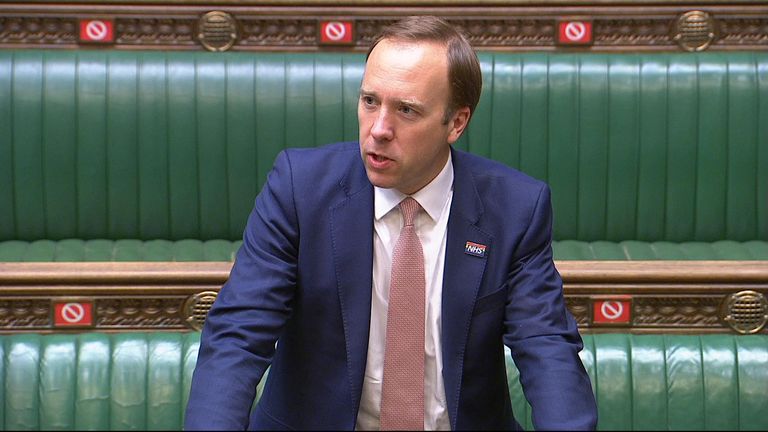
Health Secretary Matt Hancock answers an Urgent Question following Dominic Cummings' evidence to MPs
Image: Health Secretary Matt Hancock answers an Urgent Question in the Commons earlier

Mr Cummings yesterday accused the health secretary of repeatedly lying, being disastrously incompetent and claimed he should have been fired on multiple occasions during the pandemic.

Mr Hancock was attacked over failings around care homes policy, personal protective equipment (PPE) procurement and his public pledge on a target for 100k COVID tests a day by the end of April 2020 which caused disruption in Whitehall.

In the Commons earlier today, Mr Hancock insisted Mr Cummings's allegations were "unsubstantiated" and "not true", adding: "I've been straight with people in public and in private throughout."

Mr Cummings also said a second lockdown delay last autumn led to "tens of thousands" of extra deaths.

Please use Chrome browser for a more accessible video player

Cummings: 'Hancock should've been fired'

Boris Johnson, on a visit to a hospital on Thursday, avoided questions about whether he had confidence in Mr Hancock.

But he did deny Mr Cummings's claim that thousands of people needlessly died because of the prime minister.

Mr Hancock was asked if he has spoken to the prime minister about Mr Cummings's evidence to MPs and was asked if Boris Johnson has personally given him his reassurance that he has confidence in him as health secretary.

He replied: "The prime minister and I talk all the time and we're working incredibly hard on getting this vaccine rollout as broad as possible, making sure people get their second doses, and obviously very vigilant particularly to the areas of the country where cases are starting to rise as I've set out.

"That's what we focus on."

Adblock test (Why?)


https://news.google.com/__i/rss/rd/articles/CBMilAFodHRwczovL25ld3Muc2t5LmNvbS9zdG9yeS9jb3ZpZC0xOS1tYXR0LWhhbmNvY2stc2F5cy13ZS13b3JrZWQtYXMtaGFyZC1hcy13ZS1jb3VsZC10by1wcm90ZWN0LWNhcmUtaG9tZXMtYWZ0ZXItZG9taW5pYy1jdW1taW5nc3MtY3JpdGljaXNtLTEyMzE4NDkw0gGYAWh0dHBzOi8vbmV3cy5za3kuY29tL3N0b3J5L2FtcC9jb3ZpZC0xOS1tYXR0LWhhbmNvY2stc2F5cy13ZS13b3JrZWQtYXMtaGFyZC1hcy13ZS1jb3VsZC10by1wcm90ZWN0LWNhcmUtaG9tZXMtYWZ0ZXItZG9taW5pYy1jdW1taW5nc3MtY3JpdGljaXNtLTEyMzE4NDkw?oc=5

2021-05-27 17:34:18Z
CBMilAFodHRwczovL25ld3Muc2t5LmNvbS9zdG9yeS9jb3ZpZC0xOS1tYXR0LWhhbmNvY2stc2F5cy13ZS13b3JrZWQtYXMtaGFyZC1hcy13ZS1jb3VsZC10by1wcm90ZWN0LWNhcmUtaG9tZXMtYWZ0ZXItZG9taW5pYy1jdW1taW5nc3MtY3JpdGljaXNtLTEyMzE4NDkw0gGYAWh0dHBzOi8vbmV3cy5za3kuY29tL3N0b3J5L2FtcC9jb3ZpZC0xOS1tYXR0LWhhbmNvY2stc2F5cy13ZS13b3JrZWQtYXMtaGFyZC1hcy13ZS1jb3VsZC10by1wcm90ZWN0LWNhcmUtaG9tZXMtYWZ0ZXItZG9taW5pYy1jdW1taW5nc3MtY3JpdGljaXNtLTEyMzE4NDkw

COVID-19: Matt Hancock says 'we worked as hard as we could to protect care homes' after Dominic Cummings's criticism - Sky News

Matt Hancock has insisted the government "worked as hard as we could to protect care homes" following scathing criticism from Dominic Cummings.

The health secretary has defended himself for the second time in a day in the wake of the attacks from Boris Johnson's former chief adviser.

One of the key claims made by Mr Cummings was that Mr Hancock lied about COVID-testing people before they returned to care homes in the early part of the pandemic.

Mr Cummings told MPs on Wednesday that the prime minister was furious to discover in April 2020 that untested hospital patients had been discharged to care homes, adding Mr Hancock had told the PM a month earlier they would be tested.

Follow live: Health secretary gives Downing Street briefing

When asked about this claim, Mr Hancock told a Downing Street news conference: "Of course we committed, and I committed, to getting the policy in place but it took time to build the testing.

"We didn't start with a big testing system in the UK and then we built that testing system, and that's why the 100,000 target was so important because it really accelerated the availability of testing because when you don't have much testing we had to prioritise it according to clinical need."

More on Covid-19

When pressed if he had told the prime minister and Mr Cummings in March 2020 that they would all be tested, Mr Hancock said: "My recollection of events is that I committed to delivering that testing for people going from hospital into care comes when we could do it.

"I then went away and built the testing capacity for all sorts of reasons and all sorts of uses, including this one, and then delivered on the commitment that I made."

After further questions, Mr Hancock added: "There'll be a time when we can go through all of this in great detail but the most important thing right now is that we've still got a pandemic."

Sky News political correspondent Joe Pike said that despite being repeatedly asked about the matter, Mr Hancock did not give specific answers and gave generalised replies.

Addressing the allegation that Mr Hancock had lied, the health secretary told the Commons today: "We followed the clinical advice on the appropriate way forward."

There was no requirement to test patients being discharged from hospital into a care home until 15 April 2020, government documents show.

Please use Chrome browser for a more accessible video player

'We took clinical advice on discharge plans'

Guidance to care homes dated 2 April 2020 said people who were COVID-19 positive could be discharged to care homes but should isolate once there.

It added: "Negative tests are not required prior to transfers/admissions into the care home."

And guidance in place until 13 March 2020 further stated community transmission was so low it was "very unlikely that anyone receiving care in a care home or the community will become infected".

There have been 36,275 deaths involving COVID-19 in care homes since the pandemic began, according to the latest figures from the UK's statistics agencies.

Adam Purnell, care and quality lead at Kepplegate Care Home in Lancashire, told Sky News: "Up until May last year we were being told testing wasn't a requirement for people moving into care homes from hospital.

"We were being told we were protected, but at every single webinar we were having, we were told it's not a requirement for asymptomatic people to be tested."

Health Secretary Matt Hancock answers an Urgent Question following Dominic Cummings' evidence to MPs
Image: Health Secretary Matt Hancock answers an Urgent Question in the Commons earlier

Mr Cummings yesterday accused the health secretary of repeatedly lying, being disastrously incompetent and claimed he should have been fired on multiple occasions during the pandemic.

Mr Hancock was attacked over failings around care homes policy, personal protective equipment (PPE) procurement and his public pledge on a target for 100k COVID tests a day by the end of April 2020 which caused disruption in Whitehall.

In the Commons earlier today, Mr Hancock insisted Mr Cummings's allegations were "unsubstantiated" and "not true", adding: "I've been straight with people in public and in private throughout."

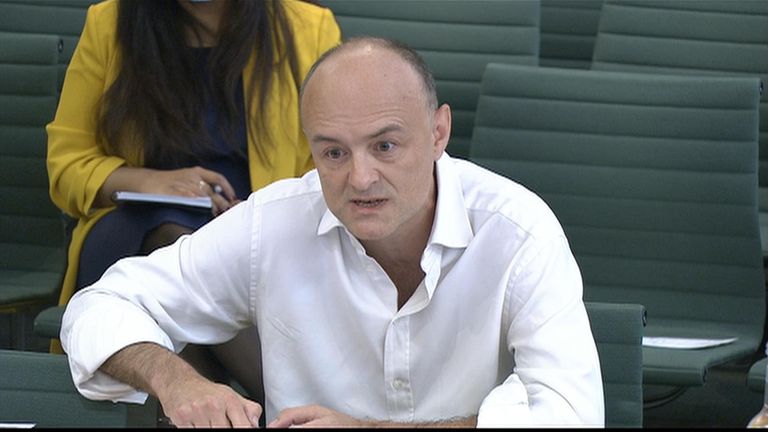
Dominic Cummings
Image: Dominic Cummings attacked the health secretary during more than seven hours of testimony

Mr Cummings also said a second lockdown delay last autumn led to "tens of thousands" of extra deaths.

Boris Johnson, on a visit to a hospital on Thursday, avoided questions about whether he had confidence in Mr Hancock.

But he did deny Mr Cummings's claim that thousands of people needlessly died because of the prime minister.

Mr Hancock was asked if he has spoken to the prime minister about Mr Cummings's evidence to MPs and was asked if Boris Johnson has personally given him his reassurance that he has confidence in him as health secretary.

He replied: "The prime minister and I talk all the time and we're working incredibly hard on getting this vaccine rollout as broad as possible, making sure people get their second doses, and obviously very vigilant particularly to the areas of the country where cases are starting to rise as I've set out.

"That's what we focus on."

Adblock test (Why?)


https://news.google.com/__i/rss/rd/articles/CBMilAFodHRwczovL25ld3Muc2t5LmNvbS9zdG9yeS9jb3ZpZC0xOS1tYXR0LWhhbmNvY2stc2F5cy13ZS13b3JrZWQtYXMtaGFyZC1hcy13ZS1jb3VsZC10by1wcm90ZWN0LWNhcmUtaG9tZXMtYWZ0ZXItZG9taW5pYy1jdW1taW5nc3MtY3JpdGljaXNtLTEyMzE4NDkw0gGYAWh0dHBzOi8vbmV3cy5za3kuY29tL3N0b3J5L2FtcC9jb3ZpZC0xOS1tYXR0LWhhbmNvY2stc2F5cy13ZS13b3JrZWQtYXMtaGFyZC1hcy13ZS1jb3VsZC10by1wcm90ZWN0LWNhcmUtaG9tZXMtYWZ0ZXItZG9taW5pYy1jdW1taW5nc3MtY3JpdGljaXNtLTEyMzE4NDkw?oc=5

2021-05-27 17:03:45Z
52781612298031

Covid-19: Up to 75% of new UK cases could be Indian variant - Matt Hancock - BBC News

Up to three quarters of new UK Covid cases could be of the Indian variant, Health Secretary Matt Hancock has said.

Public Health England data shows cases of the variant have risen by 3,535 to 6,959 since last week.

Mr Hancock told a Downing Street briefing that the government had always expected cases to rise as restrictions were eased.

But he said it was "critical" to monitor the link between cases and hospitalisations.

On Thursday, a further 3,542 coronavirus cases and 10 deaths within 28 days of a positive test were reported in the UK.

It is the second day in a row the number of new Covid cases has topped 3,000 - the first time infections have reached this level since mid-April.

Over the last seven days, cases are up 20.5% compared with the week before.

'Remain vigilant'

Mr Hancock told the briefing on Thursday: "The latest estimates are that more than half and potentially as many as three-quarters of all new cases are now of this variant.

"As we set out our roadmap we always expected cases to rise - we must remain vigilant."

Mr Hancock said the increase in cases was still focused in hotspots.

The PHE data found the worst-affected areas continue to be Bolton, Bedford, and Blackburn with Darwen, which have seen 1,354, 366 and 361 confirmed cases, respectively.

PHE added, however, that there are small numbers of cases of the variant in most parts of the country.

Mr Hancock said there was surge testing and vaccinations in the eight hotspot areas, and there was also increased testing in places where cases were lower but rising.

The health secretary urged people to get both vaccine doses, saying all of the evidence showed it was the best way to protect yourself, loved ones and the wider community.

Of the 49 people in hospital with Covid in Bolton only five had received both doses, he said.

Dr Jenny Harries, chief executive of the UK Health Security Agency, said public health experts were "actively going out and finding cases so we do expect cases to rise", and that cases were expected to go up through increased socialising.

She told the briefing that when looking at patterns of cases, such as in London, "we've seen a bit of community transmission and then it's closed down again".

She said it was "on the cusp at the moment" over whether rising cases reflected the variant taking off or whether there was a rise because more cases were being hunted for and detected.

"On the good news, of course, we are not seeing that generally translating into increased cases of hospitalisation and definitely not into deaths," she said.

"So the key message there is... if we can hold it while the vaccination programme gets rolled out, we stand a much better chance of getting through this session."

It comes after Prime Minister Boris Johnson said England "may need to wait" for the lifting of all Covid restrictions, which is currently planned for 21 June.

The PM said he saw nothing "currently in the data" to suggest the government would have to delay unlocking.

But he added there were signs of an increase in the number of cases of the Indian variant.

Mr Johnson said it was important to understand to what extent the vaccine programme "interrupts the link" between infection, hospitalisation, serious illness and death.

Government scientists had always made clear that infection levels would increase as restrictions eased, particularly the resumption of indoor mixing.

But epidemiologist Prof Neil Ferguson, whose modelling was crucial to the decision to go into the first lockdown in March 2020, said the Indian variant meant the reopening of society was now "in the balance".

He told the BBC: "The key issue as to whether we can go forward is: will the surge caused by the Indian variant... be more than has been already planned into the relaxation measures?"

On 21 June, the government hopes to move to the final stage of its roadmap for lifting lockdown.

Step four would see all legal limits on social contact removed, nightclubs would reopen, and restrictions on large events and performances would be lifted.

Scientists advising the government are currently studying all relevant data since the last set of lockdown relaxations on 17 May.

Around the BBC iPlayer banner
Around the BBC iPlayer footer

Adblock test (Why?)


https://news.google.com/__i/rss/rd/articles/CBMiJGh0dHBzOi8vd3d3LmJiYy5jb20vbmV3cy91ay01NzI3NTI3NtIBKGh0dHBzOi8vd3d3LmJiYy5jb20vbmV3cy91ay01NzI3NTI3Ni5hbXA?oc=5

2021-05-27 17:08:55Z
CBMiJGh0dHBzOi8vd3d3LmJiYy5jb20vbmV3cy91ay01NzI3NTI3NtIBKGh0dHBzOi8vd3d3LmJiYy5jb20vbmV3cy91ay01NzI3NTI3Ni5hbXA