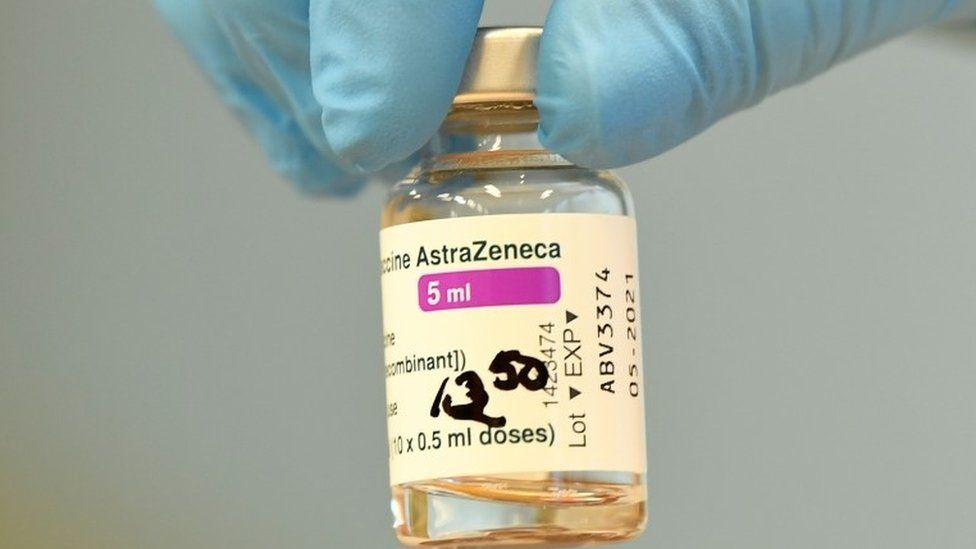
The EU's medicines regulator says unusual blood clots should be listed as a very rare side effect of the AstraZeneca vaccine for Covid-19.
After a study looking at 86 such cases in the EU, the European Medicines Agency (EMA) concluded the benefits of the vaccine outweighed the risk.
There was no definite causal link, and although most cases were in women under 60, they also occurred in men.
The EU has vaccinated more than 20 million people.
At a press briefing, EMA executive director Emer Cooke said that the combination of blood clots and low blood platelets was very rare but was seen in "all ages, and in men and women", and there was no available evidence of "specific risk factors such as age, gender, or previous medical history of clotting disorders".
"Our safety committee... has confirmed that the benefits of the AstraZeneca vaccine in preventing Covid-19 overall outweigh the risks of side effects," she said.
Ms Cooke added: "This vaccine has proven to be highly effective - it prevents severe disease and hospitalisation, and it is saving lives."
AstraZeneca has said its studies have found no causal link with blood clots.
Reuters
The EMA said that one plausible explanation was an "immune response, leading to a condition (heparin-induced thrombocytopenia, HIT) similar to one seen sometimes in patients treated with heparin".
Heparin is a blood thinner used to prevent the formation of clots, and HIT is a potentially dangerous immune-driven adverse reaction to the drug.
EU health ministers will begin a meeting shortly to discuss the findings.
The EMA evaluates and supervises medicine use for all of the EU, including drug approval.
However, this does not mean there has been unity on tackling Covid-19.
Countries within the bloc have diverged widely on vaccination campaigns and on the use of the AstraZeneca jab.
In France, it is now recommended that AstraZeneca vaccinations should be given only to those aged 55 or over. In Germany it is over 60, plus high-priority groups. Norway, not an EU member, and Denmark have a full suspension.
Germany says its under-60s who have received an AstraZeneca first dose should now get a different vaccine for their second.
France, Finland and Norway could consider similar moves.
Studies are still being done on the effectiveness of mixed vaccines.
Under-30s are to be offered an alternative Covid jab to the AstraZeneca vaccine due to the evidence linking it to rare blood clots, the UK's vaccine advisory body says.
A review by drugs regulator MHRA found by the end of March 79 people in the UK had suffered rare blood clots after vaccination - 19 of whom had died.
The regulator said this was not proof the jab had caused the clots.
But it said the link was getting firmer.
Dr June Raine, of the MHRA, said the side-effects were "extremely rare" - and more work was going to identify if the vaccine was definitely causing the clots.
"The balance of benefits and known risks is still very favourable for the majority of people."
But she said for younger age groups it was more "finely balanced".
She added: "The public's safety is at the forefront of our minds."
The review prompted the government's vaccine advisory group, the JCVI, to recommend that people aged 18 to 29 be offered an alternative vaccine where available.
People who have had their first dose of the AstraZeneca vaccine should still get their second dose. Only those who suffered one of these rare blood clots after the first dose should not get vaccinated, the MHRA said.
People with blood disorders that leave them at risk of clotting should discuss the benefits and risks of vaccination with their doctor before going for a jab.
Nearly two-thirds of the cases of rare clots were seen in women. The people who died were aged between 18 and 79.
However, it was not possible to identify whether age or gender made people more at risk of these rare blood clots.
Blood clot concerns linked to the Oxford vaccine will be addressed by the UK's drugs watchdog at a news conference this afternoon.
The briefing, together with the Joint Committee on Vaccination and Immunisation (JCVI), will be held at the Department of Health at 3pm.
England's deputy chief medical officer Professor Jonathan Van-Tam will be among those attending, along with Dr June Raine, chief executive of the Medicines and Healthcare products Regulatory Agency (MHRA) and JCVI chairman Professor Wei Shen.
Use of the Oxford/AstraZeneca jab for younger Britons has been reviewed following concerns at the weekend when it was revealed that of the 18.1 million people who have had the vaccine in the UK, 30 people have developed blood clots.
Advertisement
The MHRA confirmed that of those 30 people, seven had died as of 24 March.
But the drugs watchdog maintained there was no evidence to suggest a causal link between the rare blood clots and the Oxford jab, and that the benefits continue to outweigh any risk.
More from Covid-19
The same message has been echoed by ministers.
The EU's medical regulator is also expected to announce the findings of its own review into the jab, after several European nations paused rollout of the vaccine to younger people, following reports of the condition that prevents blood draining from the brain.
It comes after the head of the European Medicines Agency's (EMA) head of vaccine strategy said it was "increasingly difficult" to say there is "no cause and effect relationship" between the Oxford jab and "rare cases of unusual blood clots".
However, Marco Cavaleri added that full evaluation work was still "far from being completed" and that the risk-benefit ratio was still in favour of the vaccine.
Please use Chrome browser for a more accessible video player
'Follow advice of MHRA on Oxford vaccine'
Any move to restrict use of the jab will inevitably raise questions over the rollout of the UK's vaccination programme.
The government has secured a total of 457 million doses, of which 100 million are from the Anglo-Swedish firm.
However, the government has continued to express confidence that all adults would be offered a first jab by the end of July, pointing to other vaccines coming onstream, including the Moderna jab.
Meanwhile, Ravi Gupta, professor of clinical microbiology at the Cambridge Institute of Therapeutic Immunology and Infectious Diseases, has urged people to keep their vaccine appointments.
He told Sky News: "I think that's on balance at the moment - there's still transmission of COVID, and there is a risk to all of us of being infected, particularly as the economy is being opened up and society's opening up, we are at risk of getting severe infection.
"So I would certainly be going forward for that vaccine in the current situation."
Blood clot concerns linked to the Oxford vaccine will be addressed by the UK's drugs watchdog at a news conference this afternoon.
The briefing, together with the Joint Committee on Vaccination and Immunisation (JCVI), will be held at the Department of Health at 3pm.
England's deputy chief medical officer Professor Jonathan Van-Tam will be among those attending, along with Dr June Raine, chief executive of the Medicines and Healthcare products Regulatory Agency (MHRA) and JCVI chairman Professor Wei Shen.
Use of the Oxford/AstraZeneca jab for younger Britons has been reviewed following concerns at the weekend when it was revealed that of the 18.1 million people who have had the vaccine in the UK, 30 people have developed blood clots.
Advertisement
The MHRA confirmed that of those 30 people, seven had died as of 24 March.
But the drugs watchdog maintained there was no evidence to suggest a causal link between the rare blood clots and the Oxford jab, and that the benefits continue to outweigh any risk.
More from Covid-19
The same message has been echoed by ministers.
The EU's medical regulator is also expected to announce the findings of its own review into the jab, after several European nations paused rollout of the vaccine to younger people, following reports of the condition that prevents blood draining from the brain.
It comes after the head of the European Medicines Agency's (EMA) head of vaccine strategy said it was "increasingly difficult" to say there is "no cause and effect relationship" between the Oxford jab and "rare cases of unusual blood clots".
However, Marco Cavaleri added that full evaluation work was still "far from being completed" and that the risk-benefit ratio was still in favour of the vaccine.
Please use Chrome browser for a more accessible video player
'Follow advice of MHRA on Oxford vaccine'
Any move to restrict use of the jab will inevitably raise questions over the rollout of the UK's vaccination programme.
The government has secured a total of 457 million doses, of which 100 million are from the Anglo-Swedish firm.
However, the government has continued to express confidence that all adults would be offered a first jab by the end of July, pointing to other vaccines coming onstream, including the Moderna jab.
Meanwhile, Ravi Gupta, professor of clinical microbiology at the Cambridge Institute of Therapeutic Immunology and Infectious Diseases, has urged people to keep their vaccine appointments.
He told Sky News: "I think that's on balance at the moment - there's still transmission of COVID, and there is a risk to all of us of being infected, particularly as the economy is being opened up and society's opening up, we are at risk of getting severe infection.
"So I would certainly be going forward for that vaccine in the current situation."
A carer from Carmarthenshire became the first person in Britain to receive the Moderna vaccine this morning.
Elle Taylor, 24, was given a dose at the Glangwili General Hospital in Carmarthen as deployment of the jab began in the UK.
Taylor, from Ammanford, found out yesterday that she was to become the first Briton to receive the Moderna vaccine. “I’m very excited and very happy,” she said. “I’m an unpaid carer for my grandmother so it is very important to me that I get it, so I can care for her properly and safely. My grandmother has had her first dose and she is going for her second dose on Saturday.”
The UK’s vaccination programme is being bolstered by hundreds of thousands of Moderna jabs
Former Scottish first minister Alex Salmond has refused four times to say whether he believes Russia was behind the Salisbury poisonings.
Mr Salmond, who has formed a new pro-independence party ahead of next month's Scottish elections, hosts "The Alex Salmond Show" each week on RT - a Russian state-controlled TV network.
In 2019, RT - formerly known as Russia Today - was fined by Ofcom for a "serious breach" of impartiality rules.
The media watchdog said RT's "failures" had been "serious and repeated".
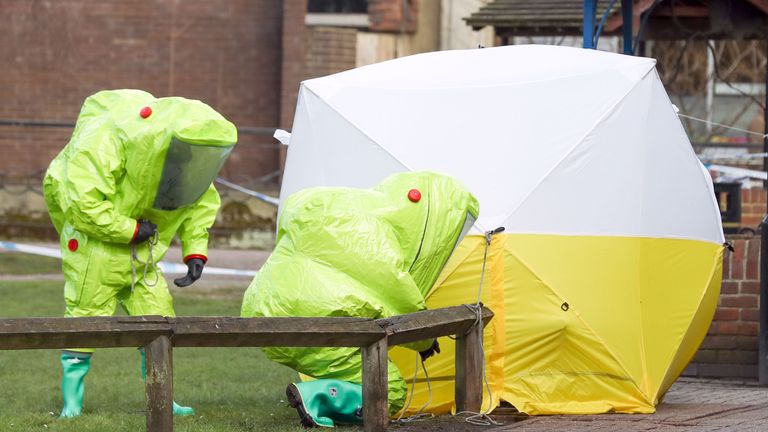
Image:The UK and a host of other countries have blamed Russia for the 2018 nerve agent attack
Following an investigation, Ofcom found that RT had broken TV impartiality rules in seven programmes discussing the Salisbury poisonings.
Advertisement
The UK government and a host of other countries have blamed Russia for the 2018 nerve agent attack, with Russian President Vladimir Putin directly held liable.
However, asked if he shared the view that Russia was behind the incident during a radio interview on Wednesday, Mr Salmond repeatedly refused to say he agreed.
More from Alex Salmond
"I think the evidence is as it came forward," he told BBC Good Morning Scotland.
Mr Salmond, who now leads the Alba Party, added: "What has this got to do with this election?"
When it was put to him that he works for RT, Mr Salmond told presenter Gary Robertson: "I produce, along with Tasmina Ahmed-Sheikh, a programme for Slainte Media which is then broadcast on the RT platform, as they're perfectly entitled to do.
"I can tell you from personal experience - I don't know what your experience at the BBC is - not a single word of editorial instruction or even suggestion has been made to me from anyone at RT and the programme stands on its own merits."
Asked again if Russia was to blame for the Salisbury attack, Mr Salmond replied: "The evidence was presented at the time.
"I'm struggling to understand what this has got to do with a Scottish election campaign.
"It's perfectly legitimate for you to ask me about the programme I produce along with others and its broadcast on RT."
Geez! Alex Salmond with a programme on Russia Today refuses to answer the question as to whether the Russians were behind the poisoning of Sergei Skripal. Extraordinary. There’s your news agenda for the rest of the day.... #BBCgms
Pressed for a fourth time, the ex-SNP leader added: "Evidence came forward as contested, I said it should go to the international tribunals and courts.
"I said that at the time and I think the evidence came forward and people can see it for what it is.
"But what I say to you Gary is, the programme which you have suggested and segued into my views on international politics because I happen to produce a television programme which is broadcast and produced independently and broadcast on RT is quite an extraordinary thing for another broadcaster to do who should be maintaining people's right to have freedom of expression and produce programmes if they're independently produced and done."
Earlier in the radio interview, Mr Salmond suggested the evidence of Russian interference in recent US elections was "very slight".
Both Mr Salmond and Ms Ahmed-Sheikh, a former SNP MP, are standing as Alba Party candidates at the Scottish parliament elections on 6 May.
Former Scottish Conservative leader Murdo Fraser accused Mr Salmond of "desperately trying to evade" questions during the BBC radio interview and claimed Scottish voters "will be horrified at the prospect of him calling the shots at Holyrood after May".
SNP MP Pete Wishart posted on Twitter: "Geez! Alex Salmond with a programme on Russia Today refuses to answer the question as to whether the Russians were behind the poisoning of Sergei Skripal. Extraordinary."
A 24-year-old carer has become the first person in the UK to receive the Moderna vaccine as it becomes the latest jab used in the country's vaccination programme.
Elle Taylor, from Ammanford in Wales, who is an unpaid carer for her 82-year-old grandmother, received the vaccine this morning.
"I'm very excited and very happy," she said. "I'm an unpaid carer for my grandmother so it is very important to me that I get it, so I can care for her properly and safely.
"My grandmother has had her first dose and she is going for her second dose on Saturday."
Miss Taylor, who works at a further education college in Llanelli, received the Moderna jab from staff nurse Laura French at West Wales General Hospital in Carmarthen.
She said she only found out on Tuesday evening that she was to be the first Briton to receive the Moderna jab in the UK.
More from Covid-19
First doses of the Moderna jab are being administered at West Wales General Hospital on Wednesday, with a total of 5,000 doses having been distributed to vaccination centres across Carmarthenshire, Ceredigion and Pembrokeshire.
Supplies of the Moderna vaccine arrived in Wales on Tuesday.
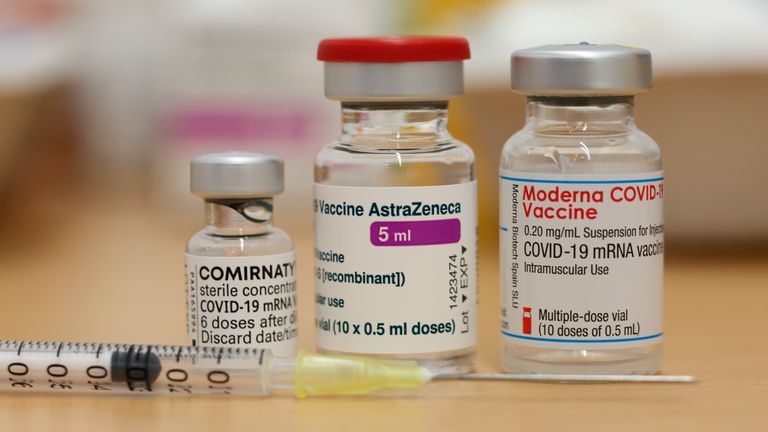
Moderna's vaccine is the third to be approved for use in the UK, and is being rolled out alongside jabs from Pfizer-BioNTech and Oxford University-AstraZeneca.
The UK has purchased 17 million doses of the Moderna jab, enough for 8.5 million people, and phase three results suggest the vaccine has 100% efficacy against severe cases of coronavirus.
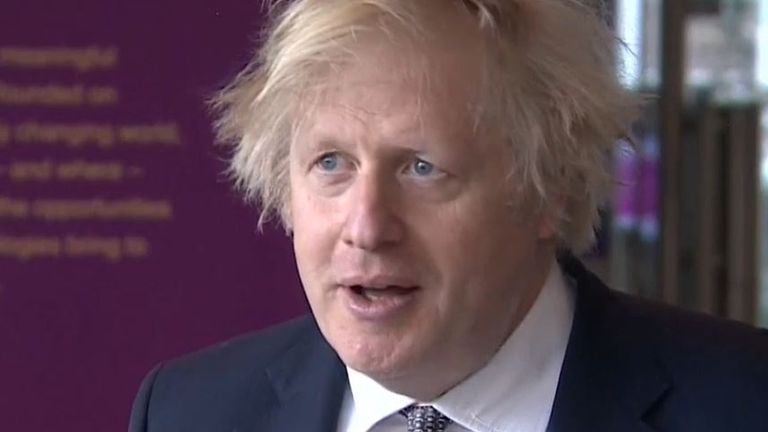
Prime Minister Boris Johnson urged people to "please get your jab as soon as you are contacted".
Health Secretary Matt Hancock said: "I'm delighted we can start the UK rollout of the Moderna vaccine in west Wales today.
"The UK government has secured vaccines on behalf of the entire nation and the vaccination programme has shown our country working together at its best.
"Three out of every five people across the whole United Kingdom have received at least one dose, and today we start with the third approved vaccine. Wherever you live, when you get the call, get the jab."
Wales health minister Vaughan Gething added that the introduction of a third vaccine "significantly adds to our defences in the face of coronavirus and will help protect our most vulnerable".
UK government minister Paul Scully told Sky News the Moderna jab would be "coming to England and the other devolved nations across the next few days".
"You've heard the vaccines minister Nadhim Zahawi talk about the third week of April, we're already just about to start the second week of April so that's not too long to wait to get that third vaccine up and running," he added.
Scotland received its first batch of Moderna vaccines on Monday.
According to Moderna, no serious safety concerns have been identified among those who have taken its vaccine. Severe events after the first dose have included pain around the injection site, while some have reported fatigue, muscle pain, joint pain and headaches after receiving their second dose.
Image:The UK now has three vaccines approved - from Pfizer, AstraZeneca and Moderna. Pic: AP
It comes after a trial of the Oxford-AstraZeneca COVID-19 vaccine on children in the UK was paused while the medicines regulator investigates a possible link between the jab and rare blood clots in adults.
A University of Oxford spokesperson stressed that there were "no safety concerns" with this specific study, but that further information was being awaited from the Medicines and Healthcare products Regulatory Agency (MHRA).
Please use Chrome browser for a more accessible video player
Concerns raised over Oxford vaccine
A spokesperson for the Department of Health and Social Care said: "No decisions have been made on whether children should be offered vaccinations.
"We will be guided by the advice of our experts on these issues including the independent MHRA and Joint Committee on Vaccines and Immunisation."
Please use Chrome browser for a more accessible video player
'MHRA will only vaccinate when it's safe
Over the weekend, it was reported that there had been 30 blood clotting casesrecorded by the MHRA out of more than 18 million doses of the AstraZeneca shot administered.
The MHRA confirmed that of those 30 people, seven had died as of 24 March.
The World Health Organisation maintains that the benefits of this vaccine outweigh any risks.
Adam Finn, professor of paediatrics at the University of Bristol, said: "There are some things that are very clear. The first is that these cases are very rare indeed. The second is that the vaccines that are available and in use in the UK prevent COVID very effectively."
He added: "In short, if you are currently being offered a dose of Oxford-AstraZeneca vaccine, your chances of remaining alive and well will go up if you take the vaccine and will go down if you don't."
Analysis: Could safety concerns derail UK's vaccine rollout? By Ashish Joshi, health correspondent
The ongoing safety concerns about the AstraZeneca-Oxford vaccine do not seem to have crossed the Channel. At least not yet.
The possible link between it and a rare type of blood clot has been around for a few weeks now.
Some governments in Europe have decided that they will not administer the jab to younger people.
That is against the advice of European Medicines Agency and the World Health Organisation.
But could these safety concerns actually derail the UK's phenomenal vaccine rollout? Potentially yes, but realistically it is unlikely. There are a number of reasons.
Vaccine hesitancy in much more culturally entrenched on the continent, especially in France and Germany. It is not as serious here among the wider population.
But clearly there are parts of the population where it is a concern, like our black and ethnic minority communities.
Also the rollout has been so successful that we are working through our target groups very quickly.
These are the ones who are most at risk: the clinically vulnerable and the elderly.
We know that our senior citizens are most compliant where vaccines are concerned.
Hesitancy becomes more prevalent in younger people. By the time we get round to vaccinating the under-40s, more vaccines will be on stream.
So if there is still uncertainty over the Oxford vaccine then it is possible an alternative can be administered.
This was simply not possible at the start of the rollout - the urgency demanded speed and scale.
For now the most significant bump in the road is the dramatic slowdown in the number of people being vaccinated. The Easter bank holidays could be a factor, and so is vaccine supply.
We were warned that this would happen. The government's own scientists have forecast a significant drop in vaccine doses being administered until the end of July.
But that has not dented the government's confidence. It says we are still on track to meet its target of vaccinating all adults by the end of July.