SARAH Everard’s family saw the cop accused of her kidnap and murder for the first time today.
Wayne Couzens, 48, made his first appearance at the Old Bailey by video link today from Belmarsh top security jail in south London - a week after police swooped on his home in Deal, Kent.
The gun cop was last night charged with the murder and kidnap of Sarah EverardCredit: SWNS:South West News Service
Sarah, 33, seemingly vanished off the streets of Clapham, South London last weekCredit: Facebook
Couzens will go on trial in October accused of kidnapping and murdering tragic Sarah Everard.
Sarah, 33, vanished after walking home from a friend's house in Clapham, South West London, on March 3.
A post-mortem has taken place but a cause of death has not been released - with an inquest due to open and adjourn this week.
Gun cop Couzens, who joined the Met Police in 2018, appeared via videolink from Belmarsh Prison today for his first crown court appearance at the Old Bailey.
Members of Sarah’s daily joined the hearing in the Central Criminal Court by video link, according to court officials.
They watched remotely as the married dad-of-two - wearing a red sweatshirt and grey jogging bottoms - spoke to confirm his name, date of birth and address.
He appeared to have a large cut on his head and rocked back and forth during the hearing.
Couzens was remanded in custody ahead of a plea hearing on July 9 at the same court.
A provisional trial date was set for October 25 and is expected to last for four weeks.
A court sketch of Wayne Couzens as he appeared at the Old Bailey todayCredit: PA
Sarah left her pal's home at around 9pm and called her boyfriend as she walked home.
She was on the call for around 14 minutes but there allegedly has been no further activity on her mobile phone since then.
It has also not been recovered yet, it is said.
Sarah was seen alone on CCTV at 9.15pm, again at 9.28pm and was later captured on the camera of a marked police car at 9.32pm.
Her boyfriend reported her missing on March 4.
Couzens is accused of kidnapping Sarah in the Poynders Road area of Clapham.
The cop, who worked on the Parliamentary and Diplomatic Protection Command unit, had finished a shift earlier on the morning of March 3 and was not on duty at the time of Sarah's disappearance.
The family of Sarah Everard later paid tribute to their "bright and beautiful daughter and sister".
In a statement, Sarah's family said: “Sarah was bright and beautiful - a wonderful daughter and sister.
“She was kind and thoughtful, caring and dependable. She always put others first and had the most amazing sense of humour.
“She was strong and principled and a shining example to us all.
“We are very proud of her and she brought so much joy to our lives.”
Sarah worked as a marketing executive and lived in Brixton, South LondonCredit: PA:Press Association
Sarah disappeared last Wednesday as she walked home
PC Couzens is attached to the Met’s Parliamentary and Diplomatic Protection (PaDP) unit normally based at the Palace of WestminsterCredit: SWNS:South West News Service
Sarah's family have paid tributeCredit: Missing People
Searches are continuing in Kent as part of the investigationCredit: PA
Sarah Everard’s heartbroken family say ‘our kind and beautiful daughter was taken from us’ after body found
The UK will reverse a reduction in its nuclear warheads and has raised the prospect of a nuclear response to catastrophic chemical, biological or even cyber threats as part of a policy overhaul released by Boris Johnson.
The significant shift in nuclear policy prompted questions from the Labour Party and condemnation from anti-nuclear weapons campaigners.
A Whitehall source told Sky News that the UK would "be an unapologetic nuclear power".
The Integrated Review, released on Tuesday, sets out how Britain hopes to shape a world where democracies can thrive, but is ready for one marked by increased conflict and division, with China seen as the biggest state threat to economic security.
Another pandemic is regarded as a "realistic possibility", while Russia is described as "the most acute threat" to UK security.
Advertisement
Please use Chrome browser for a more accessible video player
Boris Johnson says that Labour is 'weak' on defence and backing Britain when 'it matters'.
The Prime Minister revealed the conclusions of the most significant shake-up of UK foreign, defence and security policy since the Cold War.
"The overriding purpose of this review… is to make the United Kingdom stronger, safer and more prosperous while standing up for our values," he told the House of Commons.
More from China
"[It] describes how we will bolster our alliances, strengthen our capabilities, find new ways of reaching solutions and relearn the art of competing against states with opposing values."
He described China as posing a "great challenge for an open society like ours". But said the UK would also work with Beijing "where that is consistent with our values and interests".
This includes by building a stronger and positive economic relationship and in addressing climate change - a tricky balancing act.
The 114-page document outlines Britain's goals and challenges,which include:
• Tackling climate change and the loss of biodiversity is the top international priority
• A "tilt" to the Indo-Pacific region focused on strengthening diplomatic and trade links
• The precondition for "Global Britain" is the safety of British citizens and the security of the Euro-Atlantic region, which remains the prime focus of UK security
• An ambition to make the UK a "science and tech superpower" by 2030
• Shaping the international order of the future, with rules to protect democratic values in the real world as well as in cyberspace and space
• Building resilience in the UK to future emergencies
• Increased funding for spy agencies as part of efforts to counter the threat from terrorism
The shift on Britain's nuclear deterrent is one of the most notable aspects of the review.
It warned of a growing international threat from nuclear weapons, noting that some states are "significantly increasing and diversifying their nuclear arsenals".
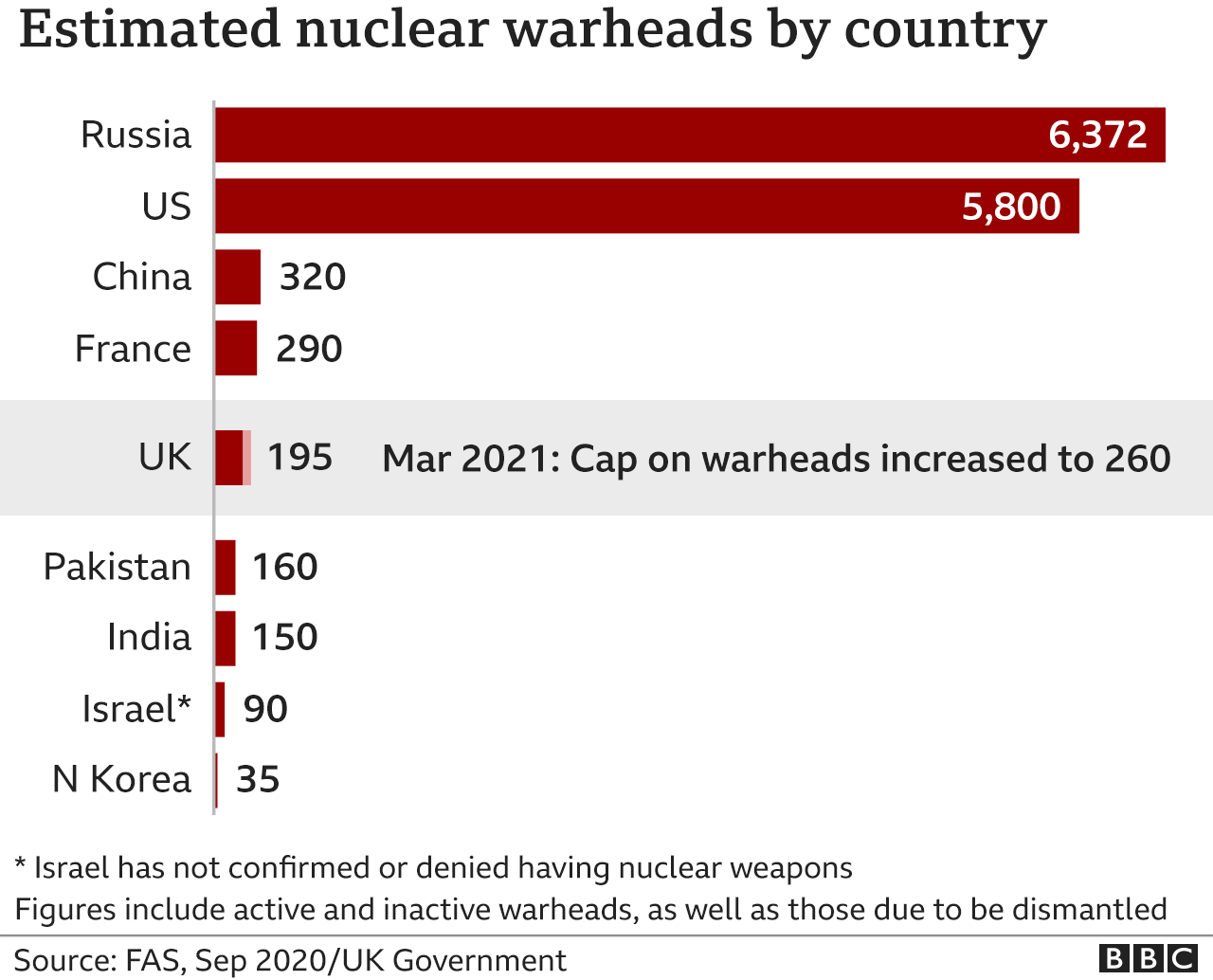
In response to the "evolving security environment", the UK plans to reverse a reduction in its stockpile of Trident nuclear warheads. A new cap will rise to 260 from 180.
Britain's nuclear deterrent is delivered by four nuclear-armed submarines, which guarantees one boat will always be at sea.
The document said that the government would remain "deliberately ambiguous" about when, how and at what scale the UK would use nuclear weapons.
But it hinted at the possibility of the types of threats that would justify a nuclear response widening.
The review says that the UK would not use or threaten to use nuclear weapons against a country that is a member of the Non-Proliferation of Nuclear Weapons Treaty and is not a nuclear weapons state.
"However, we reserve the right to review this assurance if the future threat of weapons of mass destruction, such as chemical and biological capabilities, or emerging technologies that could have a comparable impact, makes it necessary," it says.
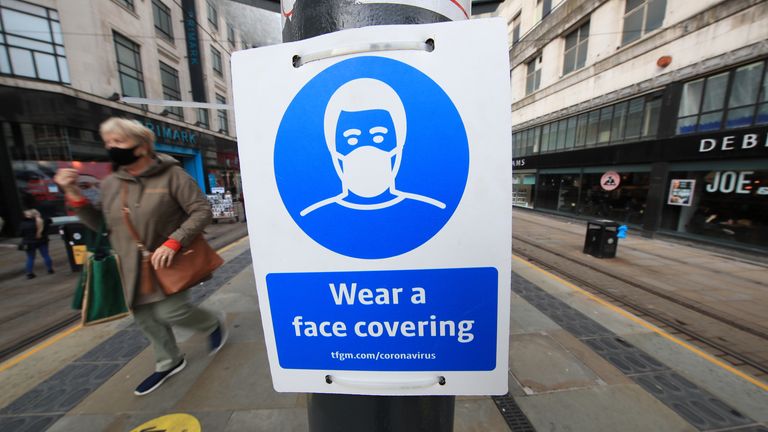
Image:Another pandemic remains a 'realistic possibility,' the review says
Sir Keir Starmer, the Labour leader, challenged Mr Johnson on the changes.
"I voted for the renewal of Trident and the Labour Party's support for nuclear deterrence is non-negotiable but this review breaks the goal of successive prime ministers and cross-party efforts to reduce our nuclear stockpile," he said.
"It doesn't explain when, why and for what strategic purpose. So the prime minister needs to answer that question today."
The International Campaign to Abolish Nuclear Weapons called the announcement a "dangerous U-turn" that would be a huge blow to allies in the non-proliferation treaty and would raise global security concerns.
The review featured four themes: geopolitical and geoeconomic shifts; systemic competition; rapid technological change; and transnational challenges such as climate change and global health risks.
It described a "realistic optimum scenario" as an "international order in which these trends can be managed effectively, with nations coming together to revive multilateral cooperation, strengthen global governance and harness the opportunities ahead for growth and prosperity".
The review warned though that the UK "must also prepare for the possibility that the post-COVID international order will be increasingly contested and fragmented, reducing global cooperation and making it harder to protect our interests and values".
Image:China is described as a "systemic competitor", with its authoritarian system at odds with the values of the UK. Pic: AP
China is described as a "systemic competitor", with its authoritarian system at odds with the values of the UK and other liberal democracies.
At the same time, its economic strength makes the country a valuable trading partner for the UK as it looks to enhance ties in the Indo-Pacific region after Brexit.
The review sets out this balancing act, describing how the UK seeks to continue its relationship with China while at the same time standing up for democratic values and strengthening resilience to security threats.
"The fact that China is an authoritarian state, with different values to ours, presents challenges for the UK and our allies," the review said.
"China will contribute more to global growth than any other country in the next decade with benefits to the global economy.
"China and the UK both benefit from bilateral trade and investment, but China also presents the biggest state-based threat to the UK's economic security."
In the section on transnational challenges, the review predicted that infectious disease outbreaks are likely to be more frequent over the next decade.
"Another novel pandemic remains a realistic possibility. On current trends, global deaths related to antimicrobial resistance will rise from 700,000 to 20 million per year by 2050," it warns.
The terrorist threat is still described as "major", with the main sources coming from Islamist, Northern Ireland-related far-right, far-left, anarchist and single-issue terrorism.
The review warns it is likely a terrorist group will launch a successful chemical, biological, radiological or nuclear attack in the coming nine years.
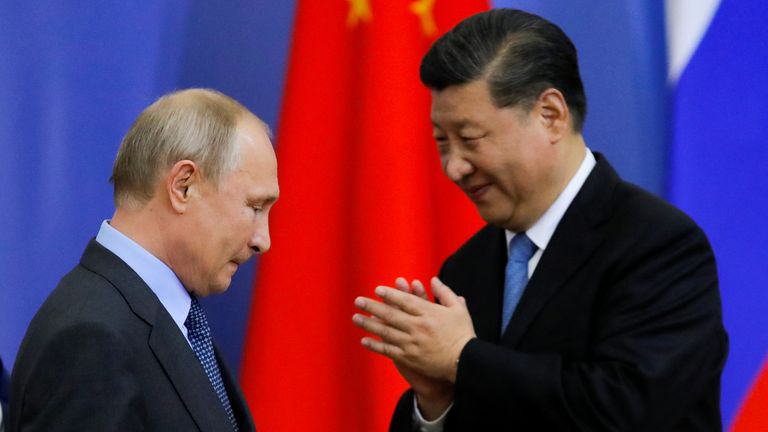
Image:Russia (left, President Vladimir Putin) and China (right, President Xi Jinping) are listed among the greatest threats facing Britain
The document also described how the UK had to improve its ability to push back against attacks by hostile foreign states like Russia, China and Iran in the grey zone, under the threshold of war.
This includes cyber attacks and disinformation spread online.
Moving to counter mounting criticism about a cut to Britain's overseas aid spending because of the economic hit from coronavirus, Mr Johnson said the UK would return to spending 0.7% of national income on overseas aid, after reducing it to 0.5% - a move critics say fundamentally undermines the concept of "global Britain".
The integrated review of foreign and defence policies, which runs to over 100 pages, has taken over a year and sets out UK priorities until 2030.
The UK nuclear stockpile is estimated to comprise 195 warheads, and had been due to fall to 180 by the mid-2020s under a 2010 defence review.
But the latest assessment says this ambition is "no longer possible" given the "evolving security environment" over the last decade.
It adds that the UK will no longer publish figures on the size of its operational stockpile, to maintain "deliberate ambiguity" for adversaries.
However, it pledges the UK will maintain the "minimum destructive power needed to guarantee that the UK's nuclear deterrent remains credible".
The review, which identifies Russia as the "most acute threat" to UK security, also says:
It is "likely" that a terrorist group will launch a successful chemical, biological or nuclear attack by 2030
The UK will set up a new counter-terrorism operations centre to improve the response to terror attacks
The government wants the UK to become a "science and tech superpower" by the end of the decade
The review also pledged to reverse cuts on foreign aid, from 0.7% of national income down to 0.5%, when "the fiscal situation allows".
The government has previously faced criticism for the cuts, which it said were necessary in the wake of financial challenges posed by the Covid pandemic.
The review argues the UK should refocus its foreign policy towards countries such as India, Japan and Australia in the "Indo-Pacific" region.
It said the region's shipping lanes were vital to maintain UK trade with Asia, whilst the region is also on the "frontline of new security challenges".
Tory disquiet over China position
Analysis by Damian Grammaticas, BBC political correspondent
The review calls China the "biggest state-based threat to the UK's economic security".
But there is clearly disquiet among the government's own MPs that it hasn't been robust enough in identifying the challenge posed by its Communist regime.
Former Conservative foreign secretary Jeremy Hunt said he was worried by its description of China as a "systemic" challenge, given its current clampdown on Uighur Muslims and democratic rights in Hong Kong.
Another senior Conservative, Julian Lewis, took issue with its description of China as a "partner".
He added it suggested the "grasping naivety" of the party's approach under David Cameron and George Osborne, when it actively sought Chinese investment, "still lingers on".
Boris Johnson said there was a "balance to be struck", and although the UK wanted a "strong trading relationship," it should be "clear-eyed" and "tough where we see risk".
But the trade-offs between seeking investment and protecting the UK from becoming too vulnerable to Chinese economic and political influence and pressure will come under increasing scrutiny.
Mr Johnson said: "The review describes how we will bolster our alliances, strengthen our capabilities, find new ways of reaching solutions and relearn the art of competing against states with opposing values."
He said the UK had led international condemnation of China's "mass detention" of Uighur people in Xinjiang, and its actions in Hong Kong, adding: "There is no question China will pose a great challenge for an open society such as ours."
In response, Sir Keir said UK policy towards China had been "inconsistent" and the government had "turned a blind eye" to the country's human rights abuses.
He said Labour remained committed to retaining nuclear weapons, but said the document had failed to detail the "strategic purpose" for increasing the warhead stockpile.
SNP Westminster leader Ian Blackford said the review demonstrated "just how hollow the brand of Global Britain is".
He also asked the prime minister "who gave his government the democratic right to renege on the UK's obligations under the nuclear proliferation treaty" referring to the government's plans on nuclear weapons.
Speaking to the BBC, Beatrice Fihn - head of the International Campaign to Abolish Nuclear Weapons - described the UK's decision to change its nuclear provision as "outrageous, irresponsible and very dangerous".
She said it went against international law and didn't address the real security threats faced by Britain such as climate change and disinformation.
Sturgeon announces 'Stay At Home' will end on April 2
FM warns against complacency
Nicola Sturgeon warned against complacency as she announced the easing of restrictions in the coming weeks in Scotland.
The First Minister said that while she hopes to be able to lift the stay-at-home order and open retail and hospitality at different points next month, work was still required to ensure cases did not rise.
She said: “This is certainly the most hopeful I have felt about the situation for a long time.
“However, as you would expect, I do need to add a note of caution.
“I know this is the bit none of us want to hear, but the route back to normality does depend on continued suppression.”
The First Minister added: “We must continue to suppress it to the lowest level possible.”
‘Stay Local’ to replace ‘Stay at Home’ rule
The First Minister told MSPs that when the “Stay at Home” rule is lifted on April 2, it will be replaced with an order for Scots to “Stay Local”.
The change means that, while people will be allowed to leave their homes for non-essentials reasons, they will not be allowed to travel outside their local authority areas unless for an essential purpose.
Ms Sturgeon said the new rule would last for around three weeks, and help prevent the spread of coronavirus from one region of Scotland to another.
Scotland to move from Level 3 to Level 2 in May
Nicola Sturgeon told MSPs that she expected “as many regions as possible” to move from Level 3 to Level 2 on May 17 - three weeks after the country will be moved down from Level 4.
She said: “We would hope, from that date, to allow indoor hospitality to return to greater normality, with alcohol able to be served indoors and within more normal opening hours, though possibly with some continued restrictions - a requirement for people to book in two hour slots, for example.”
May 17 will also see the return of adult outdoor contact sports and indoor group exercises, as well as the reopening of cinemas, amusement arcades and bingo halls.
Ms Sturgeon said she also expects restrictions on outdoor social gatherings to be eased further.
A message from the Editor:
Thank you for reading this article. We’re more reliant on your support than ever as the shift in consumer habits brought about by coronavirus impacts our advertisers.
If you haven’t already, please consider supporting our trusted, fact-checked journalism by taking out a digital subscription.
Shielders to return to work on April 26
From 26 April, people on the shielding list can return to work; children and young people on the shielding list can return to school or nursery; and students on the shielding list can return to college or university.
Nicola Sturgeon
The Chief Medical Officer will write this week to everyone on the shielding list to provide more detailed advice.
Live indoor and outdoor events from May
Hospitality to reopen from April 26
From that date, cafés, restaurants and bars will be able to serve people outdoors – in groups of up to six from three households - until 10pm. Alcohol will be permitted, and there will be no requirement for food to be served.
Dependent on continued suppression of the virus, Ms Sturgeon suggested there could be limited indoor opening of hospitality from 26 April too.
This will be limited initially to the service of food and non-alcoholic drinks until 8pm, and for groups of up to four people from no more than two households.
As was the case last year, venues will need to retain customers’ contact details for three weeks after their visit.
Limits for weddings and funerals to be raised
On April 26 the limit on attendance at weddings, funerals and associated receptions will be raised to 50 people from 26 April.
From 26 April, the restrictions on outdoor socialising will be eased further too.
From that date, six people from up to three households will be able to meet outdoors - and with no mainland travel restrictions in place.
Ms Sturgeon added that, at the moment, she is unable to say whether indoor visits will be allowed to go ahead.
All tourism accommodation will reopen from April 26
Ms Sturgeon said all tourism accommodation will be able to re-open from April 26, subject to any wider restrictions that remain in place.
She added that libraries, museums and galleries will also reopen from 26 April.
Work in people’s homes will resume from that date, as will driving lessons. Gyms are also expected to reopen then too.
Scotland expected to move to Level 3 on April 26
The First Minister told MSPs that she expects all of Scotland currently in Level 4 restrictions will move to a “modified” Level 3.
Island communities currently in Level 3 will have the option to move at that stage to Level 2, though ministers will discuss this with local officials in the next few weeks.
Ms Sturgeon also said that travel restrictions within mainland Scotland will be “lifted entirely” on April 26.
She added: “We hope that restrictions on journeys between Scotland and other parts of the UK and the wider common travel area can also be lifted, if not on 26 April, then as soon as possible thereafter.”
On-campus learning to restart in April
The First Minister said she expects more students in further education to return to on-campus learning from April 5.
She told MSPs: “Colleges will prioritise those students whose return is essential – including those who are most at risk of not completing their courses.
“That includes those who are taking qualifications in construction, engineering, hairdressing, beauty and related courses.”
Contact sports for 12 to 17-year-olds will also resume on that date.
Non-essential retail to reopen on April 5
Click and collect retail services will be permitted to reopen from April 5, along with garden centres, homeware stores, car showrooms and forecourts.
Ms Sturgeon also said she expected hairdresser and barber salons to reopen for appointments on that date too.
‘Stay at home’ rule to be lifted in April
The First Minister has announced the Scottish Government plans to lift the “stay at home” rule for Scots on April 2.
She said: “Initially, though we hope for no more than 3 weeks, ‘stay at home’ will be replaced by guidance to stay local - in other words, not to travel outside your own local authority area unless for an essential purpose.
People will also continue to be able to meet up outdoors, including in private gardens, in groups of no more than four from two households.
The UK is set to reverse plans to reduce its stockpile of nuclear weapons by the middle of the decade, as part of a foreign policy overhaul.
The cap on the number of warheads will now increase to 260, having been due to drop to 180 under previous plans from 2010.
The UK will shift focus towards Indo-Pacific countries, described as the world's "growth engine".
And it pledges the UK will do more on the "systemic challenge" of China.
Outlining the strategy to MPs, Boris Johnson said after Brexit the UK would have to "relearn the art" of competing against countries with "opposing values".
But he added the UK would remain "unswervingly committed" to the Nato defence alliance and preserving peace and security in Europe.
Labour leader Sir Keir Starmer accused the Conservatives of overseeing an "era of retreat," with armed forces cuts "every year for the last decade".
The integrated review of foreign and defence policies, which runs to over 100 pages, has taken over a year and sets out UK priorities until 2030.
It says the decision to lift the overall cap on the UK's nuclear warhead stockpile is justified by the "evolving security environment" since 2010.
The document says the UK will not give exact figures on the size of its operational stockpile, to maintain "deliberate ambiguity" for adversaries.
But it pledges the UK will maintain the "minimum destructive power needed to guarantee that the UK's nuclear deterrent remains credible".
The document, which indentifies Russia as the "most acute threat" to UK security, also says:
It is "likely" that a terrorist group will launch a successful chemical, biological or nuclear attack by 2030
The UK will set up a new counter-terrorism operations centre to improve the response to terror attacks
The government wants the UK to become a "science and tech superpower" by the end of the decade
The review also pledged to reverse cuts on foreign aid, from 0.7% of national income down to 0.5%, when "the fiscal situation allows".
The government has previously faced criticism for the cuts, which it said were necessary in the wake of financial challenges posed by the Covid pandemic.
The review argues the UK should refocus its foreign policy towards countries such as India, Japan and Australia in the "Indo-Pacific" region.
It said the region's shipping lanes were vital to maintain UK trade with Asia, whilst the region is also on the "frontline of new security challenges".
PA Media
Mr Johnson said: "The review describes how we will bolster our alliances, strengthen our capabilities, find new ways of reaching solutions and relearn the art of competing against states with opposing values."
He said the UK had led international condemnation of China's "mass detention" of Uighur people in Xinjiang, and its actions in Hong Kong, adding: "There is no question China will pose a great challenge for an open society such as ours."
In response, Sir Keir said UK policy towards China had been "inconsistent" and the government had "turned a blind eye" to the country's human rights abuses.
He said Labour remained committed to retaining nuclear weapons, but said the document had failed to detail the "strategic purpose" for increasing the warhead stockpile.
SNP Westminster leader Ian Blackford said the review demonstrated "just how hollow the brand of Global Britain is".
He also asked the prime minister "who gave his government the democratic right to renege on the UK's obligations under the nuclear proliferation treaty" referring to the government's plans on nuclear weapons.
Speaking to the BBC, Beatrice Fihn - head of the International Campaign to Abolish Nuclear Weapons - described the UK's decision to change its nuclear provision as "outrageous, irresponsible and very dangerous".
She said it went against international law and didn't address the real security threats faced by Britain such as climate change and disinformation.
From that date, cafés, restaurants and bars will be able to serve people outdoors – in groups of up to six from three households - until 10pm. Alcohol will be permitted, and there will be no requirement for food to be served.
Dependent on continued suppression of the virus, Ms Sturgeon suggested there could be limited indoor opening of hospitality from 26 April too.
This will be limited initially to the service of food and non-alcoholic drinks until 8pm, and for groups of up to four people from no more than two households.
As was the case last year, venues will need to retain customers’ contact details for three weeks after their visit.
Limits for weddings and funerals to be raised
On April 26 the limit on attendance at weddings, funerals and associated receptions will be raised to 50 people from 26 April.
From 26 April, the restrictions on outdoor socialising will be eased further too.
From that date, six people from up to three households will be able to meet outdoors - and with no mainland travel restrictions in place.
Ms Sturgeon added that, at the moment, she is unable to say whether indoor visits will be allowed to go ahead.
All tourism accommodation will reopen from April 26
Ms Sturgeon said all tourism accommodation will be able to re-open from April 26, subject to any wider restrictions that remain in place.
She added that libraries, museums and galleries will also reopen from 26 April.
Work in people’s homes will resume from that date, as will driving lessons. Gyms are also expected to reopen then too.
Scotland expected to move to Level 3 on April 26
The First Minister told MSPs that she expects all of Scotland currently in Level 4 restrictions will move to a “modified” Level 3.
Island communities currently in Level 3 will have the option to move at that stage to Level 2, though ministers will discuss this with local officials in the next few weeks.
Ms Sturgeon also said that travel restrictions within mainland Scotland will be “lifted entirely” on April 26.
She added: “We hope that restrictions on journeys between Scotland and other parts of the UK and the wider common travel area can also be lifted, if not on 26 April, then as soon as possible thereafter.”
On-campus learning to restart in April
The First Minister said she expects more students in further education to return to on-campus learning from April 5.
She told MSPs: “Colleges will prioritise those students whose return is essential – including those who are most at risk of not completing their courses.
“That includes those who are taking qualifications in construction, engineering, hairdressing, beauty and related courses.”
Contact sports for 12 to 17-year-olds will also resume on that date.
Non-essential retail to reopen on April 5
Click and collect retail services will be permitted to reopen from April 5, along with garden centres, homeware stores, car showrooms and forecourts.
Ms Sturgeon also said she expected hairdresser and barber salons to reopen for appointments on that date too.
‘Stay at home’ rule to be lifted in April
The First Minister has announced the Scottish Government plans to lift the “stay at home” rule for Scots on April 2.
She said: “Initially, though we hope for no more than 3 weeks, ‘stay at home’ will be replaced by guidance to stay local - in other words, not to travel outside your own local authority area unless for an essential purpose.
People will also continue to be able to meet up outdoors, including in private gardens, in groups of no more than four from two households.
Care and caution in the face of this virus continues to be essential.
Nicola Sturgeon
Sturgeon to speak in next few minutes
The First Minister is due to speak after MSPs finish a round of topical questions directed at John Swinney.
A message from the Editor:
Thank you for reading this article. We’re more reliant on your support than ever as the shift in consumer habits brought about by coronavirus impacts our advertisers.
If you haven’t already, please consider supporting our trusted, fact-checked journalism by taking out a digital subscription.
Nicola Sturgeon coronavirus briefing: Why there is no lunchtime briefing on Tuesday, and how First Minister will update Scotland instead
Deaths involving Covid-19 among people aged 80 and over have fallen by 86% since the second-wave peak, the latest ONS figures show.
Waiting list for bone, muscle and joint treatment halves during pandemic
The waiting list for bone, muscle and joint treatment had almost halved by the end of last year because of plummeting numbers of patients being referred.
A total of 34,324 patients were waiting for their first musculoskeletal appointment on December 31 2020, down 49% compared to the same day in 2019.
Public Health Scotland statistics show that far more patients have been seen or removed from waiting lists compared to the number of new patients added.
But despite the drop in patients on the waiting list, more than a third (39.3%) were not seen within the Government’s four-week target, although this is lower than the 56.3% recorded at the end of the previous year.
One in five patients (20%) waited more than 24 weeks to be seen, according to the NHS Scotland data.
Musculoskeletal referrals are for conditions that affect joints, bones, cartilage, ligaments, tendons and muscles, including physiotherapy, occupational therapy, chiropody and podiatry treatments.
During the final three months of 2020, 66,535 first outpatient referrals were made, 36.8% fewer than the last quarter of the previous year.
There were also 52,537 patients seen at a first outpatient appointment, a fall of 37.2% on last year’s figure.
Another pandemic is a ‘realistic possibility’ by 2030, review warns
Another pandemic is a “realistic possibility” by 2030, a Government review has warned, as the world continues to battle against Covid-19.
Boris Johnson’s major review of foreign policy stated that infectious disease outbreaks are likely to be more frequent by the end of the decade.
The document said population growth and the loss of natural habitat would increase interaction between humans and animals, fuelling the risk of a disease spreading from one species to another, as is believed to have happened with Covid-19.
In his foreword to the Integrated Review of Security, Defence, Development and Foreign Policy, the Prime Minister said when work began on the document in early 2020 “we could not have anticipated how a coronavirus would trigger perhaps the greatest international crisis since the Second World War, with tragic consequences that will persist for years to come”.
“Covid-19 has reminded us that security threats and tests of national resilience can take many forms.”
In a section on global health – listed as one of the “transnational challenges” facing the world – the document said: “Infectious disease outbreaks are likely to be more frequent to 2030.
“Many will be zoonoses – diseases caused by viruses, bacteria or parasites that spread from animals to humans – as population growth drives the intensification of agriculture and as the loss of habitats increases interaction between humans and animals.
“Another novel pandemic remains a realistic possibility.”