Ms Patel has instructed the police watchdog, Her Majesty's Inspectorate of Constabulary (HMIC), to "conduct a lessons learned review in to the policing of the event", the prime minister has said.
Mr Johnson said he was "deeply concerned" by the scenes on Clapham Common on Saturday night and that Dame Cressida had "committed to reviewing how this was handled".
"The death of Sarah Everard must unite us in determination to drive out violence against women and girls and make every part of the criminal justice system work to protect and defend them," he added.
Dame Cressida said she agreed on the need for a "sober review" and defended how officers responded to the "really big crowd".
"They have to make these really difficult calls and I don't think anybody should be sitting back in an armchair and saying 'well that was done badly' or 'I would have done it differently' without actually understanding what was going through their minds," she said.
She added that what happened to Ms Everard made her "more determined" to lead the organisation.
Four people were arrested for public order and coronavirus regulation breaches, the Met said.
Reuters
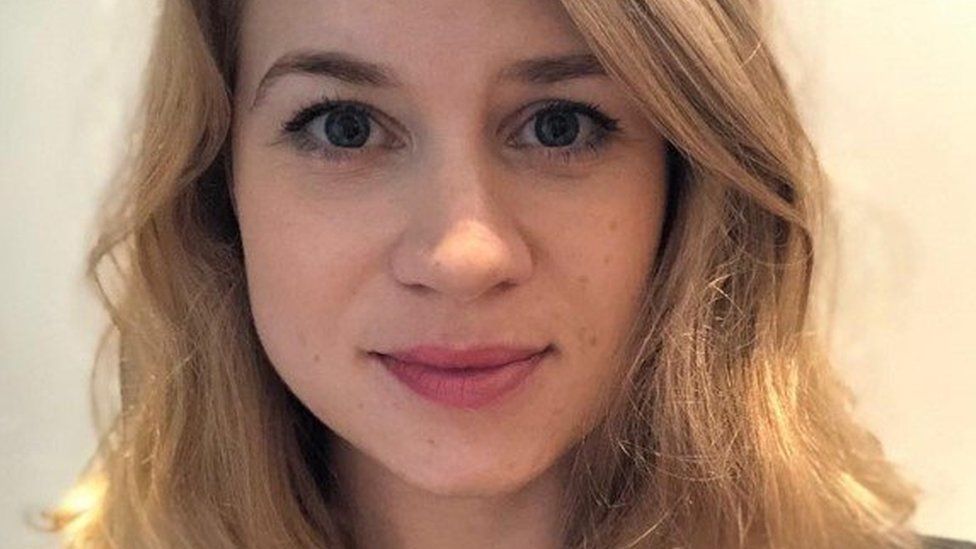
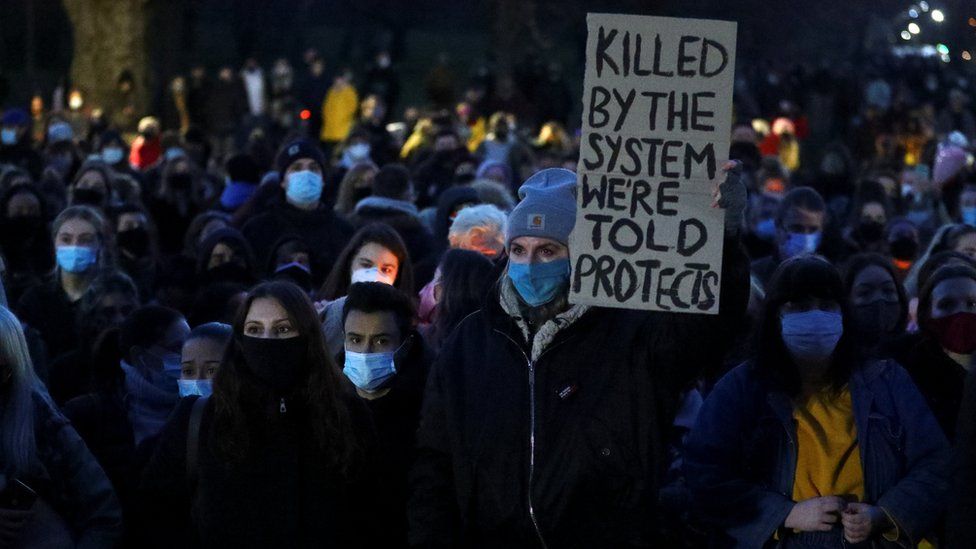
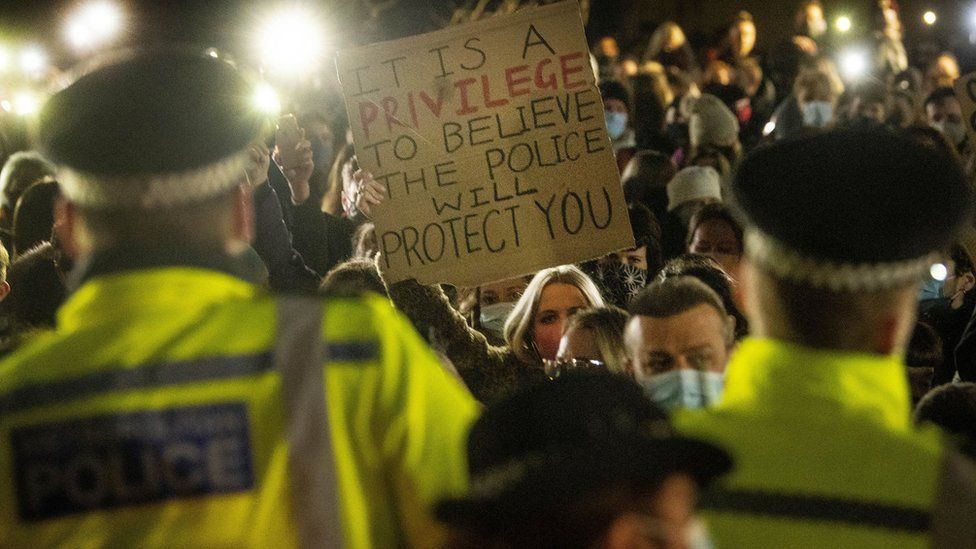
Hundreds gathered at the bandstand in Clapham Common, south London, on Saturday evening for a vigil for Ms Everard, who went missing while walking home from a friend's house on 3 March.
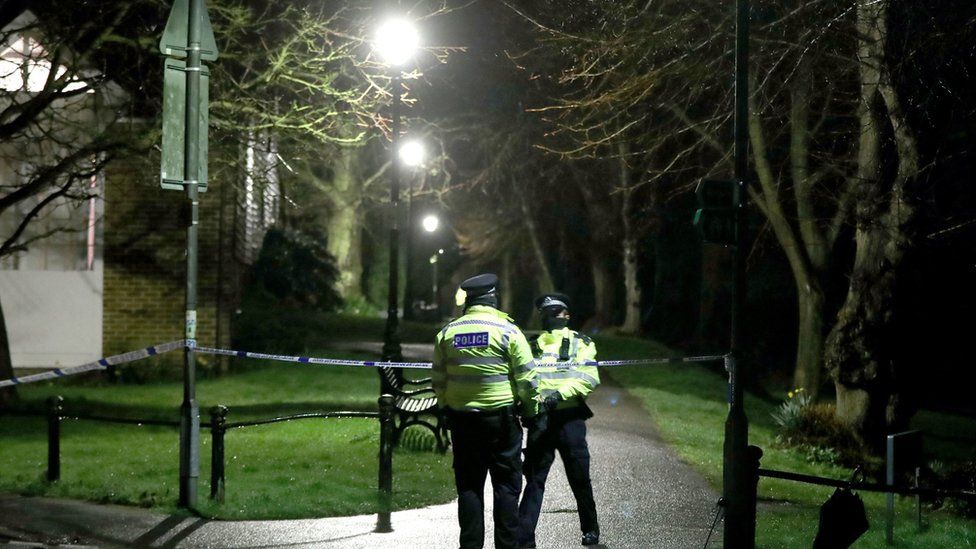
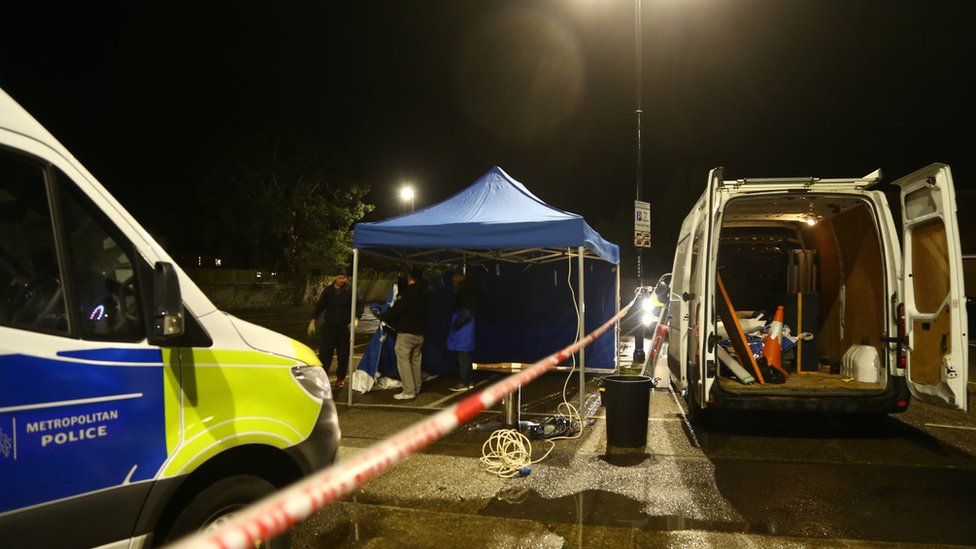
Her remains were later found in woodland in Kent and Met Police officer Wayne Couzens, 48, has been charged with the 33-year-old's kidnap and murder.
Maintaining public order at protests is one of the hardest jobs in modern policing. If everything goes well, the public won't notice how commanders and demo organisers have worked out how to make an event safe.
But when it goes wrong, then the inevitable accusations of failure come piling in.
Sunday dawned badly for the Metropolitan Police's commissioner, Dame Cressida Dick. Her officers were accused of oppressing women and politicians waded in calling for her head.
But the seeds for Saturday's PR disaster for the force were sown in the legal dispute over whether a vigil could take place at all - and how events then seemed to run out of control.
The question is whether the police should have foreseen that happening. That, time and again, is the great challenge of public order policing.
The force's action at the vigil have drawn widespread criticism, with images and footage showing officers forcibly detaining women.
London Mayor Sadiq Khan described the police's actions as "unacceptable", adding he was "not satisfied" with the explanation provided by Dame Cressida and the deputy commissioner when he spoke to them.
He said he wanted HMIC to investigate the events and for the Independent Office for Police Conduct to investigate the actions of police officers.
PA Media
Ahead of the event, organisers Reclaim These Streets had called off the vigil, saying the police had failed to "constructively engage" on how it could be held in a Covid-secure way.
In a letter to Dame Cressida, posted on Twitter on Sunday, Reclaim These Streets accused the Met chief of putting those who attended "at a serious health risk through a lack of Covid-safe marshalling" and "at risk of being manhandled, fined and arrested" by officers.
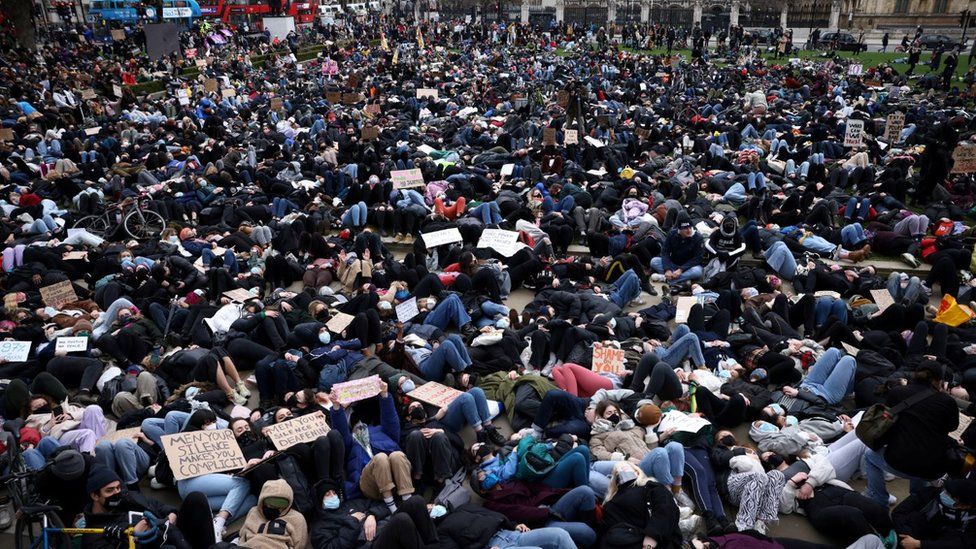
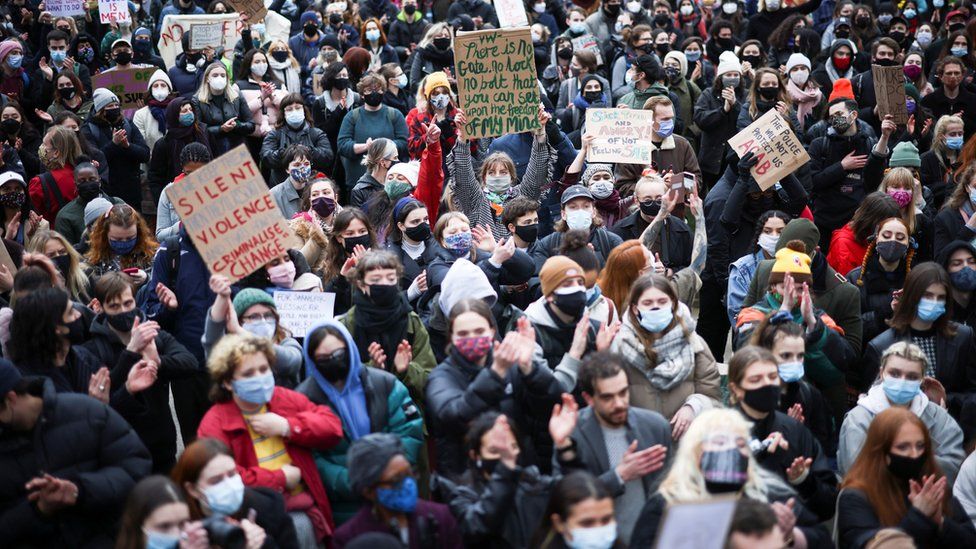
Thousands congregated in central London on Sunday to protest about violence against women.
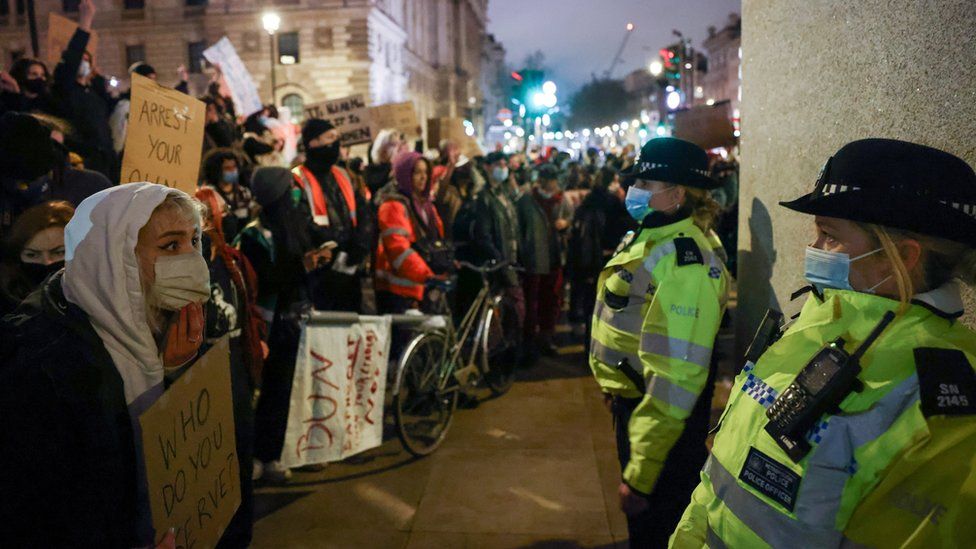
Sisters Uncut held an event outside the Metropolitan Police's headquarters at New Scotland Yard, which it said was to remember Ms Everard and demonstrate against broader "police brutality".
Demonstrators chanted "shame on you" at police and officers erected barriers around the building near the Houses of Parliament in central London.
If you are reading this page and can't see the form you will need to visit the mobile version of the BBC website to submit your question or comment or you can email us at HaveYourSay@bbc.co.uk. Please include your name, age and location with any submission.
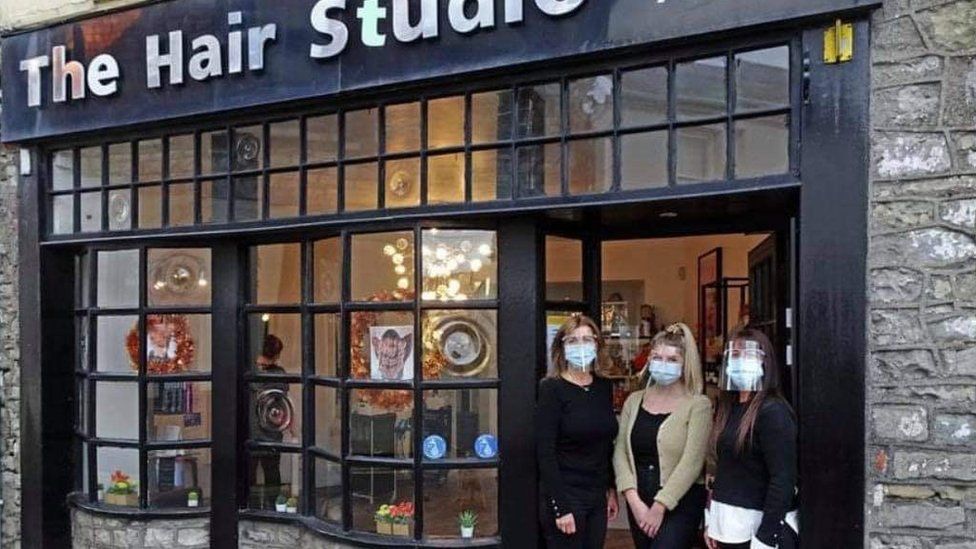
Ms Jenkins said following Friday's announcement that she could reopen, she spent the day phoning regular clients to book them in and was "inundated" with phone calls and voicemails.
Her salon, in Llantwit Major, Vale of Glamorgan, is now fully booked for two weeks.
'It's not just about the hair'
She said some clients were emotional at the thought of returning.
"Some of them burst into tears when we spoke to them and said they could come in - some of them live alone and don't see many people," she explained.
"To come back and have a haircut, it's not just about the hair, it's the whole social thing and company.
"I'm sure I'll be quite emotional [when we reopen] as well."
Facebook / Llantwit Major
She said she had been overwhelmed with the support from her clients: "People have given us lovely cards... people have actually taken the time to congratulate us on things like the [Covid] measures and everything and how safe they felt [when they last came in].
"Some have paid in advance for their hair... I've had one or two clients who've actually bought a year's worth of vouchers... it's been so lovely for them to think of it, really kind."
She had mixed emotions when she heard she could reopen.
"I think we were all quite apprehensive, not so much going back because of the virus, but just knowing it was quite hard last year - all the sanitising, cleaning, wearing the masks and the visors, I mean it's hard work," she added.
"On the flip side, having all of that in place has given them the confidence to go back."
'Breaking, frazzled and limp'
Having not had a haircut since last summer, Ms Trelawny said she was "particularly excited" to return to her salon.
Kat Trelawny
She said her lockdown hair was starting to get her down: "It is just really dark, I'm desperate for a cut, I've been using a straighteners and it is breaking, frazzled, limp...
"I've bought a special mask for my hair, heat protective spray and a nice serum... I dry it and straighten it too much."
She said visiting her hairdresser would give her a boost: "I'll feel loads better about myself and a lot more confident, a bit more vibrant - I just feel a bit drab at the minute."
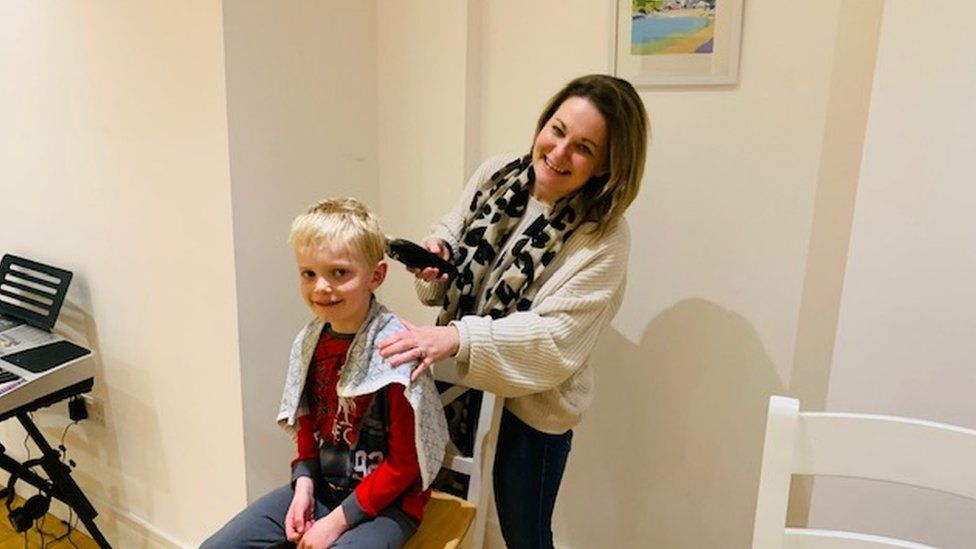
In lockdown she has let hair grow but has been cutting her husband's and son's hair.
"I don't think I've done a great job but I've had a go," she said.
"I watched a few YouTube clips and bought myself some clippers."
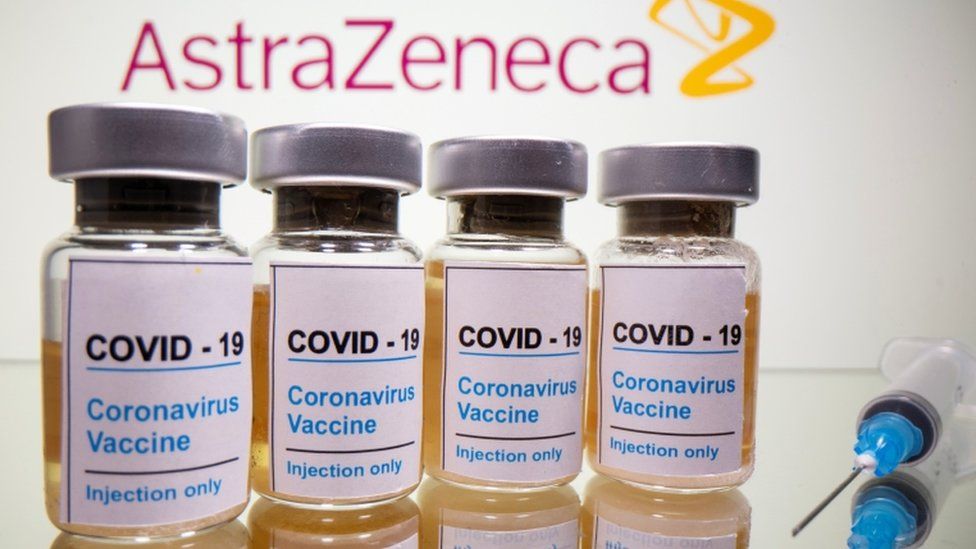
Health officials in Northern Ireland will continue to use the Oxford-AstraZeneca vaccine after its suspension in the Republic of Ireland.
The country's National Immunisation Advisory Committee (NIAC) recommended the move after reports of serious blood clotting events in adults in Norway.
Ireland's Health Minister Stephen Donnelly said it was "precautionary".
AstraZeneca said there is no evidence of a link between the vaccine and increased risk of clotting.
On Sunday, the Netherlands became the latest country to suspend use of the vaccine. The Dutch government said the move, which will last until at least 29 March, was a precaution based on reports from Denmark and Norway of possible serious side effects.
The UK's Medicines and Healthcare products Regulatory Agency (MHRA) said it was aware of the suspension in Ireland and was "closely reviewing reports".
"But given the large number of doses administered, and the frequency at which blood clots can occur naturally, the evidence available does not suggest the vaccine is the cause," a spokesperson said.
In a statement, Northern Ireland's Department of Health said it administers vaccines under the "expert direction of the MHRA".
It said it had received guidance from the MHRA in light of the vaccine's suspension in the Republic and that the "roll-out of Northern Ireland's vaccination programme will continue".
The Department of Health also said a "further expansion of the programme will be announced very shortly".
Chair of the British Medical Association NI's GP committee, Dr Alan Stout, said it was important that anyone with a vaccine appointment scheduled attends it as planned.
"We are confident that the vaccine is extremely safe to use and it is one of the key facets of our fight against Covid-19," he said.
More than 110,000 doses of the AstraZeneca vaccine have been administered in Ireland, which is about 20% of all doses given to date.
Stephen Donnelly, Ireland's Health Minister, said he hoped the suspension was "nothing more than a very short deferral".
Ireland's deputy chief medical officer Dr Ronan Glynn said new information had been received from the Norwegian Medicines Agency on Saturday night and that, while there is no conclusion that there's a link to the AstraZeneca vaccine, the decision to suspend the vaccine programme came from "an abundance of caution".
He told Irish broadcaster RTÉ that there have been no reports of clotting events in Ireland similar to those seen in Norway and that there should still be full confidence in the vaccine programme.
The decision to temporarily suspend use of the AstraZeneca Covid-19 vaccine was based on new information from Norway that emerged late last night. This is a precautionary step. The National Immunisation Advisory Comm meets again this morning and we’ll provide an update after that
In a statement, AstraZeneca said there was no evidence of an increased risk of clotting due to the vaccine.
It said that across the EU and UK there had been 15 events of deep-vein thrombosis (DVT) and 22 events of pulmonary embolism reported among those vaccinated.
"Around 17 million people in the EU and UK have now received our vaccine, and the number of cases of blood clots reported in this group is lower than the hundreds of cases that would be expected among the general population," said Ann Taylor, the firm's chief medical officer.
"The nature of the pandemic has led to increased attention in individual cases and we are going beyond the standard practices for safety monitoring of licensed medicines in reporting vaccine events, to ensure public safety."
Vaccine disruption 'undesirable'
Prof Adam Finn, a member of the UK's Joint Committee on Vaccination and Immunisation (JCVI), warned that, given evidence of the vaccine's "real-world effectiveness", a "stop-start approach" to the vaccine programme needed to be considered carefully.
"If clear evidence of serious or life threatening side-effects emerges that will have important consequences," he said.
"However so far it hasn't and it's highly undesirable to disrupt a complex and urgent programme every time people develop illnesses after receiving vaccine that may be coincidental and not causally related."
"Blood clots can occur naturally and are not uncommon. More than 11 million doses of the Covid-19 AstraZeneca vaccine have now been administered across the UK," said Phil Bryan of the MHRA.
"People should still go and get their Covid-19 vaccine when asked to do so."
The Public Health Agency in Northern Ireland said it would "closely monitor" the situation.
"From our perspective the vaccine is safe and we're continuing to use it," said Dr Stephen Bergin, interim Director of Public Health.
"We've had good experience over the last three months now, we've had over 600,000 people vaccinated, not all of course with this particular vaccine."
London’s police commissioner says she will not resign, defends officers’ actions dispersing a vigil for Sarah Everard.
London’s police commissioner has defended her officers’ actions and said she did not intend to resign amid a backlash over the way police treated some protesters during a vigil for a woman whose suspected murderer is a police officer.
London police faced heavy criticism from the public and politicians on Sunday for their heavy-handed tactics in breaking up the vigil.
The disappearance of Sarah Everard, 33, as she walked home on the evening of March 3, has provoked a huge outpouring of grief and dismay in the UK at the failure of police and wider society to tackle violence against women.
Police had denied permission for a vigil on Saturday evening at London’s Clapham Common, near where Everard was last seen alive, citing regulations aimed at preventing the spread of coronavirus.
But hundreds of people, mostly women, gathered peacefully at the park in defiance of the ban to pay their respects to Everard throughout the day, including Kate, the Duchess of Cambridge.
Late on Saturday, dozens of police officers marched into the crowd to shouts of “shame on you.” Scuffles broke out and officers dragged several women away from the scene.
Metropolitan Police Commissioner Cressida Dick defended the actions of police officers at the vigil [File: Peter Nicholls/Reuters]Home Secretary Priti Patel, the minister in charge of policing, described footage of the incident as “upsetting”. The BBC reported she had ordered an independent inquiry after an initial police report left some questions unanswered.
London Mayor Sadiq Khan said he was “not satisfied” with police chiefs’ explanation of the events and officers’ conduct must be examined. An image of officers handcuffing a woman as she lay on the floor was widely shared and condemned on social media.
Police were seen scuffling with some women at the event, and one woman was seen pinned to the ground by two officers. Video widely shared on social media showed a woman pulled up from the ground by officers, who then shoved her from the back.
Several women were led away in handcuffs. The force later said four people were arrested for violating public order and coronavirus regulations.
On Sunday, Metropolitan Police Commissioner Cressida Dick, who is the first woman to head the force, said she was “more determined than ever” to lead the organisation.
She said she fully understood the strength of feeling in response to Everard’s case, but stressed that Saturday’s vigil was an unlawful gathering and officers had been put in a “very difficult position”.
My full statement following my meeting with the Met Commissioner to discuss the policing of the vigil on Clapham Common last night: pic.twitter.com/lagvqVNSDf
Everard’s murder has resonated with women across the country, prompting thousands to share on social media their experiences of violence and sexual assaults perpetrated by men, and vividly describe the daily fear they feel.
A steady flow of quiet mourners visited the site of the vigil on Sunday, placing flowers around a bandstand.
Al Jazeera’s Nadim Baba, reporting from London, said it was a “peaceful gathering”.
“But the emotion was clear, they were denouncing what they see as police brutality, heavy-handed tactics, and the tone-deafness of what happened on Saturday evening,” Baba reported.
Patsy Stevenson, who was pictured pinned to the ground by two officers during Saturday’s clashes, said she was considering whether to challenge the 200-pound ($278) fine she received.
“We were there to remember Sarah, we all felt deeply saddened and still do that it happened, so I brought a candle with me but unfortunately wasn’t even able to light it to put it down because the police turned up and barged their way through,” she told LBC radio.
Police officer Wayne Couzens charged with Everard’s murder appeared in court on Saturday. Police discovered her body on Wednesday in woodland about 50 miles (80 km) southeast of London. The court heard that her body was found in a builder’s refuse bag, and identified using dental records.
People mourn at a memorial site at the Clapham Common Bandstand, following the kidnap and murder of Sarah Everard [Henry Nicholls/Reuters]







 Metropolitan Police Commissioner Cressida Dick defended the actions of police officers at the vigil [File: Peter Nicholls/Reuters]
 People mourn at a memorial site at the Clapham Common Bandstand, following the kidnap and murder of Sarah Everard [Henry Nicholls/Reuters]