Sabtu, 23 Januari 2021

COVID-19: Halve the gap between Pfizer vaccine doses, senior doctors urge - Sky News

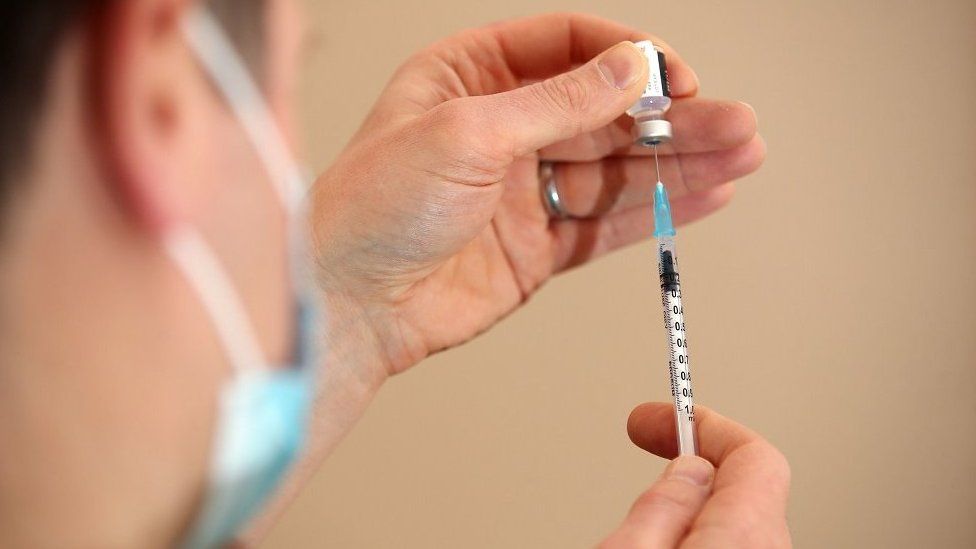
Senior doctors have called on England's chief medical officer to halve the gap between the first and second doses of the Pfizer coronavirus vaccine.

The British Medical Association (BMA) says the gap between doses being given to patients should be cut from 12 weeks to six.

The World Health Organisation has recommended that the gap should be a maximum of 6 weeks - but the UK's Medicines and Healthcare Products Regulatory Agency (MHRA) has opted to delay a second Pfizer dose for up to 12 weeks, to ensure more people get the first jab sooner.

Pfizer initially tested the vaccine's efficacy when the two doses were given up to 21 days apart.

The chair of the BMA Council, Chaand Nagpaul, told Sky News the organisation would like "to have a dialogue with the chief medical officer over this issue" considering the differing advice.

Please use Chrome browser for a more accessible video player

BMA wants a study on vaccine dose gap

Live COVID news from UK and around the world

He said a delay of six weeks - in line with the WHO's advice - would still allow for a high number of people to be vaccinated and would be more in line with other countries.

More from Covid-19

He said: "We wrote to the chief medical officer asking him to reconsider the decision in the UK, looking at guidance from the World Health Organisation, and and taking stock of the fact that no other nation in the world other than the UK has adopted the 12-week delay.

"A six-week delay compared to the original three weeks [advised by Pfizer] is still doubling the number of people who can be vaccinated."

Dr Nagpaul added: "We are talking specifically about the Pfizer vaccine, the AstraZenica vaccine has got approval from its manufacturer for a delay of up to 12 weeks."

Richard Vautrey, the chair of the BMA's GP committee, told Sky News the organisation is talking to Professor Chris Whitty, England's chief medical officer, but they want all the data for the UK's vaccination programme to be considered.

He said: "We are still not doing what the World Health Organisation and other European countries are doing but we need to understand the data… to really fully understand what level of protection is given after one dose."

More than 5.3m people have received their first vaccine jab across the UK.

Until they have had the second jab they won't have the maximum level of protection that it can provide.

Mr Vautrey said the BMA is "supportive" of the way the vaccination programme is targeting as many people as possible, but they are "open" to looking at the data and implementing it as "best we can".

A Department of Health and Social Care spokesperson said: "The decision by the MHRA to change vaccine dosage intervals followed a thorough review of the data and was in line with the recommendations of the UK's four Chief Medical Officers.
Please use Chrome browser for a more accessible video player

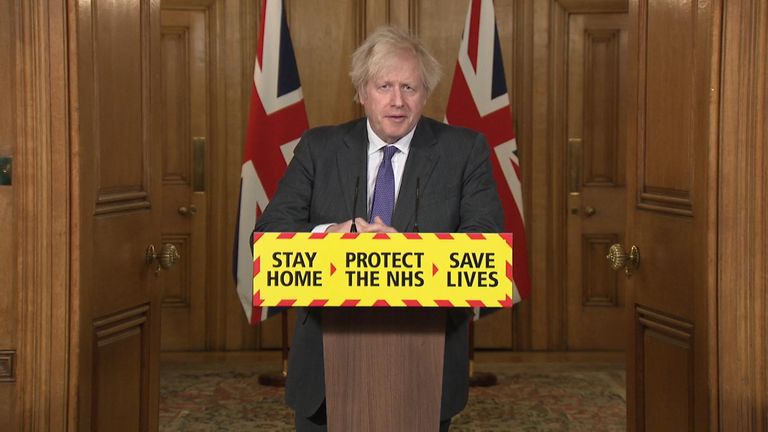
New UK COVID variant more deadly

"Both vaccines provide a high degree of protection after the first dose, and the Government has closely followed the guidance of the Joint Committee on Vaccination and Immunisation (JCVI) which was clear that we should give as many people as possible some level of immunity initially."

Speaking at a Downing Street press conference on Friday, Professor Whitty said delaying a second jab would double the number of people receiving a vaccination.

He said extending the gap was a "public health decision" that would allow "many more people to be vaccinated much more quickly".

It follows data from Israel's vaccine rollout that suggested the efficacy of one Pfizer dose is just 33%.

Meanwhile, Prime Minister Boris Johnson has urged people to stay home and follow the rules after he revealed the new COVID variant, which emerged in the southeast of England, may cause "a higher degree of mortality".
Please use Chrome browser for a more accessible video player

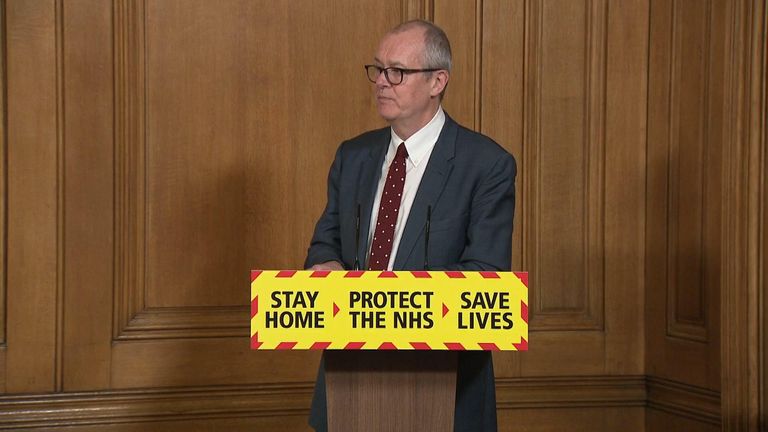
Vallance: 'Virus is with us forever'

He and a number of experts have also warned that lifting restrictions too soon would simply lead to another lockdown, leaving the UK with no hope of a return to normality any time soon.

The shift in tone comes as a series of hard-hitting government adverts launched on Friday evening, asking Britons if they "can look coronavirus patients in the eye".

The first of the new adverts, aired on ITV and Channel 4, features COVID-19 patients and the staff looking after them at Basingstoke and North Hampshire Hospital.

It begins with a room full of doctors trying to save someone in intensive care before showing the faces of those very ill with the virus and the medics taking care of them.

They remain silent, staring at the viewer, before a voice asks: "Can you look them in the eyes and tell them you're doing all you can to stop the spread of COVID-19?"

The prime minister's chief scientific officer Sir Patrick Vallance said that with the new variant, 13 or 14 people out of every 1,000 over the age of 60 with the virus are dying.

With the initial virus, the number was 10 in 1,000.

Let's block ads! (Why?)


https://news.google.com/__i/rss/rd/articles/CBMiZGh0dHBzOi8vbmV3cy5za3kuY29tL3N0b3J5L2NvdmlkLTE5LWhhbHZlLXRoZS1nYXAtYmV0d2Vlbi12YWNjaW5lLWRvc2VzLXNlbmlvci1kb2N0b3JzLXVyZ2UtMTIxOTYwNjjSAWhodHRwczovL25ld3Muc2t5LmNvbS9zdG9yeS9hbXAvY292aWQtMTktaGFsdmUtdGhlLWdhcC1iZXR3ZWVuLXZhY2NpbmUtZG9zZXMtc2VuaW9yLWRvY3RvcnMtdXJnZS0xMjE5NjA2OA?oc=5

2021-01-23 12:06:12Z
52781321128098

Experts still not sure mutant strain of Covid is more deadly - Metro.co.uk

composite image of ambulances and Boris Johnson
Boris Johnson announced yesterday the mutant strain of the virus is causing more deaths (Pictures: Getty/Rex)

Scientists say they were ‘surprised’ to hear Boris Johnson’s grave warnings about the new strain of coronavirus because they are still ‘only around 50%’ sure it is more deadly.

The Prime Minister announced to the public yesterday that the latest studies indicate the variant first found in Kent is associated with a higher death rate.

But some experts say the findings are still not conclusive and more data is needed before the increased risk of mortality is fully understood.

Boris Johnson – flanked by Chris Whitty and Sir Patrick Vallance – choose to announce the news from Downing Street, hours after first being informed of the latest developments himself.

Mr Johnson said: ‘Since the beginning of this pandemic, we’ve tried to update you as soon as possible about changes in the scientific data or the analysis.

Advertisement

Advertisement

‘So I must tell you this afternoon that we’ve been informed today that, in addition to spreading more quickly, it also now appears that there is some evidence that the new variant – that was first identified in London and the south east – may be associated with a higher degree of mortality.’

Dr Mike Tildesley, a member of the Sage subgroup the Scientific Pandemic Influenza Group on Modelling (Spi-M), said that it was still too early to be drawing ‘strong conclusions’.

He said: ‘I was actually quite surprised the news had been announced at a news conference.

‘It seems to have gone up a little bit from about 10 people per thousand to about 13 which is quite a small rise but it’s based on a relatively small amount of data.

Boris Johnson speaking at a coronavirus press conference
Boris Johnson during yesterday’s press conference (Picture: Getty)

‘I would be wanting to wait for a week or two more, monitoring a little bit more before we draw really strong conclusions about this.’

Speaking on BBC Breakfast he added: ‘I just worry that where we report things pre-emptively where the data are not really particularly strong.’

Sir Patrick, the country’s chief scientific officer, repeatedly stressed that the evidence around the increased severity of the Kent strain was ‘weak’ and there’s a lot of ‘uncertainty’ about the numbers.

‘These data are currently uncertain and we don’t have a very good estimate of the precise nature or indeed whether it is an overall increase, but it looks like it is,’ he said.

The warnings about the new variant came from the Government’s New and Emerging Respiratory Virus Threats Advisory Group, a sub-committee of Sage.

a queue of ambulances outside of a hospital
Ambulance crew wheel a stretcher outside the emergency department at the the Royal London Hospital yesterday (Picture: Getty)

It was based on three studies conducted by the London School of Hygiene and Tropical Medicine, Imperial College London and the University of Exeter.

Advertisement

Advertisement

These estimated that the increased risk of death was between 1.35 times higher and 1.91 times higher.

All three studies took a small sample of the deaths that have occurred since the variant emerged late last year and applied different methodologies to assess the risk of mortality.

Nervtag concluded there was a ‘realistic possibility’ the new strain is more deadly but this phraseology is used by scientists when they are around 50% sure of something.

a man lying on a hospital bed
A new Government advert has launched encouraging people to stay at home to protect others

Public Health England medical director Dr Yvonne Doyle said the findings are still not ‘absolutely clear’ and more studies are needed.

‘There are several investigations going on at the moment. It is not absolutely clear that that will be the case (the new strain is more deadly). It is too early to say,’ she told the BBC Radio 4 Today programme.

‘There is some evidence, but it is very early evidence. It is small numbers of cases and it is far too early to say this will actually happen.’

The new variant was not found to have driven up death rates among patients already in hospital but may increase the risk of going into hospital in the first place.

It’s thought the true picture will become clearer over the next few weeks as more data becomes available.

Professor Peter Horby, who chairs Nervtag, defended the decision to go public with the findings but urged people to ‘keep things in perspective.’

He told BBC Breakfast: ‘There are some limitations in the data so we need to be cautious with the interpretations but it is important that people understand that we are looking at this and this may be true.

Advertisement

‘If you look at it as a relative change like 30 or 40% then it sounds really bad but a big change in a very small risk takes it from a very small number to a slightly bigger, but still very small number, so for most people the risk is very, very small.

‘People need to put it into perspective. This is a risk for certain age groups and that risk may have increased but for most people it is still not a serious disease.’

Get in touch with our news team by emailing us at webnews@metro.co.uk.

For more stories like this, check our news page.

Advertisement

Advertisement

Let's block ads! (Why?)


https://news.google.com/__i/rss/rd/articles/CBMiZWh0dHBzOi8vbWV0cm8uY28udWsvMjAyMS8wMS8yMy9leHBlcnRzLXN0aWxsLW5vdC1zdXJlLW11dGFudC1zdHJhaW4tb2YtY292aWQtaXMtbW9yZS1kZWFkbHktMTM5NTMyODcv0gFpaHR0cHM6Ly9tZXRyby5jby51ay8yMDIxLzAxLzIzL2V4cGVydHMtc3RpbGwtbm90LXN1cmUtbXV0YW50LXN0cmFpbi1vZi1jb3ZpZC1pcy1tb3JlLWRlYWRseS0xMzk1MzI4Ny9hbXAv?oc=5

2021-01-23 09:20:00Z
52781317119751

COVID-19: Halve the gap between vaccine doses, senior doctors urge - Sky News

Senior doctors have called on England's chief medical officer to halve the gap between the first and second doses of the Pfizer coronavirus vaccine.

The British Medical Association (BMA) says the gap between doses being given to patients should be cut from 12 weeks to six.

The World Health Organisation has recommended that the gap should be a maximum of 6 weeks - but the UK's Medicines and Healthcare Products Regulatory Agency (MHRA) has opted to delay a second dose for up to 12 weeks, to ensure more people get the first jab sooner.

Pfizer initially tested the vaccine's efficacy when the two doses were given up to 21 days apart.

The chair of the BMA's GP committee, Richard Vautrey, told Sky News the organisation is talking to Professor Chris Whitty, England's chief medical officer, but they want all the data for the UK's vaccination programme to be considered.

He said: "We are still not doing what the World Health Organisation and other European countries are doing but we need to understand the data… to really fully understand what level of protection is given after one dose."

More than 5.3m people have received their first vaccine jab across the UK.

More from Covid-19

Until they have had the second jab they won't have the maximum level of protection that it can provide.

Mr Vautrey said the BMA is "supportive" of the way the vaccination programme is targeting as many people as possible, but they are "open" to looking at the data and implementing it as "best we can".

A Department of Health and Social Care spokesperson said: "The decision by the MHRA to change vaccine dosage intervals followed a thorough review of the data and was in line with the recommendations of the UK's four Chief Medical Officers.

Please use Chrome browser for a more accessible video player

New UK COVID variant more deadly

"Both vaccines provide a high degree of protection after the first dose, and the Government has closely followed the guidance of the Joint Committee on Vaccination and Immunisation (JCVI) which was clear that we should give as many people as possible some level of immunity initially."

Speaking at a Downing Street press conference on Friday, Professor Whitty said delaying a second jab would double the number of people receiving a vaccination.

He said extending the gap was a "public health decision" that would allow "many more people to be vaccinated much more quickly".

It follows data from Israel's vaccine rollout that suggested the efficacy of one Pfizer dose is just 33%.

Meanwhile, Prime Minister Boris Johnson has urged people to stay home and follow the rules after he revealed the new COVID variant, which emerged in the southeast of England, may cause "a higher degree of mortality".

He and a number of experts have also warned that lifting restrictions too soon would simply lead to another lockdown, leaving the UK with no hope of a return to normality any time soon.

The shift in tone comes as a series of hard-hitting government adverts launched on Friday evening, asking Britons if they "can look coronavirus patients in the eye".

The first of the new adverts, aired on ITV and Channel 4, features COVID-19 patients and the staff looking after them at Basingstoke and North Hampshire Hospital.

Please use Chrome browser for a more accessible video player

Vallance: 'Virus is with us forever'

It begins with a room full of doctors trying to save someone in intensive care before showing the faces of those very ill with the virus and the medics taking care of them.

They remain silent, staring at the viewer, before a voice asks: "Can you look them in the eyes and tell them you're doing all you can to stop the spread of COVID-19?"

The prime minister's chief scientific officer Sir Patrick Vallance said that with the new variant, 13 or 14 people out of every 1,000 over the age of 60 with the virus are dying.

With the initial virus, the number was 10 in 1,000.

Nurses, meanwhile, have written to the government calling for an "urgent" review into whether standard surgical face masks prevent transmission of the new variant on COVID wards.

Dame Donna Kinnair, chief executive of the Royal College of Nursing has said that some hospitals are using enhanced PPE, creating a "postcode lottery" of protection.

A record 1,820 people were reported to have died of coronavirus on Wednesday, with another 1,401 COVID-related deaths registered on Friday.

The government says that someone is admitted to hospital with the virus every 30 seconds in England, with a quarter of them under the age of 55.

Please use Chrome browser for a more accessible video player

Vallance: 'Virus is with us forever'

At Friday's briefing, Chief Medical Officer Professor Chris Whitty stressed that infections nationwide are still "at a very high level" and the situation is "extremely precarious".

"The impact of the current wave is still putting significant pressure on hospitals across the country and many patients are very sick," he urged.

"Vaccines give clear hope for the future, but for now we must all continue to play our part in protecting the NHS and saving lives."

Sir Patrick Vallance also cautioned that there is still not enough evidence to tell if current vaccines will protect against the emerging variants from South Africa and Brazil.

But despite the rising death toll, the government's scientific advisory group for emergencies (SAGE) said on Friday that the virus reproduction (R) number had fallen from between 1.2 and 1.3 to between 0.8 and 1.0.

Although this suggests lockdown is working, experts have warned that restrictions are still a long way from being eased - as hospitals are still in crisis - and that more could be necessary to keep numbers down.

Rowland Kao, professor of veterinary epidemiology at the University of Edinburgh, said: "While the recent results showing declining case numbers is good news, and suggest that the variant is controllable via existing measures, these results on deaths imply that burden in hospitals will continue to be high requiring a more prolonged period of restrictions."

SAGE member and former chief scientific advisor Sir Mark Walport told the BBC: "If the evidence shows that the decrease in cases isn't continuing, then clearly policymakers will have to consider much tougher measures."

Let's block ads! (Why?)


https://news.google.com/__i/rss/rd/articles/CBMiZGh0dHBzOi8vbmV3cy5za3kuY29tL3N0b3J5L2NvdmlkLTE5LWhhbHZlLXRoZS1nYXAtYmV0d2Vlbi12YWNjaW5lLWRvc2VzLXNlbmlvci1kb2N0b3JzLXVyZ2UtMTIxOTYwNjjSAWhodHRwczovL25ld3Muc2t5LmNvbS9zdG9yeS9hbXAvY292aWQtMTktaGFsdmUtdGhlLWdhcC1iZXR3ZWVuLXZhY2NpbmUtZG9zZXMtc2VuaW9yLWRvY3RvcnMtdXJnZS0xMjE5NjA2OA?oc=5

2021-01-23 09:11:15Z
52781323954080

Covid: Gap between Pfizer vaccine doses should be halved, say doctors - BBC News

A doctor with the Pfizer vaccine
PA Media

Senior doctors are calling on England's chief medical officer to cut the gap between the first and second doses of the Pfizer-BioNTech Covid-19 vaccine.

Health officials across the UK extended the maximum wait from three to 12 weeks to get the first jab to more people.

But in a letter seen by the BBC, the British Medical Association said the current plan was "difficult to justify" and should be changed to six weeks.

Prof Chris Whitty said extending the gap was a "public health decision".

Speaking at a Downing Street briefing on Friday, he said it would allow "many more people to be vaccinated much more quickly".

The government's Joint Committee on Vaccination and Immunisation (JCVI) says unpublished data suggests the Oxford-AstraZeneca vaccine is still effective with doses 12 weeks apart - but Pfizer has said it has tested the vaccine's efficacy only when the two doses were given up to 21 days apart.

The World Health Organization has recommended a gap of four weeks between doses - to be extended only in exceptional circumstances to six weeks.

The Department of Health and Social Care said the decision to extend the maximum gap between doses for both the Oxford and Pfizer vaccines "followed a thorough review of the data and was in line with the recommendations of the UK's four chief medical officers".

"Our number one priority is to give protection against coronavirus to as many vulnerable people as possible, as quickly as possible," a spokeswoman added.

In the letter to Prof Whitty, the British Medical Association (BMA) said it agreed that the vaccine should be rolled out "as quickly as possible" - but called for an urgent review and for the gap to be reduced.

The doctors' union said the UK's strategy "has become increasingly isolated internationally" and "is proving evermore difficult to justify".

"The absence of any international support for the UK's approach is a cause of deep concern and risks undermining public and the profession's trust in the vaccination programme," the letter said.

Dr Chaand Nagpaul, chair of the BMA, said there were "growing concerns" that the vaccine could become less effective with doses 12 weeks apart.

"Obviously the protection will not vanish after six weeks, but what we do not know is what level of protection will be offered [after that point]," he told BBC Breakfast.

"We should not be extrapolating data when we don't have it."

2px presentational grey line
Analysis box by Hugh Pym, health editor

There has been understandable enthusiasm over a promising start to the hugely ambitious UK vaccination rollout.

But there has been some tension over the decision to lengthen the time between doses for the Pfizer vaccine to 12 weeks.

Prof Whitty and other health leaders and experts say this will allow many more people to get vaccinated quickly and the first dose gives most of the protection.

But critics argue this goes against Pfizer's recommendation of a three-week gap and there is no data to back up the long delay.

The intervention of the BMA is significant as it shows senior doctors now have widespread concerns, including worries about reliability of supplies if people have to wait longer for a second jab.

This is a private letter to Prof Whitty seen by the BBC and not a grandstanding press release.

The BMA wants to have talks with the chief medical officer about moving to six weeks. Prof Whitty will no doubt restate his case.

It will be interesting to see whether the BMA argument gains traction in the wider medical world.

2px presentational grey line

The BMA also suggested second doses might not be guaranteed after a 12-week delay "given the unpredictability of supplies".

However, Public Health England's medical director said people would get their second dose.

Dr Yvonne Doyle told BBC Radio 4's Today programme that she backed the current strategy, saying it was "about bearing down on transmission" to reduce deaths and reduce the chance of more dangerous variants of the virus emerging.

"The more people that are protected against this virus, the less opportunity it has to get the upper hand," she said.

Other issues highlighted in the letter include:

  • Concerns that one dose of the Pfizer jab "does not produce sufficient neutralising antibodies and the potential to reduce transmission"
  • A mismatch between policies across the UK - in particular, Northern Ireland's decision to give the Pfizer vaccine to care home residents and staff within three weeks
  • Reports from Israel's vaccination programme suggesting "lower protection than expected"

The UK's chief medical officers have said the "great majority" of initial protection came from the first jab, while the second dose is likely to help the protection last longer.

The Pfizer and Oxford vaccine are both expected to work against the variant of Covid-19 that emerged in the UK.

At Friday's briefing, Prime Minister Boris Johnson said early evidence suggests the variant may be more deadly.

Previous work suggests the new variant spreads between 30% and 70% faster than others, and there are hints it is about 30% more lethal.

A further 40,261 cases, and 1,401 deaths within 28 days of a positive coronavirus test were reported on Friday in the UK.

Around the BBC iPlayer banner
Around the BBC iPlayer footer
Banner saying 'Get in touch'

What has been your experience of receiving the vaccine? Are you waiting for your second dose? Email: haveyoursay@bbc.co.uk.

Please include a contact number if you are willing to speak to a BBC journalist. You can also get in touch in the following ways:

If you are reading this page and can't see the form you will need to visit the mobile version of the BBC website to submit your question or comment or you can email us at HaveYourSay@bbc.co.uk. Please include your name, age and location with any submission.

Let's block ads! (Why?)


https://news.google.com/__i/rss/rd/articles/CBMiJmh0dHBzOi8vd3d3LmJiYy5jby51ay9uZXdzL3VrLTU1Nzc3MDg00gEqaHR0cHM6Ly93d3cuYmJjLmNvLnVrL25ld3MvYW1wL3VrLTU1Nzc3MDg0?oc=5

2021-01-23 08:56:00Z
52781323942368

Covid: Gap between Pfizer vaccine doses should be halved, say doctors - BBC News

A doctor with the Pfizer vaccine
PA Media

Senior doctors are calling on England's chief medical officer to cut the gap between the first and second doses of the Pfizer-BioNTech Covid-19 vaccine.

Health officials extended the wait from three to 12 weeks to get the first jab to as many people as possible.

But in a letter seen by the BBC, the British Medical Association said the gap should be six weeks, saying the policy was "difficult to justify".

Prof Chris Whitty said it would double the number of people receiving jabs.

Speaking at a Downing Street briefing on Friday, he said extending the gap was a "public health decision" that would allow "many more people to be vaccinated much more quickly".

The UK is administering both parts of the Pfizer and Oxford-AstraZeneca vaccines 12 weeks apart, having initially planned to leave three weeks between the Pfizer jabs.

The World Health Organization has recommended a gap of four weeks between doses - to be extended only in exceptional circumstances to six weeks.

Pfizer has said it has tested the vaccine's efficacy only when the two doses were given up to 21 days apart.

But the Department of Health and Social Care said the decision to extend the wait in the UK "followed a thorough review of the data and was in line with the recommendations of the UK's four chief medical officers".

"Our number one priority is to give protection against coronavirus to as many vulnerable people as possible, as quickly as possible," a spokeswoman added.

In the letter to Prof Whitty, the British Medical Association (BMA) said it agreed that the vaccine should be rolled out "as quickly as possible" - but called for an urgent review and for the gap to be reduced.

The doctors' union said the UK's strategy "has become increasingly isolated internationally" and "is proving evermore difficult to justify".

"The absence of any international support for the UK's approach is a cause of deep concern and risks undermining public and the profession's trust in the vaccination programme," the letter said.

Dr Chaand Nagpaul, chair of the BMA, said there were "growing concerns" that the vaccine could become less effective with doses 12 weeks apart.

"Obviously the protection will not vanish after six weeks, but what we do not know is what level of protection will be offered [after that point]," he told BBC Breakfast.

"We should not be extrapolating data when we don't have it."

2px presentational grey line
Analysis box by Hugh Pym, health editor

There has been understandable enthusiasm over a promising start to the hugely ambitious UK vaccination rollout.

But there has been some tension over the decision to lengthen the time between doses for the Pfizer vaccine to 12 weeks.

Prof Whitty and other health leaders and experts say this will allow many more people to get vaccinated quickly and the first dose gives most of the protection.

But critics argue this goes against Pfizer's recommendation of a three-week gap and there is no data to back up the long delay.

The intervention of the BMA is significant as it shows senior doctors now have widespread concerns, including worries about reliability of supplies if people have to wait longer for a second jab.

This is a private letter to Prof Whitty seen by the BBC and not a grandstanding press release.

The BMA wants to have talks with the chief medical officer about moving to six weeks. Prof Whitty will no doubt restate his case.

It will be interesting to see whether the BMA argument gains traction in the wider medical world.

2px presentational grey line

The BMA also suggested second doses might not be guaranteed after a 12-week delay "given the unpredictability of supplies".

However, Public Health England's medical director said people would get their second dose.

Dr Yvonne Doyle told BBC Radio 4's Today programme that she backed the current strategy, saying it was "about bearing down on transmission" to reduce deaths and reduce the chance of more dangerous variants of the virus emerging.

"The more people that are protected against this virus, the less opportunity it has to get the upper hand," she said.

Other issues highlighted in the letter include:

  • Concerns that one dose of the Pfizer jab "does not produce sufficient neutralising antibodies and the potential to reduce transmission"
  • A mismatch between policies across the UK - in particular, Northern Ireland's decision to give the Pfizer vaccine to care home residents and staff within three weeks
  • Reports from Israel's vaccination programme suggesting "lower protection than expected"

The UK's chief medical officers have said the "great majority" of initial protection came from the first jab, while the second dose is likely to help the protection last longer.

The Pfizer and Oxford vaccine are both expected to work against the variant of Covid-19 that emerged in the UK.

At Friday's briefing, Prime Minister Boris Johnson said early evidence suggests the variant may be more deadly.

Previous work suggests the new variant spreads between 30% and 70% faster than others, and there are hints it is about 30% more lethal.

His comments came as ministers prepared to discuss whether to further tighten restrictions at UK borders, including the possibility of hotel quarantines for travellers.

Prof Whitty said the UK is at an "extremely precarious" point, despite signs that infections are beginning to fall.

A further 40,261 cases, and 1,401 deaths within 28 days of a positive coronavirus test were reported on Friday in the UK.

Around the BBC iPlayer banner
Around the BBC iPlayer footer
Banner saying 'Get in touch'

What has been your experience of receiving the vaccine? Are you waiting for your second dose? Email: haveyoursay@bbc.co.uk.

Please include a contact number if you are willing to speak to a BBC journalist. You can also get in touch in the following ways:

If you are reading this page and can't see the form you will need to visit the mobile version of the BBC website to submit your question or comment or you can email us at HaveYourSay@bbc.co.uk. Please include your name, age and location with any submission.

Let's block ads! (Why?)


https://news.google.com/__i/rss/rd/articles/CBMiJmh0dHBzOi8vd3d3LmJiYy5jby51ay9uZXdzL3VrLTU1Nzc3MDg00gEqaHR0cHM6Ly93d3cuYmJjLmNvLnVrL25ld3MvYW1wL3VrLTU1Nzc3MDg0?oc=5

2021-01-23 08:06:00Z
CBMiJmh0dHBzOi8vd3d3LmJiYy5jby51ay9uZXdzL3VrLTU1Nzc3MDg00gEqaHR0cHM6Ly93d3cuYmJjLmNvLnVrL25ld3MvYW1wL3VrLTU1Nzc3MDg0