Senin, 21 September 2020

Covid: Pubs and restaurants in England to have 10pm closing times - BBC News

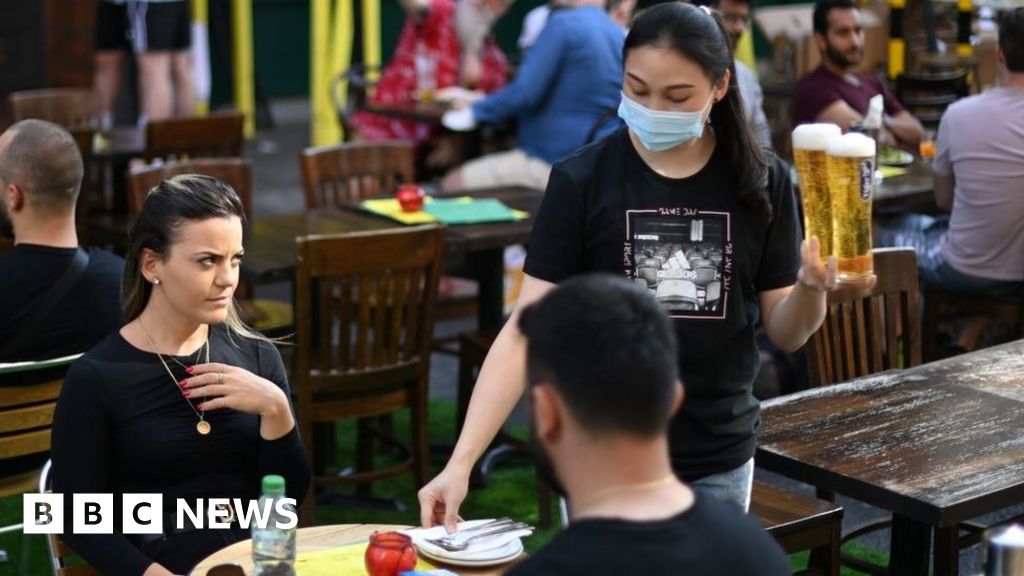
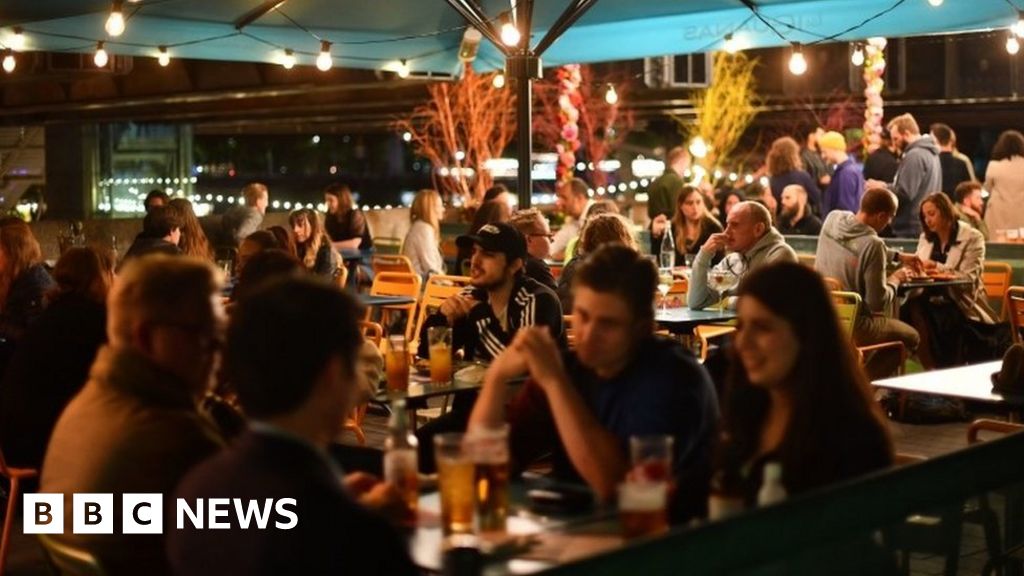
All pubs, bars, restaurants and other hospitality venues in England must have a 22:00 closing time from Thursday, to help curb the spread of coronavirus.

The sector will also be restricted by law to table service only.

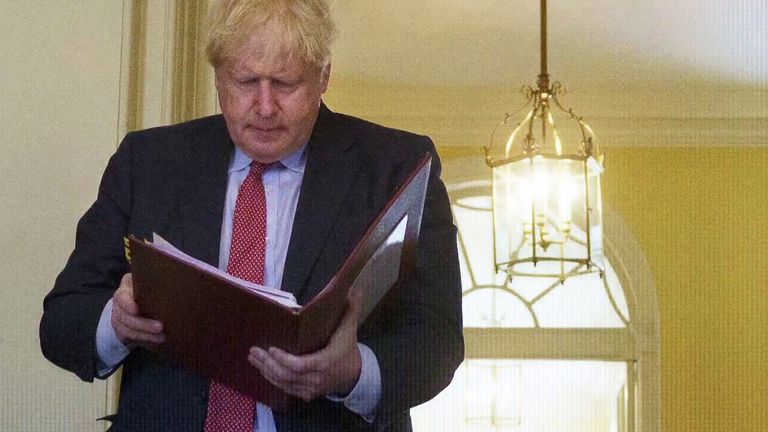
The measures will be set out by the prime minister in Parliament before an address to the nation to be broadcast live at 20:00 BST on Tuesday.

It comes as the UK's Covid-19 alert level moved to 4, meaning transmission is "high or rising exponentially".

Boris Johnson is also expected to stress the need for people to follow social distancing guidelines, wear face coverings and wash their hands regularly.

And, according to newspaper reports, he will urge people to work from home where it does not negatively impact businesses.

The government's chief scientific adviser Sir Patrick Vallance has warned there could be 50,000 new coronavirus cases a day by mid-October without further action - which, he said, could lead to more than 200 deaths per day by mid-November.

On Monday, a further 4,368 daily cases and 11 deaths were reported in the UK. There were 3,899 cases reported on Sunday.

Further restrictions will also be announced in Scotland on Tuesday, while restrictions on households mixing indoors will be extended to all of Northern Ireland.

Also from 18:00 on Tuesday, four more counties in south Wales will face new measures, including a 23:00 curfew for pubs and bars.

The UK cabinet will meet on Tuesday morning and Boris Johnson will also chair a Cobra emergency meeting - which will be attended by the leaders of Scotland, Wales and Northern Ireland.

Speaking about the new closing times, a No 10 spokesperson said: "No-one underestimates the challenges the new measures will pose to many individuals and businesses.

"We know this won't be easy, but we must take further action to control the resurgence in cases of the virus and protect the NHS."

Tighter restrictions on pub and restaurant opening times are already in place in parts of north-east and north-west England, and Wales.

What difference will it make?

People are understandably asking what difference closing at 22:00 makes. Coupled with the table service law, it will be little more than a marginal gain.

But what ministers hope is that the move, along with the rule of six that came into force last week, will act as a warning to the public that efforts to curb the virus need to be redoubled.

What remains to be seen is whether any other restrictions will accompany this move.

Behind the scenes both ministers and their advisers have argued over what is the right thing to do and how much the public will be willing to tolerate.

It seems inevitable that the virus will continue to spread - that's what respiratory viruses do during winter, especially one for which there is limited immunity and no vaccine.

But how quickly and widely is something no one knows.

The risk of trying to suppress the virus is the government will soon find itself having to make another decision about further steps.

How far are ministers prepared to go? Every restriction that is taken has a negative consequence to society.

But the nature of the virus means lives will undoubtedly be lost the more it spreads. Balancing those two harms will define the next six months.

Kate Nicholls, chief executive of trade body UKHospitality, said the new rules should be "applied with flexibility" and called for more support for the sector.

"A hard close time is bad for business and bad for controlling the virus - we need to allow time for people to disperse over a longer period," she said.

"Table service has been widely adopted in some parts of the sector since reopening, but it is not necessary across all businesses, such as coffee shops."

Michael Kill, chief executive of the Night-Time Industries Association, said the announcement was "yet another devastating blow" and warned it would result in a "surge of unregulated events and house parties".

Christopher Snowdon, head of lifestyle economics at free-market think tank the Institute of Economic Affairs, said the move "seems to have emerged from a random policy generator" and called on the government to publish the evidence upon which it was based.

"While mandatory table service has been part of the successful Swedish approach and may have merit, the new closing time will be devastating to a hospitality sector that was already suffering after the first lockdown," he said.

If Boris Johnson had decreed a year ago that he was going to call last orders on the pub at 22:00, the ravens might have left the Tower.

But given the terrible warnings from the government's top scientists on Monday, the kind of strict measures that ministers had been discussing - and the extent of restrictions that many people are already living with in some of our towns and cities - you might wonder if what the prime minister has ended up deciding is less stringent than it might have been.

As we have talked about many times, Downing Street is all too aware of the economic havoc the restrictions around the pandemic have caused.

Logically, therefore, it has always only wanted to take action when it has felt absolutely urgent. It is also the case that, as we enter a second surge, more is understood about the virus itself.

That means the government ought to be able to take a more sophisticated approach to managing the spread, rather than blunt, blunderbuss nationwide measures.

At least for now, the prime minister has concluded there is a narrow, but real chance to put the brakes on the outbreak before taking more draconian steps.

Read more from Laura.

New measures will also come into force in Lancashire, Merseyside, parts of the Midlands and West Yorkshire from Tuesday.

Other areas of England, Scotland and Wales are already under local lockdown, with restrictions including a ban on mixing with other households.

The prime minister's announcement on closing times comes after a series of meetings over the weekend, including with the government's chief medical adviser Prof Chris Whitty, Chancellor Rishi Sunk and Health Secretary Matt Hancock.

Let's block ads! (Why?)


https://news.google.com/__i/rss/rd/articles/CBMiJmh0dHBzOi8vd3d3LmJiYy5jby51ay9uZXdzL3VrLTU0MjQyNjM00gEqaHR0cHM6Ly93d3cuYmJjLmNvLnVrL25ld3MvYW1wL3VrLTU0MjQyNjM0?oc=5

2020-09-22 00:23:55Z
52781072133712

Covid: Pubs and restaurants in England to have 10pm closing times - BBC News

All pubs, bars, restaurants and other hospitality venues in England must have a 22:00 closing time from Thursday, to help curb the spread of coronavirus.

The sector will also be restricted by law to table service only.

The measures will be set out by the prime minister in Parliament before an address to the nation to be broadcast live at 20:00 BST on Tuesday.

It comes as the UK's Covid-19 alert level moved to 4, meaning transmission is "high or rising exponentially".

Boris Johnson is also expected to stress the need for people to follow social distancing guidelines, wear face coverings and wash their hands regularly.

And, according to newspaper reports, he will urge people to work from home where it does not negatively impact businesses.

The government's chief scientific adviser Sir Patrick Vallance has warned there could be 50,000 new coronavirus cases a day by mid-October without further action - which, he said, could lead to more than 200 deaths per day by mid-November.

On Monday, a further 4,368 daily cases and 11 deaths were reported in the UK. There were 3,899 cases reported on Sunday.

Further restrictions will also be announced in Scotland on Tuesday, while restrictions on households mixing indoors will be extended to all of Northern Ireland.

Also from 18:00 on Tuesday, four more counties in south Wales will face new measures, including a 23:00 curfew for pubs and bars.

The UK cabinet will meet on Tuesday morning and Boris Johnson will also chair a Cobra emergency meeting - which will be attended by the leaders of Scotland, Wales and Northern Ireland.

Speaking about the new closing times, a No 10 spokesperson said: "No-one underestimates the challenges the new measures will pose to many individuals and businesses.

"We know this won't be easy, but we must take further action to control the resurgence in cases of the virus and protect the NHS."

Tighter restrictions on pub and restaurant opening times are already in place in parts of north-east and north-west England, and Wales.

What difference will it make?

People are understandably asking what difference closing at 22:00 makes. Coupled with the table service law, it will be little more than a marginal gain.

But what ministers hope is that the move, along with the rule of six that came into force last week, will act as a warning to the public that efforts to curb the virus need to be redoubled.

What remains to be seen is whether any other restrictions will accompany this move.

Behind the scenes both ministers and their advisers have argued over what is the right thing to do and how much the public will be willing to tolerate.

It seems inevitable that the virus will continue to spread - that's what respiratory viruses do during winter, especially one for which there is limited immunity and no vaccine.

But how quickly and widely is something no one knows.

The risk of trying to suppress the virus is the government will soon find itself having to make another decision about further steps.

How far are ministers prepared to go? Every restriction that is taken has a negative consequence to society.

But the nature of the virus means lives will undoubtedly be lost the more it spreads. Balancing those two harms will define the next six months.

Kate Nicholls, chief executive of trade body UKHospitality, said the new rules should be "applied with flexibility" and called for more support for the sector.

"A hard close time is bad for business and bad for controlling the virus - we need to allow time for people to disperse over a longer period," she said.

"Table service has been widely adopted in some parts of the sector since reopening, but it is not necessary across all businesses, such as coffee shops."

Michael Kill, chief executive of the Night-Time Industries Association, said the announcement was "yet another devastating blow" and warned it would result in a "surge of unregulated events and house parties".

Christopher Snowdon, head of lifestyle economics at free-market think tank the Institute of Economic Affairs, said the move "seems to have emerged from a random policy generator" and called on the government to publish the evidence upon which it was based.

"While mandatory table service has been part of the successful Swedish approach and may have merit, the new closing time will be devastating to a hospitality sector that was already suffering after the first lockdown," he said.

If Boris Johnson had decreed a year ago that he was going to call last orders on the pub at 22:00, the ravens might have left the Tower.

But given the terrible warnings from the government's top scientists on Monday, the kind of strict measures that ministers had been discussing - and the extent of restrictions that many people are already living with in some of our towns and cities - you might wonder if what the prime minister has ended up deciding is less stringent than it might have been.

As we have talked about many times, Downing Street is all too aware of the economic havoc the restrictions around the pandemic have caused.

Logically, therefore, it has always only wanted to take action when it has felt absolutely urgent. It is also the case that, as we enter a second surge, more is understood about the virus itself.

That means the government ought to be able to take a more sophisticated approach to managing the spread, rather than blunt, blunderbuss nationwide measures.

At least for now, the prime minister has concluded there is a narrow, but real chance to put the brakes on the outbreak before taking more draconian steps.

Read more from Laura.

New measures will also come into force in Lancashire, Merseyside, parts of the Midlands and West Yorkshire from Tuesday.

Other areas of England, Scotland and Wales are already under local lockdown, with restrictions including a ban on mixing with other households.

The prime minister's announcement on closing times comes after a series of meetings over the weekend, including with the government's chief medical adviser Prof Chris Whitty, Chancellor Rishi Sunk and Health Secretary Matt Hancock.

Let's block ads! (Why?)


https://news.google.com/__i/rss/rd/articles/CBMiJmh0dHBzOi8vd3d3LmJiYy5jby51ay9uZXdzL3VrLTU0MjQyNjM00gEqaHR0cHM6Ly93d3cuYmJjLmNvLnVrL25ld3MvYW1wL3VrLTU0MjQyNjM0?oc=5

2020-09-21 23:19:53Z
52781072133712

Covid: Pubs and restaurants in England to have 10pm closing times - BBC News

All pubs, bars, restaurants and other hospitality venues in England must have a 22:00 closing time from Thursday, to help curb the spread of coronavirus.

The sector will also be restricted by law to table service only.

The measures will be set out by the prime minister in Parliament before an address to the nation to be broadcast live at 20:00 BST on Tuesday.

It comes as the UK's Covid-19 alert level moved to 4, meaning transmission is "high or rising exponentially".

The government's chief scientific adviser Sir Patrick Vallance warned there could be 50,000 new coronavirus cases a day by mid-October without further action - which, he said, could lead to more than 200 deaths per day by mid-November.

On Monday, a further 4,368 daily cases and 11 deaths were reported in the UK. There were 3,899 cases reported on Sunday.

Further restrictions will also be announced in Scotland on Tuesday, while restrictions on households mixing indoors will be extended to all of Northern Ireland.

Also from 18:00 BST on Tuesday, four more counties in south Wales will face new measures, including a 23:00 curfew for pubs and bars.

The UK cabinet will meet on Tuesday morning and Boris Johnson will also chair a Cobra emergency meeting - which will be attended by the leaders of Scotland, Wales and Northern Ireland.

Speaking about the new closing times, a No 10 spokesperson said: "No-one underestimates the challenges the new measures will pose to many individuals and businesses.

"We know this won't be easy, but we must take further action to control the resurgence in cases of the virus and protect the NHS."

Tighter restrictions on pub and restaurant opening times are already in place in parts of north-east and north-west England, and Wales.

What difference will it make?

People are understandably asking what difference closing at 22:00 makes. Coupled with the table service law, it will be little more than a marginal gain.

But what ministers hope is that the move, along with the rule of six that came into force last week, will act as a warning to the public that efforts to curb the virus need to be redoubled.

What remains to be seen is whether any other restrictions will accompany this move.

Behind the scenes both ministers and their advisers have argued over what is the right thing to do and how much the public will be willing to tolerate.

It seems inevitable that the virus will continue to spread - that's what respiratory viruses do during winter, especially one for which there is limited immunity and no vaccine.

But how quickly and widely is something no one knows.

The risk of trying to suppress the virus is the government will soon find itself having to make another decision about further steps.

How far are ministers prepared to go? Every restriction that is taken has a negative consequence to society.

But the nature of the virus means lives will undoubtedly be lost the more it spreads. Balancing those two harms will define the next six months.

Kate Nicholls, chief executive of trade body UKHospitality, said the new rules should be "applied with flexibility" and called for more support for the sector.

"A hard close time is bad for business and bad for controlling the virus - we need to allow time for people to disperse over a longer period," she said.

"Table service has been widely adopted in some parts of the sector since reopening, but it is not necessary across all businesses, such as coffee shops."

Michael Kill, chief executive of the Night-Time Industries Association, said the announcement was "yet another devastating blow" and warned it would result in a "surge of unregulated events and house parties".

Christopher Snowdon, head of lifestyle economics at free-market think tank the Institute of Economic Affairs, said the move "seems to have emerged from a random policy generator" and called on the government to publish the evidence upon which it was based.

"While mandatory table service has been part of the successful Swedish approach and may have merit, the new closing time will be devastating to a hospitality sector that was already suffering after the first lockdown," he said.

If Boris Johnson had decreed a year ago that he was going to call last orders on the pub at 10pm, the ravens might have left the Tower.

But given the terrible warnings from the government's top scientists on Monday, the kind of strict measures that ministers had been discussing - and the extent of restrictions that many people are already living with in some of our towns and cities - you might wonder if what the prime minister has ended up deciding is less stringent than it might have been.

As we have talked about many times, Downing Street is all too aware of the economic havoc the restrictions around the pandemic have caused.

Logically, therefore, it has always only wanted to take action when it has felt absolutely urgent. It is also the case that, as we enter a second surge, more is understood about the virus itself.

That means the government ought to be able to take a more sophisticated approach to managing the spread, rather than blunt, blunderbuss nationwide measures.

At least for now, the prime minister has concluded there is a narrow, but real chance to put the brakes on the outbreak before taking more draconian steps.

Read more from Laura.

New measures will also come into force in Lancashire, Merseyside, parts of the Midlands and West Yorkshire from Tuesday.

Other areas of England, Scotland and Wales are already under local lockdown, with restrictions including a ban on mixing with other households.

The prime minister's announcement on closing times comes after a series of meetings over the weekend, including with the government's chief medical adviser Prof Chris Whitty, Chancellor Rishi Sunk and Health Secretary Matt Hancock.

Let's block ads! (Why?)


https://news.google.com/__i/rss/rd/articles/CBMiJmh0dHBzOi8vd3d3LmJiYy5jby51ay9uZXdzL3VrLTU0MjQyNjM00gEqaHR0cHM6Ly93d3cuYmJjLmNvLnVrL25ld3MvYW1wL3VrLTU0MjQyNjM0?oc=5

2020-09-21 22:09:31Z
52781072133712

Coronavirus curfew: Pubs and restaurants will be forced to shut at 10pm - Sky News

Pubs, bars and restaurants throughout England will be forced to close at 10pm from Thursday, Boris Johnson will announce in a new coronavirus crackdown.

In a House of Commons statement followed by a TV address to the nation, the prime minister will unveil a range of new measures to tackle the dramatic surge in COVID-19 cases.

The clampdown, which will include the whole of the hospitality sector being restricted by law to table service only, comes after government medical chiefs raised the COVID-19 alert level.

Boris Johnson under pressure as the COVID alert level increases
Image: Boris Johnson will make a TV address to the nation at 8pm

The chief medical officers for England, Northern Ireland, Scotland and Wales raised the level from three to four, which means a high or rising level of transmission requires enforced social distancing.

While the 10pm curfew for pubs and restaurants will dismay the hospitality industry, there will be relief that the government is not proposing a total shutdown, although that could happen in some coronavirus hotspots.

London's mayor Sadiq Khan has told Sky News he is proposing up to 15 new restrictions in the capital, including masks being worn in more public areas, curbs on weddings and funerals, and more people working from home.

The crackdown in England will be revealed by Mr Johnson in a day of frenetic activity for the prime minister, beginning with an 8.30am cabinet meeting at which ministers will be expected to sign off Downing Street's proposals.

More from Boris Johnson

Mr Johnson will then chair an emergency meeting of the COBRA committee of senior ministers and officials and the first ministers of Scotland and Wales, Nicola Sturgeon and Mark Drakeford, and the first minister and deputy first minister of Northern Ireland, Arlene Foster and Michelle O'Neill.

That will be followed by Mr Johnson's statement in the Commons at around 12.30pm and his TV address, which Downing Street says will be broadcast live at 8pm.

According to Number 10, the TV broadcast will be about "further ways we will confront the virus in line with the latest scientific advice, and the role everyone can continue to play in tackling the spread, including by following the social distancing guidance, wearing face coverings and washing hands regularly".

A Number 10 spokesperson said: "No-one underestimates the challenges the new measures will pose to many individuals and businesses.

"We know this won't be easy, but we must take further action to control the resurgence in cases of the virus and protect the NHS."

Revealing the scale of preparation for the prime minister's announcement of further measures, Downing Street has disclosed that throughout the weekend he held meetings with scientific advisers, ministers and senior officials to discuss the latest on the pandemic.

On Saturday, the Cabinet was briefed by the England's chief medical officer Professor Chris Whitty, chief scientific adviser Sir Patrick Vallance, and the chief economist Clare Lombardelli.

And on Sunday evening, Mr Johnson and Chancellor Rishi Sunak held a special summit to hear scientific views from across the spectrum.

Then the working week began with Professor Whitty and Sir Patrick giving a briefing showing the number of coronavirus cases currently doubling around every seven days and warning that if that continued there could be close to 50,000 cases a day by the middle of October.

Chief Scientific Adviser Sir Patrick Vallance
UK could face 200-plus deaths per day in November

After their briefing, at which the pair outlined potential scenarios for a "very challenging winter period", the prime minister spoke with the leaders of the devolved nations and told them the rising inflection rates were a cause for great concern, which he was taking very seriously.

"He reiterated his unwavering commitment to working with the devolved administrations as we continue to tackle the virus," said a Number 10 spokesperson.

"They all agreed to act with a united approach, as much as possible, in the days and weeks ahead."

Later, Ms Foster announced that people in Northern Ireland would be banned from mixing with other households indoors.

In Wales, around a third of the population will be under a form of local lockdown from Tuesday and in Scotland, Ms Sturgeon said more restrictions in Scotland would be announced shortly.

Responding to the raising of the COVID-19 alert level, the Health Secretary Matt Hancock said it reflected a significant shift in the current threat posed by coronavirus.

"This country now faces a tipping point in its response and it is vital everybody plays their part now to stop the spread of the virus and protect lives," he said.

"The first line of defence has always been all of us playing our part, remembering hands, face and space, the rule of six and self-isolation of those who risk passing on the virus."

:: Subscribe to Sophy Ridge on Sunday on Apple Podcasts, Google Podcasts, Spotify, Spreaker

Mr Khan later announced he had agreed a London plan with council leaders from all parties and public health experts to slow the spread of the virus and save Londoners' lives.

He said he would be discussing the plan with Mr Johnson and asking the government to implement it.

"Without adequate testing or contact tracing in London, we have no choice but to look at other measures to slow the spread of the virus," said the capital's mayor.

"I firmly believe that acting early, rather than having to impose more stringent measures later, is the right thing to do both for public health and the economy.

"I know that many Londoners, like me, will be deeply frustrated at the likelihood of imminent new restrictions. Londoners have shown incredible resolve by steadfastly following the rules and doing the right thing - at great cost.

"However, taking firm action now to prevent a deeper and longer lockdown in the future is without a doubt the best thing to both save lives, and protect jobs and our economic recovery."

Let's block ads! (Why?)


https://news.google.com/__i/rss/rd/articles/CBMiamh0dHBzOi8vbmV3cy5za3kuY29tL3N0b3J5L2Nvcm9uYXZpcnVzLWN1cmZldy1wdWJzLWFuZC1yZXN0YXVyYW50cy13aWxsLWJlLWZvcmNlZC10by1zaHV0LWF0LTEwcG0tMTIwNzgyOTDSAW5odHRwczovL25ld3Muc2t5LmNvbS9zdG9yeS9hbXAvY29yb25hdmlydXMtY3VyZmV3LXB1YnMtYW5kLXJlc3RhdXJhbnRzLXdpbGwtYmUtZm9yY2VkLXRvLXNodXQtYXQtMTBwbS0xMjA3ODI5MA?oc=5

2020-09-21 21:30:42Z
52781072133712

Coronavirus: The disease is clearly spreading - but can we trust the figures? - Sky News

Before we get to the presentation by Sir Patrick Vallance and Professor Chris Whitty this morning, do you mind if I begin with a couple of recollections?

The first of them dates back to the summer of 2016 and the midst of the EU Referendum campaign.

I vividly recall being ushered into the Treasury to be told about the severe consequences of Britain voting to leave the European Union.

Chief Scientific Adviser Sir Patrick Vallance
UK could face 49,000 new COVID-19 cases a day

Now, I am usually quite receptive to pointy-headed reports from economists, but even so there was something a little off about the whole thing.

Later on that day I reported on Sky News that it all smelt a little fishy.

You see, the main gist of their analysis was that there would be a recession if Britain left the EU, but when you read the small print it was pretty clear that they had wrangled their models to generate the scary R-word headline that George Osborne had clearly demanded.

What was strange about the moment wasn't so much the conclusion, which was pretty uncontroversial. Most economists assumed that leaving would be bad for Britain's gross domestic product.

It was the extent to which they were willing to use their PR machine to create scary headlines. It was, I felt, as if they were protesting too much.

The second recollection is from March of this year.

I recall in those very early stages of the coronavirus pandemic that many within government were quite sceptical that Britain would end up following in the footsteps of countries like Italy, Spain and France who had seen their caseload of COVID-19 rise exponentially. We were, they said, just different.

I found this a little odd. I am no epidemiologist but I can read a spreadsheet and even though in March few people had died from the disease in Britain, it was clear from the data that if we carried on following those trajectories, within a few weeks the toll would be well into five figures. And so it proved.

The reason I mention those two vignettes is that I felt a strange sense of double deja vu as I listened to the chief scientific adviser and chief medical officer laying out the state of the virus this morning.

One chart in particular leapt out - a graph showing the number of positive COVID-19 tests in recent weeks and an illustrative extrapolation if those cases doubled every seven days. Within a few weeks, the cases multiply up to 49,000 a day.

Now, Sir Patrick was at pains to assure us that this was merely an illustration of how the disease could spread, but when you consider the chart for a moment, a couple of questions arise.

First: why "doubling every seven days"?

Only three days earlier the government had published its latest estimate for how fast the disease is spreading and it was between 2% and 7%. Doubling every seven days implies growth of over 10%.

Has the disease really worsened so quickly? If so, why are we only hearing about that tangentially in an illustrative scenario rather than as part of a formal announcement? It is, to put it lightly, odd.

Anyway, it might sound like a small difference but if the disease is spreading at the rate they said it was on Friday, then that would put us on track for around 20,000 cases by mid October, less than half the figure Sir Patrick told us about.

That, after all, is the power of compound growth: only a small percentage divergence in a disease's growth rate can make an enormous difference in a small space of time.

Anyway, the second question mark over the data is why Sir Patrick's illustration assumed British COVID-19 cases would diverge so dramatically from the rest of Europe. It's a bit like March all over again, except in reverse.

For once again, UK positive COVID-19 cases are following almost lockstep behind France and Spain's.

But while in March many in government refused to countenance that our eventual virus toll could be as high as our European neighbours, this time around they seem unwilling to countenance that it could be as low as our European neighbours.

For the reality is after a short period when their COVID cases did indeed seem to be doubling every week or so, the growth in the number of cases in France and Spain has slowed quite dramatically.

They are still high, and this should give no one comfort. But their trajectory is nothing like the one laid out by Sir Patrick.

In short, if Britain carried on following in line with France and Spain, as it has done so far, by mid-October the number of cases will be around 10,000, rather than 49,000.

Now, on the one hand, this is simply pedantry. The disease is clearly spreading - the only question is how fast it's spreading.

On the other hand, these assumptions about growth rates can make some enormous differences: the difference between a gradual spread, such as we saw in Germany in March and April, and a rapid spread, such as we saw in this country in March and April.

So far at least, the data suggests the UK is more likely to experience the former than the latter - though of course these things can change rapidly.

But if, as happened last time around, the UK follows in the footsteps of France and Spain, the numbers produced by the government's scientific brains will rapidly look very wrong indeed.

That worries me, because government credibility is one of the foundations in the effort for fighting this disease.

Sir Patrick was, as I say, emphatic that these were simply illustrative numbers - not a forecast.

On the other hand, I can't help but recall that Brexit briefing in 2016, where the government protested rather too much in order to generate scary headlines. I'm sure this is different. But it's hard to escape the echoes all the same.

Let's block ads! (Why?)


https://news.google.com/__i/rss/rd/articles/CBMibWh0dHBzOi8vbmV3cy5za3kuY29tL3N0b3J5L2Nvcm9uYXZpcnVzLXRoZS1kaXNlYXNlLWlzLWNsZWFybHktc3ByZWFkaW5nLWJ1dC1jYW4td2UtdHJ1c3QtdGhlLWZpZ3VyZXMtMTIwNzgyMzLSAQA?oc=5

2020-09-21 19:48:44Z
52781072910965

Covid: UK coronavirus alert level moving to 4 - BBC News

The UK's coronavirus alert level is being upgraded from 3 to 4, meaning transmission is "high or rising exponentially", its chief medical officers have said.

It comes after the government's scientific adviser warned there could be 50,000 new coronavirus cases a day by mid-October without further action.

On Monday, a further 4,368 daily cases were reported in the UK, up from 3,899.

The prime minister will make a statement in the Commons on Tuesday.

BBC political editor Laura Kuenssberg said it sounded "very likely" that pubs and other venues in England will be forced to have 22:00 closing times, alongside other measures.

In a statement confirming their recommendation on moving to level 4, the chief medical officers for England, Scotland, Wales and Northern Ireland said cases were now "rising rapidly and probably exponentially in significant parts of all four nations".

They urged people to follow government guidelines "to avoid significant excess deaths and exceptional pressure in the NHS" over the autumn and winter.

Health Secretary Matt Hancock said the move reflected "the significant shift in the current threat posed by coronavirus".

"This country now faces a tipping point in its response and it is vital everybody plays their part now to stop the spread of the virus and protect lives," he said.

The alert level, which is recommended by the Joint Biosecurity Centre, was reduced from level 4 to 3 on 19 June - which indicated the virus was "in general circulation" but there could be a "gradual relaxation of restrictions".

The proposed upgrading comes as the PM prepares to chair a Cobra emergency meeting on Tuesday morning - which will be attended by the leaders of Scotland, Wales and Northern Ireland.

Amid data showing London was "catching up" with Covid-19 hotspots in northern England, the capital's Mayor Sadiq Khan said he believed acting early, "rather than having to impose more stringent measures later", was the right thing to do both for public health and the economy.

Speaking at Downing Street earlier, alongside chief medical adviser, Prof Chris Whitty, Sir Patrick Vallance said: "At the moment we think the epidemic is doubling roughly every seven days.

"If, and that's quite a big if, but if that continues unabated, and this grows, doubling every seven days... if that continued you would end up with something like 50,000 cases in the middle of October per day.

"Fifty-thousand cases per day would be expected to lead a month later, so the middle of November say, to 200-plus deaths per day.

"The challenge, therefore, is to make sure the doubling time does not stay at seven days.

"That requires speed, it requires action and it requires enough in order to be able to bring that down."

The move to level 4 should not come as a surprise given the warning from the UK's two most senior pandemic advisers this morning.

Infections are rising - although some experts question whether the situation is as dire as Prof Chris Witty and Sir Patrick Vallance set out when they raised the prospect of 50,000 cases a day by mid-October.

Cases were always expected to increase at this time of year when respiratory viruses tend to circulate more coupled with the continued re-opening of society.

Certainly the trajectory of countries like France and Spain is not as sharp as the worst-case scenario put forward.

But it is clear the government wants to act early this time - one of the big criticisms is that they were slow to introduce lockdown in March, which resulted in more deaths.

Level 4 paves the way for extra restrictions to be introduced with an announcement expected on Tuesday.

Officials are very aware a fine balance needs to be navigated, which is why a full lockdown is not on the cards.

Schools will certainly be protected.

But any restrictions have a cost to society. Go too far and the risk is the cure becomes worse than the disease.

Prof Whitty and Sir Patrick also said:

  • The rising case numbers cannot be blamed on an increase in testing as there is also an "increase in positivity of the tests done"
  • Around 70,000 people in the UK are estimated to currently have the disease - and about 6,000 per day are catching it (based on an ONS study)
  • Less than 8% of the population has been infected to date, although the figure could be as high as 17% in London
  • Even though different parts of the UK are seeing cases rising at different rates, and some age groups are affected more than others, the evolving situation has to be seen as a problem for everyone without exception
  • Evidence from other countries shows infections are "not staying just in the younger age groups" but are "moving up the age bands"
  • The rising transmission is a serious "six-month problem that we have to deal with collectively" - but science will eventually "ride to our rescue"
  • The virus is not milder now than in April, despite claims to the contrary
  • It is possible "that some vaccine could be available before the end of the year in small amounts for certain groups" but "the first half of next year" is much more likely

On Sunday, the prime minister held a meeting in Downing Street with Prof Whitty, Chancellor Rishi Sunak and Health Secretary Matt Hancock to discuss possible further measures for England, ahead of an expected announcement on Tuesday.

Shadow health secretary Jon Ashworth said Labour did not want to see another lockdown but it would be understandable if new measures were introduced as the "exponential growth of the virus cannot be ignored".

It is not a question of "if".

Downing Street will have to introduce extra restrictions to try to slow down the dramatic resurgence of coronavirus.

You would only have to have dipped into a minute or two of the sober briefing from the government's most senior doctor and scientist on Monday morning to see why.

What is not yet settled however, is exactly what, exactly when, and indeed, exactly where these restrictions will be.

Here's what it is important to know:

The government is not considering a new lockdown across the country right now.

The prime minister is not about to tell everyone to stay at home as he did from the Downing Street desk in March.

Ministers have no intention at all to close schools again.

Nor, right now, are they planning to tell every business, other than the non-essential, to close again.

What is likely is some kind of extra limits on our huge hospitality sector.

Read more from Laura here.

Restrictions on households mixing indoors will be extended to all of Northern Ireland from 18:00 BST on Tuesday.

Areas in north-west England, West Yorkshire, the Midlands and four more counties in south Wales will also face further local restrictions from Tuesday.

And additional lockdown restrictions will "almost certainly" be put in place in Scotland in the next couple of days, First Minister Nicola Sturgeon has said.

"Hopefully this will be with four-nations alignment, but if necessary it will have to happen without that," she said.

Welsh Health Minister Vaughan Gething added: "It may be the case that UK-wide measures will be taken but that will require all four governments to exercise our varying share of power and responsibility to do so."

Prime Minister Boris Johnson spoke with leaders of the devolved administrations on Monday afternoon.

Meanwhile, the health secretary announced a new exemption to local restrictions in England for formal and informal childcare arrangements, covering those looking after children under the age of 14 or vulnerable adults.

Let's block ads! (Why?)


https://news.google.com/__i/rss/rd/articles/CBMiJmh0dHBzOi8vd3d3LmJiYy5jby51ay9uZXdzL3VrLTU0MjQxNTgw0gEqaHR0cHM6Ly93d3cuYmJjLmNvLnVrL25ld3MvYW1wL3VrLTU0MjQxNTgw?oc=5

2020-09-21 20:34:43Z
52781075710122

Coronavirus: 'A whole package of measures' for London - Sky News

[unable to retrieve full-text content]

  1. Coronavirus: 'A whole package of measures' for London  Sky News
  2. Coronavirus infection rates across 20 London boroughs are HIGHER than parts of England already in local  The Sun
  3. London mayor Sadiq Khan says he wants facemasks worn in ALL the capital's public spaces  Daily Mail
  4. London lockdown: Sadiq Khan outlines COVID restrictions -but WON'T block households mixing  Express
  5. Coronavirus: London could face 15 new restrictions under mayor's 'new plan'  Sky News
  6. View Full coverage on Google News

https://news.google.com/__i/rss/rd/articles/CBMiK2h0dHBzOi8vd3d3LnlvdXR1YmUuY29tL3dhdGNoP3Y9bjZ0WDkxSENIS03SAQA?oc=5

2020-09-21 19:18:26Z
52781069316100