Boris Johnson is a prime minister who likes to trade in optimism and hope - and there was plenty of that on display on Friday as he dangled the prospect of our lives going back to normal - or thereabouts - in time for Christmas.
But as he set out his next phase on Britain's road to recovery, it was inevitable that this would be an address filled not just with light, but with shade, too.
Between now and Christmas comes the beginning of winter and the prospects of resurgence of the coronavirus.
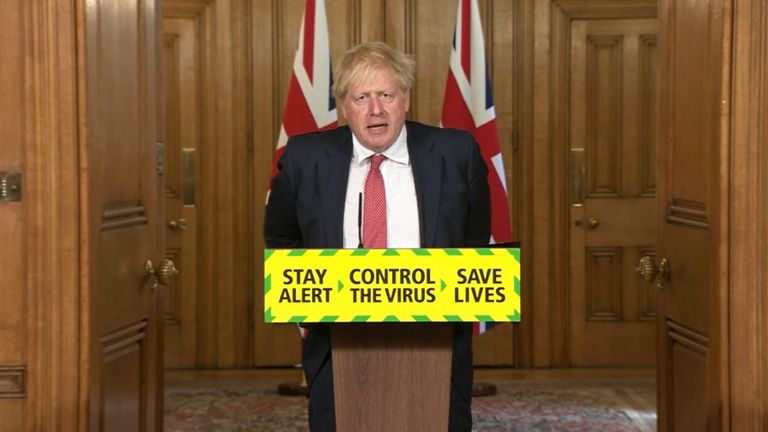
Image:Boris Johnson stressed that he must 'weigh the advice' he is given
He also laid out a commitment to ramp up testing to 500,000 a day by the end of October to boost the test and trace programme.
Advertisement
New powers for councils to impose local lockdowns were announced as well - an acknowledgement that the battle with this virus is far from over.
But even as the prime minister said all this, he pressed on with a further easing of restrictions in a bid to kickstart the economy.
More from Covid-19
Mr Johnson changed the guidance on working from home to encourage employers to send workers back into offices.
There were also plans to open bowling alleys, casinos, and skating rinks from August, and sports stadiums and conference centres from October.
Social distancing could perhaps be scrapped from November.
Warning of a possible second wave while simultaneously releasing some measures, this encapsulated the difficult balancing act he faces in trying to manage a public health crisis while rescuing the economy.
Mr Johnson acknowledged that some would think his plan was "too optimistic" and the "risks too great" as he sought to reassure the public he'd put on the brakes if necessary.
It was perhaps no coincidence that Sir Patrick Vallance, the chief scientific adviser (CSA), and Professor Chris Whitty, the chief medical officer (CMO), did not flank the prime minister for this particular set of announcements.
Could they have really endorsed a road map out of lockdown that goes against some of the public recommendations they, themselves, have made around working from home (Sir Patrick) and social distancing rules (Professor Whitty).
I understand at the cabinet meeting convened on Friday morning to sign off the announcement, Professor Whitty stressed the high level of risk that came with this plan, and that ministers needed to go into it with eyes wide open.
But he also accepted this was a decision for ministers to make.
This was a message echoed by the prime minister on Friday.
When I asked the PM whether his advisers had made themselves scarce from the news conference because they believed his plan 'too optimistic' and the 'risks too high', Mr Johnson said "no".
But he also signalled the growing divergence between the scientific advice and policy decisions.
"I must stress that the CSA and CMO give us advice which we of course take very, very seriously, but in the end decisions are taken by the elected politicians.
"We have to weigh the advice we get and I don't think our wonderful scientific and medical advisers would want to take those decisions for us; those are decisions for us to take."
This is the tension laid bare. His scientific advisers are squarely focused on trying to control the virus and prevent a second spike.
The prime minister wants to avoid that too, but he also has to balance that risk with the other very pressing problem - the prospect of a deep and prolonged recession.
If he can give consumers confidence that the situation is improving and they should get back into shops, bars and the office, he might be able to give the economy a desperately needed short-term boost.
At the peak of the crisis, the prime minister liked to say his government was "led by the science".
In more recent weeks, he's said he was "guided by it".
Now, he is considering it in the round as the acute public health crisis gives way to an economic one.
When it comes to this new chapter in the PM's recovery plan, ministers and scientific advisers are clearly not on the same page.
But Mr Johnson is determined to make hay while the sun is shining and boost the economy now before the long winter comes.
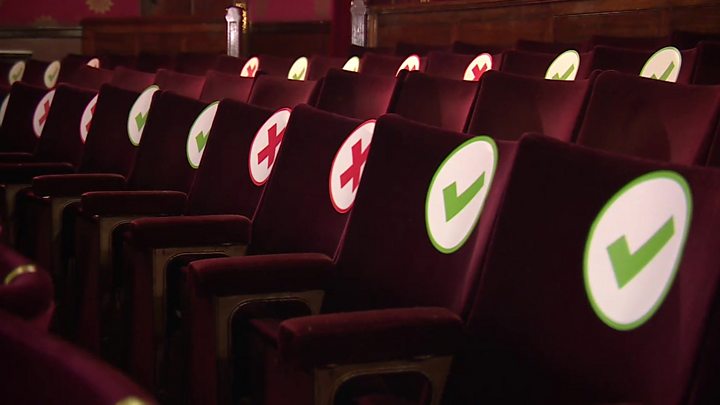
Indoor performances with socially distanced audiences can take place in England from the start of August, the prime minister has said.
The government is working with the sector on pilots of performances with socially distanced audiences in theatres and music venues.
Boris Johnson said the findings would feed into final guidance for venues in the run-up to them reopening.
But the head of Theatres Trust said the move "will not be economically viable".
Although Jon Morgan, director of Theatres Trust welcomed the news as "a step in the right direction", he said that "for most theatres it will not be economically viable to reopen with 30-40% audience required under social distancing".
He said they needed to progress to theatres being allowed to open fully "with the appropriate safety measures", adding: "Without this most theatres cannot reopen viably and we need the go-ahead for Christmas shows, on which the survival of many theatres depends, in the next few weeks at the very latest."
The government stressed that "audiences, performers and venues will be expected to maintain social distancing at all times."
Media playback is unsupported on your device
It added: "This guidance will be for organisations in England. Organisations in Scotland, Wales and Northern Ireland should adhere to the advice of the devolved administrations at all times."
Venues have been shut since March as part of the lockdown due to the coronavirus pandemic.
The Department for Digital, Culture, Media and Sport added it was now working with venues including the London Symphony Orchestra on measures for reopening.
However it added that singing and the playing of brass and wind instruments in groups or in front of an audience is "still currently limited to professionals only".
The announcement is likely to be welcomed by theatre owners and producers, but a sense of frustration with the government is likely to remain.
It makes no financial sense for many venues to open with social distancing rules in place; theatre budgets tend to be based on a breakeven of around 70% capacity.
If social distancing measures mean a theatre can only run at 20-25% capacity, the producer cannot afford to put the show on.
What the industry says it desperately needs from the government is some clear guidance on when stage five (fuller audiences indoors) of the phased return will be possible.
The call is for the government to announce a "not before" date, which would allow producers and theatre owners to make a plan of action for the coming months, be that preparing a show or reducing overheads.
The Society of London Theatre, which represents venues in London's West End, said it was "delighted" by what it called "another welcome step on the road map towards reopening with full audiences".
Yet it said it would not be "practical or economically viable" for many shows to open with social distancing restrictions.
"We welcome the news that theatres & performance venues can reopen with social distancing in August, but the reality is the vast majority will not be opening," tweeted actors' union Equity.
Choreographer Sir Matthew Bourne also expressed doubts about theatres' ability to open with social distancing in place.
"Why make these announcements when they know that the vast majority of theatre, dance and music is not financially viable under 'Covid secure' conditions?" he tweeted.
The UK's media and entertainment union Bectu said the news was "a significant development" but that venues would need government support if they are to reopen.
"We know that theatres and venues will not be open in two weeks' time," said its head Philippa Childs. "Theatres will have to bring back productions, sell tickets, conduct rehearsals and prepare for how they will operate in a Covid-secure way before they can open up again.
"This announcement brings into sharp focus the need for urgent answers to the pressing questions that we have been asking since the arts recovery package was announced nearly two weeks ago."
Earlier this month the government announced a £1.57bn support package, following several weeks of lobbying from theatres, music venues, art galleries and other cultural institutions, many of which had said they were on the brink of collapse.
The government has also now outlined measures to "support the safe return of audiences", including:
Reduced venue capacity and limited ticket sales to ensure social distancing can be maintained
Tickets should be bought online and venues encouraged to use e-tickets to reduce contact and help with track and trace
Venues should have clearly communicated social distancing marking in place in areas where queues form and adopt a limited entry approach
Increased deep cleaning of auditoriums
Performances should be scheduled to allow sufficient time to undertake deep cleaning before the next audience arrives
Performers, conductors and musicians must observe social distancing wherever possible
Culture Secretary Oliver Dowden said: "The UK's performing arts sector is renowned across the world and I am pleased that we are making real progress in getting its doors reopened to the public with social distancing."
This latest announcement will now see venues move to stage four of the government's "five-stage roadmap for the return of professional performing arts", which was recently outlined by Mr Dowden as follows:
Stage One - Rehearsal and training (no audiences and adhering to social distancing guidelines)
Stage Two - Performances for broadcast and recording purposes (adhering to social distancing guidelines)
Stage Three - Performances outdoors with an audience plus pilots for indoor performances with a limited distance audience
Stage Four - Performances allowed indoors/outdoors (but with a limited distanced audience indoors)
Stage Five - Performances allowed indoors/outdoors (with a fuller audience indoors)
Even as the government was preparing to unveil its latest measures, however, more venues announced they were having to consider staff redundancies.
And in Edinburgh, the Traverse Theatre said it had made the "painfully difficult decision to enter into redundancy consultation" with "a number" of its team.
In a statement, the venue said it was likely that "almost a third" of its staff "in customer-facing and technical roles" would lose their jobs.
Prof Carl Heneghan from University of Oxford, who spotted the issue with the data, told the BBC there was "huge variation" in the numbers of daily deaths reported in England by PHE.
While NHS England currently reports 30-35 deaths per day, Public Health England (PHE) data often shows double that or more, he said.
The reason is that anyone who has tested positive for coronavirus but then died at a later date of another cause would still be included in PHE's Covid-19 death figures.
"By this PHE definition, no one with Covid in England is allowed to ever recover from their illness," Prof Heneghan says.
"We need correct and accurate statistics so we can really understand the trend - otherwise it's very difficult to know what's going on," he added.
Figures release from PHE today show that just under 10% of coronavirus deaths in England happened more than 28 days after a positive test.
In almost half of those cases, Covid-19 was recorded as the main cause of death.
What does this mean for England's virus death toll?
This could explain why the daily death toll in England has remained higher than in other UK nations.
Scotland, Northern Ireland and Wales only include deaths in their daily count if someone died within 28 days of a positive test.
But it doesn't mean that most of England's coronavirus deaths are counting errors.
Statisticians say it's better to look at death registrations that pick up coronavirus cases that were never confirmed by a lab test.
And when you look at those figures, or deaths from all causes, England still has one of the highest deaths tolls in Europe and leading developed economies in the pandemic, to date.
Dr Susan Hopkins, from Public Health England, said there was no agreed method of counting deaths from Covid-19.
"In England, we count all those that have died who had a positive Covid-19 test at any point, to ensure our data is as complete as possible.
"We must remember that this is a new and emerging infection and there is increasing evidence of long-term health problems for some of those affected."
"Now is the right time to review how deaths are calculated," Dr Hopkins said.
Prof David Spiegelhalter, professor of the public understanding of risk at the University of Cambridge, has called for the same systems for collecting data on deaths to be used across the UK.
There are also concerns over the impact on a potential second wave.
"As we go into the winter, it will get incredibly confusing and concerning if you have an increase in deaths while you are still counting and combining deaths from within the first phase," Prof Heneghan said.
"This means we might be unable to detect early trends in rising deaths if we put them down to historical deaths due to the inadequacies of the current system."