Senin, 13 Juli 2020

Coronavirus: Face coverings in England's shops to be compulsory from 24 July - BBC News

Wearing a face covering in shops and supermarkets in England is to become mandatory from 24 July.

Those who fail to comply with the new rules will face a fine of up to £100, the government is to announce.

The move will bring England into line with Scotland and other major European nations like Spain, Italy and Germany.

Since mid-May, the public have been advised to wear coverings in enclosed public spaces, where they may encounter people they would not usually meet.

It has been compulsory on public transport since 15 June.

Health Secretary Matt Hancock is expected to set out the new guidance on face coverings on Tuesday.

They are designed to minimise the spread of coronavirus and also encourage people to return to the shops safely.

The announcement follows confusion about the government's intentions in recent days, with a senior minister suggesting on Sunday that people should use their "common sense" rather than being compelled to cover up.

Labour said ministers' response had been "slow and muddled" and questioned why the new rules would not come into force for 11 days.

Penalties

The rules will be enforced by the police, with anyone disregarding them at risk of a fine of up to £100. This will be reduced to £50 if people pay within 14 days.

While shop workers will be encouraged to prompt customers to comply, they will not be expected to enforce the rules, allaying unions' concerns about their involvement.

In line with the rules on public transport, children under 11 and those with certain disabilities will be exempt.

In Scotland, the use of coverings in shops has been mandatory since 10 July. Shoppers in Wales and Northern Ireland are not currently required to wear them, although both nations have said this will be kept under review.

Boris Johnson signalled a shift in the government's position on Friday when he spoke of the need for a stricter approach in confined settings and was pictured wearing a mask in a shop in his Uxbridge constituency.

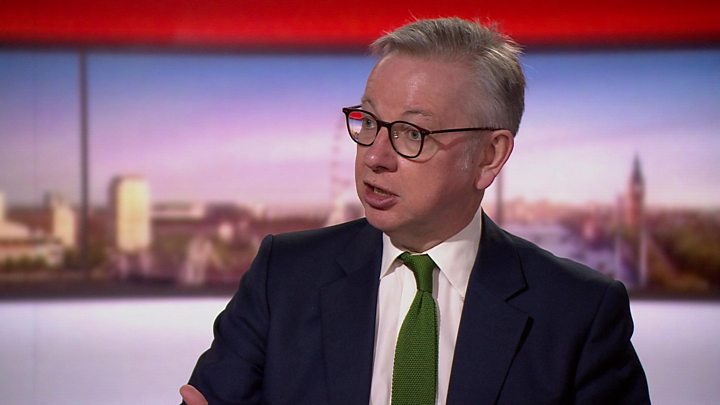
But in a BBC interview on Sunday, Cabinet Office minister Michael Gove downplayed the suggestion of any immediate legal change, saying he believed it should merely be a matter of "courtesy and good manners" to cover up.

Asked whether it should become mandatory, he replied "I don't think so, no".

'Slow and muddled'

Labour said the mixed messages were symptomatic of the government's indecision during the pandemic, and ministers had to explain the "further delay".

"The government has been slow and muddled again," said shadow health secretary Jonathan Ashworth.

"Given the government's own guidance issued on 11 May advised in favour of face masks, many will ask why yet again have ministers been slow in making a decision in this pandemic, and why it'll take another 11 days before these new guidelines to come into force."
Media playback is unsupported on your device

A No 10 spokesperson said: "There is growing evidence that wearing a face covering in an enclosed space helps protect individuals and those around them from coronavirus.

"The prime minister has been clear that people should be wearing face coverings in shops and we will make this mandatory from July 24."

Unions have said the new guidance must be "clear and detailed" to protect staff and customers.

While welcoming clarity over the issue, Usdaw said coverings could not be a substitute for strict hygiene controls and social distancing measures, such as limiting the number of people allowed in a store at any one time.

Downing Street said it would keep the guidance on face coverings in other settings, such as offices, under review.

The London Chambers of Commerce said the move would "hopefully bring much needed reassurance to consumers and boost London footfall".

Face coverings have been compulsory in shops in Germany since the end of April and in Italy since 4 May. Similar rules came into force in Spain on 21 May and in Belgium on 11 July.

But they are not mandatory in France, where it is up to retailers to decide whether customers should wear them.

What do I need to know about the coronavirus?

Let's block ads! (Why?)


https://news.google.com/__i/rss/rd/articles/CBMiL2h0dHBzOi8vd3d3LmJiYy5jby51ay9uZXdzL3VrLXBvbGl0aWNzLTUzMzk3NjE30gEzaHR0cHM6Ly93d3cuYmJjLmNvLnVrL25ld3MvYW1wL3VrLXBvbGl0aWNzLTUzMzk3NjE3?oc=5

2020-07-14 00:47:46Z
52780916535881

Coronavirus: Face coverings in England's shops to be compulsory from 24 July - BBC News

Wearing a face covering in shops and supermarkets in England is to become mandatory from 24 July.

Those who fail to comply with the new rules will face a fine of up to £100, the government is to announce.

The move will bring England into line with Scotland and other major European nations like Spain, Italy and Germany.

Since mid-May, the public have been advised to wear coverings in enclosed public spaces, where they may encounter people they would not usually meet.

It has been compulsory on public transport since 15 June.

Health Secretary Matt Hancock is expected to set out the new guidance on face coverings on Tuesday.

They are designed to minimise the spread of coronavirus and also encourage people to return to the shops safely.

The announcement follows confusion about the government's intentions in recent days, with a senior minister suggesting on Sunday that people should use their "common sense" rather than being compelled to cover up.

Labour said ministers' response had been "slow and muddled" and questioned why the new rules would not come into force for 11 days.

Penalties

The rules will be enforced by the police, with anyone disregarding them at risk of a fine of up to £100. This will be reduced to £50 if people pay within 14 days.

While shop workers will be encouraged to prompt customers to comply, they will not be expected to enforce the rules, allaying unions' concerns about their involvement.

In line with the rules on public transport, children under 11 and those with certain disabilities will be exempt.

In Scotland, the use of coverings in shops has been mandatory since 10 July. Shoppers in Wales and Northern Ireland are not currently required to wear them, although both nations have said this will be kept under review.

Boris Johnson signalled a shift in the government's position on Friday when he spoke of the need for a stricter approach in confined settings and was pictured wearing a mask in a shop in his Uxbridge constituency.

But in a BBC interview on Sunday, Cabinet Office minister Michael Gove downplayed the suggestion of any immediate legal change, saying he believed it should merely be a matter of "courtesy and good manners" to cover up.

Asked whether it should become mandatory, he replied "I don't think so, no".

'Slow and muddled'

Labour said the mixed messages were symptomatic of the government's indecision during the pandemic, and ministers had to explain the "further delay".

"The government has been slow and muddled again," said shadow health secretary Jonathan Ashworth.

"Given the government's own guidance issued on 11 May advised in favour of face masks, many will ask why yet again have ministers been slow in making a decision in this pandemic, and why it'll take another 11 days before these new guidelines to come into force."

Media playback is unsupported on your device

A No 10 spokesperson said: "There is growing evidence that wearing a face covering in an enclosed space helps protect individuals and those around them from coronavirus.

"The prime minister has been clear that people should be wearing face coverings in shops and we will make this mandatory from July 24."

Unions have said the new guidance must be "clear and detailed" to protect staff and customers.

While welcoming clarity over the issue, Usdaw said coverings could not be a substitute for strict hygiene controls and social distancing measures, such as limiting the number of people allowed in a store at any one time.

Downing Street said it would keep the guidance on face coverings in other settings, such as offices, under review.

The London Chambers of Commerce said the move would "hopefully bring much needed reassurance to consumers and boost London footfall".

Face coverings have been compulsory in shops in Germany since the end of April and in Italy since 4 May. Similar rules came into force in Spain on 21 May and in Belgium on 11 July.

But they are not mandatory in France, where it is up to retailers to decide whether customers should wear them.

What do I need to know about the coronavirus?

Let's block ads! (Why?)


https://news.google.com/__i/rss/rd/articles/CBMiL2h0dHBzOi8vd3d3LmJiYy5jby51ay9uZXdzL3VrLXBvbGl0aWNzLTUzMzk3NjE30gEzaHR0cHM6Ly93d3cuYmJjLmNvLnVrL25ld3MvYW1wL3VrLXBvbGl0aWNzLTUzMzk3NjE3?oc=5

2020-07-14 00:26:14Z
52780916535881

British business faces £7bn red tape bill under Brexit border plan - Financial Times

British companies trading with Europe will have to absorb a post-Brexit bureaucracy burden and fill in an extra 215m customs declarations at a cost of about £7bn a year, according to government officials.

The scale of the additional red tape involved in future trade with the EU was confirmed as cabinet office minister Michael Gove laid out the government’s plans to manage the UK’s borders in a 206-page document that included the admission: “Customs declarations are complicated.”

Mr Gove has not disputed industry estimates that some 50,000 new private sector customs agents will have to be hired by business to deal with formalities at the UK-EU border — regardless of whether the two sides reach a trade deal.

The cabinet minister was speaking on the day the government launched an upbeat advertising campaign to prepare the country for the end of the Brexit transition deal on January 1, under the strapline: “UK’s new start — let’s get going”.

In spite of business concerns that new IT, customs experts and lorry parks will not be ready by the end of the year, Mr Gove and prime minister Boris Johnson insisted that the “Project Fear” warnings of anti-Brexit campaigners would turn out to be ill-founded.

Mr Johnson claimed that the Covid-19 crisis had put the costs associated with Brexit “very much into perspective”.

Michael Gove: his report admits that ‘customs declarations are complicated’ © AFP via Getty Images

But while Mr Gove told MPs that Brexit would allow Britain to set its own immigration policy and strike trade deals around the world, for businesses trading with Europe and for individuals travelling abroad for work or leisure Brexit will throw up new hurdles.

Officials confirmed that the government’s most recent estimates — first published by HM Revenue & Customs in December 2018 — were that there would be an extra 215m customs declaration forms for businesses importing or exporting goods. 

That would apply regardless of whether Britain and the EU conclude a trade deal this year with the aim of removing all tariffs and quotas. Only a fraction of the estimated 50,000 extra agents needed to handle the new customs forms have so far been recruited.

Jon Thompson, former head of HMRC, in 2018 estimated that the cost of each declaration could be £32.50, but cited a range from £20 up to a possible £55.

The estimated 215m import and export declarations made by British traders would be mirrored by the same process by counterparties in the EU, meaning some 430m forms would have to be completed in total; that will add considerably to the cost of trade across a currently open border.

Mr Gove announced £705m of extra spending for new infrastructure, jobs and technology, and the border with the EU and confirmed plans to build lorry inspection sites away from congested ports such as Dover. Officials estimate that up to a dozen may be needed.

Rachel Reeves, shadow cabinet office minister, said the extra bureaucracy was “staggering”. Last week Liz Truss, international trade secretary, raised concerns with ministerial colleagues about the delay in preparing the new border.

Julian Smith, former chief whip, said it was “deeply problematic and worrying” that the government was imposing additional costs on businesses that were already struggling with coronavirus.

Richard Burnett, head of the Road Haulage Association, warned of a serious shortage of customs agents and expressed concern about a proposed new “Smart Freight” app, that lorry drivers will have to complete in advance before travelling to ports in Kent.

Hauliers have been promised it will be ready by the end of the year, but Mr Burnett said: “That’s not that much use to say it’s ready by the end of the year. We need to be able to ‘touch, feel and train people on the functionality for it to be working from Jan 1.” 

Meanwhile Dominic Goudie, head of international trade for the Food and Drink Federation, said the requirement that all fish imports and exports must have full documentation by January 1 could “hit consumers quite quickly” given that 75 per cent of UK-caught fish is exported to the EU, and about a third of fish consumed in the UK is imported from the EU.

Meanwhile, MPs criticised the government for leaving business in the dark over new customs arrangements that must operate from January between Northern Ireland and Great Britain. 

With business increasingly concerned about the lack of detail from the government, the House of Commons Northern Ireland affairs select committee called on ministers to set out exactly how the new regime will operate by October 1. 

“The government may be able to wait until the wire for clarity on customs arrangements, but business cannot,” said Simon Hoare, committee chair. “Those trading across the Irish sea have been told to prepare without knowing what to prepare for. It’s now time for them to get that clarity,” 

The Brexit withdrawal treaty keeps Northern Ireland in the UK customs territory. But the region must adhere to EU customs and single market rules to avoid a hard border with the Irish republic.

The UK government must clarify what new administrative requirements traders will face and reimburse business for any new costs incurred, said the committee.

“The situation is now urgent, and the continued lack of detail risks Northern Ireland not being prepared for the new trading arrangements, an outcome which would have significant economic consequences,” it added. 

Let's block ads! (Why?)


https://news.google.com/__i/rss/rd/articles/CBMiP2h0dHBzOi8vd3d3LmZ0LmNvbS9jb250ZW50L2ZiYzZmMTkxLTZkNjktNGRjYi1iMzc0LTBmYTZlNDhhOWExZdIBP2h0dHBzOi8vYW1wLmZ0LmNvbS9jb250ZW50L2ZiYzZmMTkxLTZkNjktNGRjYi1iMzc0LTBmYTZlNDhhOWExZQ?oc=5

2020-07-13 23:05:00Z
52780915083610

Coronavirus: Face coverings in England's shops to be compulsory from 24 July - BBC News

Wearing a face covering in shops and supermarkets in England is to become mandatory from 24 July.

Those who fail to comply with the new rules will face a fine of up to £100, the government is to announce.

The move will bring England into line with Scotland and other major European nations like Spain, Italy and Germany.

Since mid-May, the public have been advised to wear coverings in enclosed public spaces, where they may encounter people they would not usually meet.

It has been compulsory on public transport since 15 June.

Health Secretary Matt Hancock is expected to set out the new guidance on face coverings on Tuesday.

They are designed to minimise the spread of coronavirus and also encourage people to return to the shops safely.

The announcement follows confusion about the government's intentions in recent days, with a senior minister suggesting on Sunday that people should use their "common sense" rather than being compelled to cover up.

Labour said ministers' response had been "slow and muddled" and questioned why the new rules would not come into force for 11 days.

Penalties

The rules will be enforced by the police, with anyone disregarding them at risk of a fine of up to £100. This will be reduced to £50 if people pay within 14 days.

While shop workers will be encouraged to prompt customers to comply, they will not be expected to enforce the rules, allaying unions' concerns about their involvement.

In line with the rules on public transport, children under 11 and those with certain disabilities will be exempt.

In Scotland, the use of coverings in shops has been mandatory since 10 July. Shoppers in Wales and Northern Ireland are not currently required to wear them, although both nations have said this will be kept under review.

Boris Johnson signalled a shift in the government's position on Friday when he spoke of the need for a stricter approach in confined settings and was pictured wearing a mask in a shop in his Uxbridge constituency.

But in a BBC interview on Sunday, Cabinet Office minister Michael Gove downplayed the suggestion of any immediate legal change, saying he believed it should merely be a matter of "courtesy and good manners" to cover up.

Asked whether it should become mandatory, he replied "I don't think so, no".

'Slow and muddled'

Labour said the mixed messages were symptomatic of the government's indecision during the pandemic, and ministers had to explain the "further delay".

"The government has been slow and muddled again," said shadow health secretary Jonathan Ashworth.

"Given the government's own guidance issued on 11 May advised in favour of face masks, many will ask why yet again have ministers been slow in making a decision in this pandemic, and why it'll take another 11 days before these new guidelines to come into force."

Media playback is unsupported on your device

A No 10 spokesperson said: "There is growing evidence that wearing a face covering in an enclosed space helps protect individuals and those around them from coronavirus.

"The prime minister has been clear that people should be wearing face coverings in shops and we will make this mandatory from July 24."

Unions have said the new guidance must be "clear and detailed" to protect staff and customers.

While welcoming clarity over the issue, Usdaw said coverings could not be a substitute for strict hygiene controls and social distancing measures, such as limiting the number of people allowed in a store at any one time.

Downing Street said it would keep the guidance on face coverings in other settings, such as offices, under review.

The London Chambers of Commerce said the move would "hopefully bring much needed reassurance to consumers and boost London footfall".

Face coverings have been compulsory in shops in Germany since the end of April and in Italy since 4 May. Similar rules came into force in Spain on 21 May and in Belgium on 11 July.

But they are not mandatory in France, where it is up to retailers to decide whether customers should wear them.

What do I need to know about the coronavirus?

Let's block ads! (Why?)


https://news.google.com/__i/rss/rd/articles/CBMiL2h0dHBzOi8vd3d3LmJiYy5jby51ay9uZXdzL3VrLXBvbGl0aWNzLTUzMzk3NjE30gEzaHR0cHM6Ly93d3cuYmJjLmNvLnVrL25ld3MvYW1wL3VrLXBvbGl0aWNzLTUzMzk3NjE3?oc=5

2020-07-13 23:48:11Z
52780916535881

Coronavirus: Face coverings in England's shops to be compulsory from 24 July - BBC News

Wearing a face covering in shops and supermarkets in England is to become mandatory from 24 July.

Those who fail to comply with the new rules will face a fine of up to £100, the government is to announce.

The move will bring England into line with Scotland and other major European nations like Spain, Italy and Germany.

Since mid-May, the public have been advised to wear coverings in enclosed public spaces, where they may encounter people they would not usually meet.

It has been compulsory on public transport since 15 June.

Health Secretary Matt Hancock is expected to set out the new guidance on face coverings on Tuesday.

They are designed to minimise the spread of coronavirus and also encourage people to return to the shops safely.

The announcement follows confusion about the government's intentions in recent days, with a senior minister suggesting on Sunday that people should use their "common sense" rather than being compelled to cover up.

Labour said ministers' response had been "slow and muddled" and questioned why the new rules would not come into force for 11 days.

Penalties

The rules will be enforced by the police, with anyone disregarding them at risk of a fine of up to £100. This will be reduced to £50 if people pay within 14 days.

While shop workers will be encouraged to prompt customers to comply, they will not be expected to enforce the rules, allaying unions' concerns about their involvement.

In line with the rules on public transport, children under 11 and those with certain disabilities will be exempt.

In Scotland, the use of coverings in shops has been mandatory since 10 July. Shoppers in Wales and Northern Ireland are not currently required to wear them, although both nations have said this will be kept under review.

Boris Johnson signalled a shift in the government's position on Friday when he spoke of the need for a stricter approach in confined settings and was pictured wearing a mask in a shop in his Uxbridge constituency.

But in a BBC interview on Sunday, Cabinet Office minister Michael Gove downplayed the suggestion of any immediate legal change, saying he believed it should merely be a matter of "courtesy and good manners" to cover up.

Asked whether it should become mandatory, he replied "I don't think so, no".

'Slow and muddled'

Labour said the mixed messages were symptomatic of the government's indecision during the pandemic, and ministers had to explain the "further delay".

"The government has been slow and muddled again," said shadow health secretary Jonathan Ashworth.

"Given the government's own guidance issued on 11 May advised in favour of face masks, many will ask why yet again have ministers been slow in making a decision in this pandemic, and why it'll take another 11 days before these new guidelines to come into force."

Media playback is unsupported on your device

A No 10 spokesperson said: "There is growing evidence that wearing a face covering in an enclosed space helps protect individuals and those around them from coronavirus.

"The prime minister has been clear that people should be wearing face coverings in shops and we will make this mandatory from July 24."

Unions have said the new guidance must be "clear and detailed" to protect staff and customers.

While welcoming clarity over the issue, Usdaw said coverings could not be a substitute for strict hygiene controls and social distancing measures, such as limiting the number of people allowed in a store at any one time.

Downing Street said it would keep the guidance on face coverings in other settings, such as offices, under review.

The London Chambers of Commerce said the move would "hopefully bring much needed reassurance to consumers and boost London footfall".

Face coverings have been compulsory in shops in Germany since the end of April and in Italy since 4 May. Similar rules came into force in Spain on 21 May and in Belgium on 11 July.

But they are not mandatory in France, where it is up to retailers to decide whether customers should wear them.

What do I need to know about the coronavirus?

Let's block ads! (Why?)


https://news.google.com/__i/rss/rd/articles/CBMiL2h0dHBzOi8vd3d3LmJiYy5jby51ay9uZXdzL3VrLXBvbGl0aWNzLTUzMzk3NjE30gEzaHR0cHM6Ly93d3cuYmJjLmNvLnVrL25ld3MvYW1wL3VrLXBvbGl0aWNzLTUzMzk3NjE3?oc=5

2020-07-13 22:30:00Z
52780916535881

Coronavirus: Face coverings in England's shops to be compulsory from 24 July - BBC News

Wearing a face covering in shops and supermarkets in England is to become mandatory from 24 July.

Those who fail to comply with the new rules will face a fine of up to £100, the government is to announce.

The move will bring England into line with Scotland and other major European nations like Spain, Italy and Germany.

Since mid-May, the public have been advised to wear coverings in enclosed public spaces, where they may encounter people they would not usually meet.

It has been compulsory on public transport since 15 June.

The announcement follows confusion about the government's intentions in recent days, with a senior minister suggesting on Sunday that people should use their "common sense" rather than being compelled to cover up.

Labour said ministers' response had been "slow and muddled" and questioned why the new rules would not come into force for 11 days.

Health Secretary Matt Hancock is expected to set out the new guidance on face coverings on Tuesday. They are designed to minimise the spread of coronavirus and also encourage people to return to the shops safely.

Penalties

The rules will be enforced by the police, with anyone disregarding them at risk of a fine of up to £100. This will be reduced to £50 if people pay within 14 days.

While shop workers will be encouraged to prompt customers to comply, they will not be expected to enforce the rules, allaying unions' concerns about their involvement.

In line with the rules on public transport, children under 11 and those with certain disabilities will be exempt.

In Scotland, the use of coverings in shops has been mandatory since 10 July. Shoppers in Wales and Northern Ireland are not currently required to wear them although both nations have said this will be kept under review.

Boris Johnson signalled a shift in the government's position on Friday when he spoke of the need for a stricter approach in confined settings and was pictured wearing a mask in a shop in his Uxbridge constituency.

But in a BBC interview on Sunday, Cabinet Office minister Michael Gove downplayed any immediate legal change, saying he believed it should merely be a matter of "courtesy and good manners" to cover up.

Asked whether it should become mandatory, he replied "I don't think so no".

'Slow and muddled'

Labour said the mixed messages were symptomatic of the government's indecision during the pandemic and ministers had to explain the "further delay".

"The government has been slow and muddled again," said shadow health secretary Jonathan Ashworth.

"Given the government's own guidance issued on 11 May advised in favour of face masks, many will ask why yet again have ministers been slow in making a decision in this pandemic, and why it'll take another 11 days before these new guidelines to come into force."

Media playback is unsupported on your device

A No 10 spokesperson said: "There is growing evidence that wearing a face covering in an enclosed space helps protect individuals and those around them from coronavirus.

"The prime minister has been clear that people should be wearing face coverings in shops and we will make this mandatory from July 24."

Unions have said the new guidance must be "clear and detailed" to protect staff and customers.

While welcoming clarity over the issue, Usdaw said coverings could not be a substitute for proper hygiene controls and people continuing to follow social distancing guidelines.

The British Retail Consortium said it would have been wrong to put hard-working staff, already suffering abuse, "in harm's way" by asking them to enforce the rules and clarity was needed on whether they too must cover up.

Face coverings have been compulsory in shops in Germany since the end of April and in Italy since 4 May. Similar rules came into force in Spain on 21 May and in Belgium on 11 July.

But they are not mandatory in France, where it is up to retailers to decide whether customers should wear them.

What do I need to know about the coronavirus?

Let's block ads! (Why?)


https://news.google.com/__i/rss/rd/articles/CBMiL2h0dHBzOi8vd3d3LmJiYy5jby51ay9uZXdzL3VrLXBvbGl0aWNzLTUzMzk3NjE30gEzaHR0cHM6Ly93d3cuYmJjLmNvLnVrL25ld3MvYW1wL3VrLXBvbGl0aWNzLTUzMzk3NjE3?oc=5

2020-07-13 21:32:32Z
52780916535881

British business faces £7bn red tape bill under Brexit border plan - Financial Times

British companies trading with Europe will have to absorb a post-Brexit bureaucracy burden and fill in an extra 215m customs declarations at a cost of about £7bn a year, according to government officials.

The scale of the additional red tape involved in future trade with the EU was confirmed as cabinet office minister Michael Gove laid out the government’s plans to manage the UK’s borders in a 206-page document that included the admission: “Customs declarations are complicated.”

Mr Gove has not disputed industry estimates that some 50,000 new private sector customs agents will have to be hired by business to deal with formalities at the UK-EU border — regardless of whether the two sides reach a trade deal.

The cabinet minister was speaking on the day the government launched an upbeat advertising campaign to prepare the country for the end of the Brexit transition deal on January 1, under the strapline: “UK’s new start — let’s get going”.

In spite of business concerns that new IT, customs experts and lorry parks will not be ready by the end of the year, Mr Gove and prime minister Boris Johnson insisted that the “Project Fear” warnings of anti-Brexit campaigners would turn out to be ill-founded.

Mr Johnson claimed that the Covid-19 crisis had put the costs associated with Brexit “very much into perspective”.

Michael Gove: his report admits that ‘customs declarations are complicated’ © AFP via Getty Images

But while Mr Gove told MPs that Brexit would allow Britain to set its own immigration policy and strike trade deals around the world, for businesses trading with Europe and for individuals travelling abroad for work or leisure Brexit will throw up new hurdles.

Officials confirmed that the government’s most recent estimates — first published by HM Revenue & Customs in December 2018 — were that there would be an extra 215m customs declaration forms for businesses importing or exporting goods. 

That would apply regardless of whether Britain and the EU conclude a trade deal this year with the aim of removing all tariffs and quotas. Only a fraction of the estimated 50,000 extra agents needed to handle the new customs forms have so far been recruited.

Jon Thompson, former head of HMRC, in 2018 estimated that the cost of each declaration could be £32.50, but cited a range from £20 up to a possible £55.

The estimated 215m import and export declarations made by British traders would be mirrored by the same process by counterparties in the EU, meaning some 430m forms would have to be completed in total; that will add considerably to the cost of trade across a currently open border.

Mr Gove announced £705m of extra spending for new infrastructure, jobs and technology, and the border with the EU and confirmed plans to build lorry inspection sites away from congested ports such as Dover. Officials estimate that up to a dozen may be needed.

Rachel Reeves, shadow cabinet office minister, said the extra bureaucracy was “staggering”. Last week Liz Truss, international trade secretary, raised concerns with ministerial colleagues about the delay in preparing the new border.

Julian Smith, former chief whip, said it was “deeply problematic and worrying” that the government was imposing additional costs on businesses that were already struggling with coronavirus.

Richard Burnett, head of the Road Haulage Association, warned of a serious shortage of customs agents and expressed concern about a proposed new “Smart Freight” app, that lorry drivers will have to complete in advance before travelling to ports in Kent.

Hauliers have been promised it will be ready by the end of the year, but Mr Burnett said: “That’s not that much use to say it’s ready by the end of the year. We need to be able to ‘touch, feel and train people on the functionality for it to be working from Jan 1.” 

Meanwhile Dominic Goudie, head of international trade for the Food and Drink Federation, said the requirement that all fish imports and exports must have full documentation by January 1 could “hit consumers quite quickly” given that 75 per cent of UK-caught fish is exported to the EU, and about a third of fish consumed in the UK is imported from the EU.

Let's block ads! (Why?)


https://news.google.com/__i/rss/rd/articles/CBMiP2h0dHBzOi8vd3d3LmZ0LmNvbS9jb250ZW50L2ZiYzZmMTkxLTZkNjktNGRjYi1iMzc0LTBmYTZlNDhhOWExZdIBP2h0dHBzOi8vYW1wLmZ0LmNvbS9jb250ZW50L2ZiYzZmMTkxLTZkNjktNGRjYi1iMzc0LTBmYTZlNDhhOWExZQ?oc=5

2020-07-13 18:46:00Z
52780915083610