The decision to reduce the alert level followed a recommendation by the Joint Biosecurity Centre, the chief medical officers for England, Scotland, Wales and Northern Ireland said.
'Pandemic not over'
"There has been a steady decrease in cases we have seen in all four nations, and this continues," the medical officers said in a joint statement.
But they warned it "does not mean that the pandemic is over" and that "localised outbreaks are likely to occur".
"We have made progress against the virus thanks to the efforts of the public and we need the public to continue to follow the guidelines carefully to ensure this progress continues," they said.
There are five coronavirus alert levels in total.
Two factors determine the UK's alert level. They are:
Covid-19's reproduction (R) number, a scientific measure of how fast the virus is spreading
The number of confirmed coronavirus cases at any one time
Mr Hancock said recent progress in both factors showed "a real testament to the British people's determination to beat this virus".
"Infection rates are rapidly falling, we have protected the NHS and, thanks to the hard work of millions in our health and social care services, we are getting the country back on her feet," he added.
The move comes weeks after some restrictions were first eased in each UK nation.
At the end of May, Prime Minister Boris Johnson told MPs that "we're coming down the Covid alert system from level four to level three tomorrow, we hope, we're going to be taking a decision tomorrow".
But the next day, the government decided instead not to lower the alert level and it remained at four until now.
Step one, the first easing of lockdown, involved allowing people to take unlimited exercise and spend more time outdoors.
Step two permitted the gradual opening of schools and non-essential retail, which is the current situation.
The third step in government's published plan, which it said was to take place "no earlier than 4 July", includes opening further non-essential services like hairdressers and beauty salons, restaurants, pubs and leisure facilities.
The UK's coronavirus alert level has been downgraded from four to three, the country's chief medical officers said.
Under level three, the virus is considered to be "in general circulation" and there could be a "gradual relaxation of restrictions".
Previously transmission was considered to be "high or rising exponentially".
Health Secretary Matt Hancock said the change was "a big moment for the country" and showed that the government's plan was working.
The decision to reduce the alert level followed a recommendation by the Joint Biosecurity Centre, the chief medical officers for England, Scotland, Wales and Northern Ireland said.
'Pandemic not over'
"There has been a steady decrease in cases we have seen in all four nations, and this continues," the medical officers said in a joint statement.
But they warned it "does not mean that the pandemic is over" and that "localised outbreaks are likely to occur".
"We have made progress against the virus thanks to the efforts of the public and we need the public to continue to follow the guidelines carefully to ensure this progress continues," they said.
There are five coronavirus alert levels in total.
Two factors determine the UK's alert level. They are:
Covid-19's reproduction (R) number, a scientific measure of how fast the virus is spreading
The number of confirmed coronavirus cases at any one time
The move comes weeks after some restrictions were first eased in each UK nation.
At the end of May, Prime Minister Boris Johnson told MPs that "we're coming down the Covid alert system from level four to level three tomorrow, we hope, we're going to be taking a decision tomorrow".
But the next day, the government decided instead not to lower the alert level and it remained at four until now.
A day after President Emmanuel Macron and Boris Johnson’s cordial meeting in London, France’s Europe minister has suggested the UK had more to lose from a no deal than the bloc. Amelie de Montchalin added there are still a chance both sides could fail to reach an agreement before the transition period expires at the end of the year. "I am not ruling out anything,” she said.
She added: “Those who need a deal the most are the British. They cannot withstand a second shock after the epidemic.
“They will not have access to the safety net that is Europe, nor to the recovery plan.”
Ms Montchalin lashed out at the Government’s decision not to extend the post-Brexit transition, insisting France would not compromise under pressure.
She said: “We will not give in to this pressure of the calendar, to this final sprint that the British want to impose on us, hoping that we will yield.”
“We want to protect our businesses, our fishermen, our farmers,” she added.
“What we want is a balanced relationship.”
Mr Johnson yesterday welcomed Mr Macron to London to mark the 80th anniversary of Charles De Gaulle’s historic radio broadcast from the capital to rally the French Resistance.
During their meeting, the Prime Minister warned that Brexit talks cannot drag on into the autumn.
He said it “does not make sense” to keep extending talks on a new trading relationship with the EU beyond the summer.
The British and Brussels negotiating teams have agreed to accelerate the talks in July in the hope of making a breakthrough.
A Downing Street spokeswoman said: “The Prime Minister welcomed the agreement to intensify talks in July and underlined that the UK does not believe it makes sense for there to be prolonged negotiations into the autumn."
Mr Macron told Mr Johnson that France is still supporting his efforts to strike a Brexit deal, according to an Elysee source.
“France reminded its commitment to a deal and its support of Michel Barnier,” the source said.
European Council President Charles Michel today debriefed EU leaders on his recent high-level talks with Mr Johnson.
During a video conference on Monday, also attended by European Commission chief Ursula von der Leyen, they agreed to intensify negotiations.
The two sides also promised to be flexible in reaching a political understanding next month that could be used to pave the way towards a trade deal.
Japan is the latest nation with which the UK has come to the table, and the Department for International Trade last month drew up a mammoth 96-page policy paper setting out why this is a good idea.
What’s more, the government thinks a deal could be secured before the year is out.
But Bill Emmott, chairman of the Japan Society of the UK and former editor-in-chief of The Economist, has a more cautious view – starting with this ambitious date of completion.
He toldExpress.co.uk: “There is zero chance of a UK-Japan trade deal until the EU-UK trade arrangements have been agreed.
“Japanese companies have in the past treated the UK as a gateway to Europe, as well as buying a lot of components from EU suppliers for their UK operations, so they have to treat the UK and EU markets as being essentially connected.”
Whether this intricate relationship with the EU – as far as Japan is concerned – will throw a spanner in the works remains to be seen.
Whether a Japan trade deal happens this year could depend on EU negotiations. (Image: Martin Bureau / AFP / Getty)
Clearly, it depends on how UK-EU trade negotiations go, but as things stand Brexit trade deal talks have been essentially at an impasse for months, with competition rules – or a ‘level playing field’ – a key sticking point.
Emmott suggests that it would be frustrating for the UK’s financial services sector if the Japan deal were to be in any way affected by Brexit, since this industry stands to make important gains.
But it’s also worth considering what exactly Japan would want as part of its terms. In other words, what can the UK offer that Japan needs or wants? And, conversely, what can the UK promise to buy the Japanese exporters would like to sell?
As far as Emmott is concerned, the EU already plugs a lot of Japan’s gaps.
Agriculture is one UK industry Emmott said may be of interest to Japan. (Image: Scott Barbour / Getty)
“For Japanese exporters, the EU is a much bigger and more important market than the UK. So the EU-Japan FTA (“Economic Partnership Arrangement”) that was agreed last year is their model,” he explained.
“For the UK, there could be some gains in agri-food exports, because Japan’s food market is quite closed so a direct negotiation may make it possible to secure access for particular meats or cheeses, for example, and perhaps English wine too.
“But this is small. I can’t see much chance of gains in automotive exports to Japan either, given that Japan is one of the world’s biggest and most competitive auto producers. Here, Japan will be aiming to maintain the access to the UK market that they currently enjoy.”
In any case, the government has said that the “free flow of data” is one area in which it hopes to make some progress in a free trade deal with Japan, which could mean support for the field of AI.
Japanese Prime Minister Shinzo Abe (middle) and Donald Tusk (L) sign an agreement in 2018. (Image: Martin Bureau / AFP / Getty)
One company that is hoping to benefit from this more liberal flow of data is NTT Data, a global IT services business with a significant presence in the UK.
Simon Williams, CEO of the firm, explained in a statement why this would be the case.
“The data mobility elements of the free trade agreement discussions are of particular importance as they will provide for the free flow of ideas and innovation between Japan and the UK.
“This ensures we are able to best utilise NTT Data’s R&D efforts in Japan for our work with UK industries.”
We asked NTT Data what it is about the UK’s current data mobility relationship with Japan that prohibits such innovation at the moment, but they were unable to comment.
In any case, the negotiations come at an opportune time for the firm; NTT Data last year announced a £68 million investment into its UK operations, including a new London ‘innovation centre’ plus expanded presence in Scotland and Birmingham.
Another area of interest for some is air travel. This is obviously relevant at the moment given the international travel restrictions in place amid the Covid-19 pandemic, and American Express Global Business Travel (GBT) explained the importance of this in relation to the FTA.
The travel management firm is understood to be working with the government currently, lobbying and advising on ways in which it can open up ‘travel corridors’.
International Trade Secretary Liz Truss kicked off Japan negotiations on June 9. (Image: Wiktor Szymanowicz / Barcroft Media / Getty)
The firm’s idea is that trips booked through travel management companies could be made exempt from the UK’s 14-day quarantine rule, and Martin Ferguson, head of public affairs, explained why.
“Business travel is the engine room of the UK economy. It is responsible for generating £220 billion of GDP while helping businesses grow, creating jobs and generating tax receipts. As an island we need international travel and air lift if we are to prosper.
“Japan is already an important trade partner for the UK. We saw business traffic across the finance, technology, manufacturing and professional service sectors increase by 10 percent in 2019.”
Related articles
And creative industries is also a sector that the government claims will benefit. TMF, a film and publicity company looking to help Japanese media producers and animation studios build their presence in the UK, could be one set to benefit from this latter aspect.
Xander Ross, head of TV and Entertainment at Percy and Warren Media Consultants on behalf of TMF, toldExpress.co.uk: “Japan is renowned for having brilliant, unique, and incredibly high quality productions across film, TV and animation.
“Likewise, having the chance to showcase the best of British content to the Japanese market offers the chance for our production industry to further enhance its position as truly world leading in entertainment.”
A £1bn fund to help England's children catch up on what they have missed while schools have been closed has been announced by the prime minister.
The most disadvantaged pupils will have access to tutors through a £350m programme over the next academic year.
Primary and secondary schools will be given a further £650m to spend on one-to-one or group tuition for any pupils they think need it.
Head teachers welcomed the funds, but said more details were needed.
Boris Johnson said the fund would help head teachers provide what pupils need.
He thanked teachers, childcare workers and support staff for their efforts during the pandemic, and said he was "determined to do everything" he could to get all children back in school from September.
"We will bring forward plans on how this will happen as soon as possible," he said.
However, early years providers and colleges for 16- to 19-year-olds are not included in the plans.
Nor was there any mention of summer schemes to help pupils get back on track for the start of the autumn term.
Education Secretary Gavin Williamson said the funding package would bring reform and protect "a generation of children from the effects of this pandemic".
Schools were shut across the UK on 20 March. Apart from the children of key workers, most children have not been to school since then and will not enter a classroom until after the summer holidays.
Children in nursery, Reception, Year 1 and Year 6 have begun returning to primary schools in England, and some Year 10 and 12 pupils returned to secondary schools and colleges this week.
Schools in Wales are reopening at the end of June, with only a third of pupils in class at any time, while in Scotland, schools are preparing to reopen on 11 August.
Labour said ministers should convene a taskforce - involving trade unions and scientific and health experts - to help all pupils return to school safely as soon as possible.
Shadow education secretary Rebecca Long Bailey said the plans "lack detail and appear to be a tiny fraction of the support" needed and called for a "detailed national education plan to get children's education and health back on track".
Preserve of wealthy
Plans for the subsidised National Tutoring Programme have been developed with a group of social mobility organisations and academics led by the Education Endowment Fund (EEF), a charity.
The EEF has said that until now, access to tutoring has been the preserve of wealthy families - but this would no longer be the case as schools would be able to seek subsidised tutoring.
However, individual schools would be expected to pay 25% of the tutoring costs in the first year, or from their share of the £650m in extra funding being made available to them as part of this package.
"Tutoring is the catch-up approach supported by the strongest evidence," said the EEF's chief executive, Prof Becky Francis.
'Long-term response'
She called the move a tremendous opportunity to create a long-lasting change.
Association of School and College Leaders general secretary, Geoff Barton, welcomed the investment, saying it would help support the work schools are already undertaking on pupil catch-up.
But he noted that the investment was expected to be spent on tutoring, rather than being left to head teachers to decide.
He was also concerned that there was no investment for sixth forms.
"As ever, we suspect the devil will be in the detail and we await further information," he said.
David Hughes, chief executive of the Association of Colleges, said teenage college students deserved as much catch-up support as every other age group and it was "indefensible" to overlook them.
Bill Watkin, chief executive of the Sixth Form Colleges Association, said it would be "entirely unjustifiable" to exclude sixth form students from the package.
While Neil Leitch, chief executive of the Early Years Alliance, said the government's decision not to include pre-schoolers "beggars belief".
National Association of Head Teachers general secretary Paul Whiteman said he was pleased ministers had listened to calls for a longer term response, rather than short term quick fixes.
"This is a considerable sum of money," said Mr Whiteman - but he also warned there were many details still to be worked through.
Scotland has moved to the second phase of its four-phase "route map" aimed at ending the lockdown, allowing certain people to visit another home indoors without social distancing
The toxic combination of an unpopular leader, confused message on Brexit and a manifesto rejected as fantasy pushed Labour to its lowest point in almost a century in the December election.
Bringing back the smallest number of MPs since 1935, Labour has a mountain to climb to get back into power, according to a Labour Party review of the 2019 election defeat released on Friday.
Just to become the largest party in the UK requires a swing towards Labour on the scale of Tony Blair's 1997 Labour landslide. To win outright, Labour must increase its total number of seats by 60%, something no party has ever done before - more Everest than Ben Nevis.
Sir Keir Starmer: 'We can't go back to business as usual'
But the report also concluded that the defeat was not solely down to Jeremy Corbyn's leadership, manifesto and Brexit.
The 15-strong panel of commissioners, including former leader Ed Miliband and Manchester Central MP Lucy Powell concluded that this defeat had been a "long time coming" and could be traced back to two decades of demographic and political change that had fractured Labour's voter coalition.
Advertisement
"It was a historic defeat, but it was a long time coming," Ms Powell told Sky News in an interview about the 150-page report she helped to write.
"Along the way there were positive points - particularly in 2017 when we really did mobilise non-voters in a way we hadn't done before - but in many other working-class communities which have been de-industrialised, where political alienation has taken place where there is a real desire and thirst for change, the Labour Party has not been offering the kind of change that these voters and communities have wanted."
More from Jeremy Corbyn
The party lost all types of votes everywhere when compared with 2017, except in London. Labour lost 1.7 million Leave voters and one million Remain supporters. It also failed to win over swing voters and turned out fewer non-voters than in 2017.
The report also lays bare the shortcomings of the Corbyn operation going into the 2019 general election, concluding that the leadership lacked a clear strategy and a coherent message. The report also said there was a "toxic culture" in the party, spawned by years of infighting which resulted in "significant strategic and operational dysfunction".
April: What direction will Labour head in now?
However, the commission refused to lay all the blame for Labour's defeat on Mr Corbyn and Brexit, saying it "would be a mistake to believe that a different leader, with Brexit no longer a defining issue, would in itself be sufficient to change Labour's fortunes".
"Labour could have further to fall unless deep thinking is done to overcome the deep problems that have been growing for many years."
Ed Miliband, the former Labour leader, appealed to the party to "put aside the factionalism and division of years".
"We owe it to the people whom we represent to look outwards to the country rather than inwards," Mr Miliband wrote in the Guardian.
But Mr Corbyn's leadership was a decisive factor in the disastrous 2019 defeat, according to the report, which found that the "Stop Jeremy Corbyn" message was a "major driver" of the Conservatives' success across all key groups, including non-voters and swing voters.
The report also concluded that Labour was beaten by the Tories in the digital war.
"Our organisation and campaigning is not fit for purpose: our methods still owe more to the 1990s than the 2020s," said Mr Miliband. "And while we prided ourselves on digital innovation in 2017, the Conservatives were miles ahead of us last year. A top-to-bottom transformation is required."
Some changes have already begun: Mr Corbyn has gone - as have many of this team - and Brexit is done. But the party has so much more to do to win back those lost working communities along the Red Wall while also trying to win back seats in Scotland: not since 1955 has the Labour Party formed a government with fewer than 40 seats in Scotland; they currently hold one.
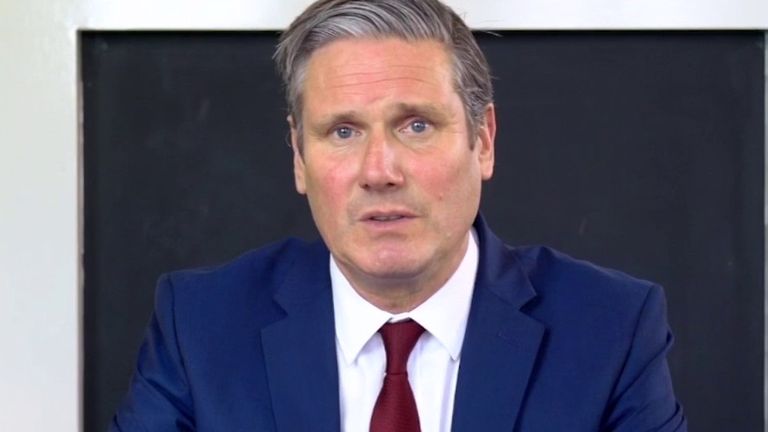
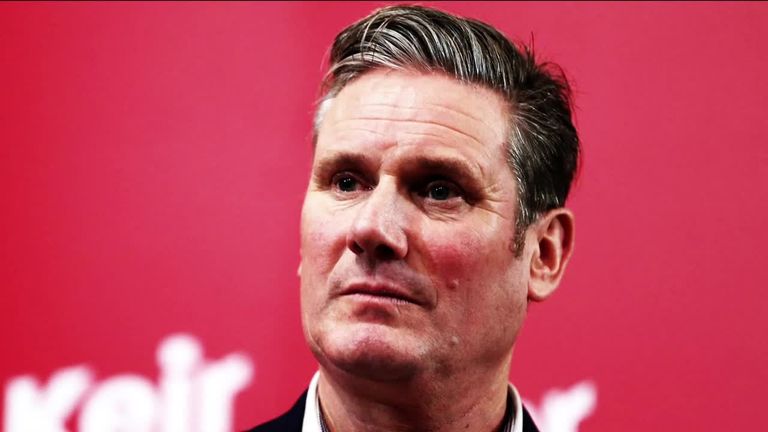
Sir Keir Starmer, who became leader in April, has so far avoided being drawn into the debate. He has instead focused on scrutinising the government's handling on the coronavirus pandemic, but surely the way to bring a divided Labour party, and his disparate, disillusioned voter base together is to sketch out a new economic settlement, a new social and economic plan.
The unanswerable question right now is the extent to which the coronavirus crisis will not just reshape our economy but our communities too.
Image:Boris Johnson's Conservatives won a convincing victory over the Labour Party in December
Richard Burgon, a key Corbyn ally and former shadow justice secretary, believes the divisions that characterised the past four years for Labour have been transformed by a public health crisis that will fundamentally shift the centre ground of politics further to the left.
"We basically, tragically, got smashed at the general election but going forward I think that coronavirus, and the economic crisis that I fear is on its way hot on the heels of coronavirus will mean that the Labour Party really needs to carry on putting forward radical innovative bold policy solutions," he told Sky News. "I think people's demand for practical policies that protect living standards will actually increase in the months and the years ahead."
Tony Blair's election victory of 1997 is the stuff of Labour history. Sir Keir will have to better it to win the keys to No 10.
That is a ballot box challenge that would surely seem impossible in normal times but these are not normal times. The coronavirus pandemic will force big economic change - and on this the commissioners of the report think they can build consensus across a very disparate group of Labour voters - be they lapsed or active.
It gives Sir Keir a mission that will not just rally his party - but just might rally those voters who have left Labour behind.