New rules requiring all people arriving in the UK to self-isolate for 14 days have come into effect.
Those arriving by plane, ferry or train - including UK nationals - will have to provide an address where they will self-isolate and face fines of up to £1,000 if they do not follow the rules.
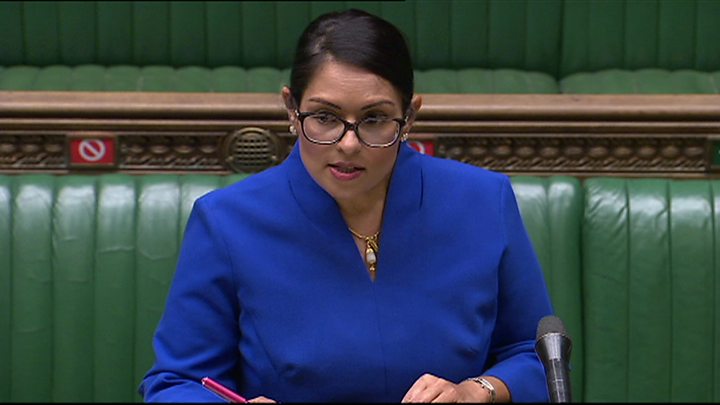
Home Secretary Priti Patel said the laws were designed "to prevent a second wave" of coronavirus.
But some industries have warned they will be severely impacted by the rules.
Anyone arriving from the Republic of Ireland, the Channel Islands or the Isle of Man does not have to complete the form or enter quarantine.
There are also exemptions for workers in some industries such as road haulage and medical professionals who are providing essential care.
All other travellers have to fill in a "public health passenger locator" form on arrival. Failure to do so could lead to a penalty of £100, or travellers may be refused entry.
If they are unable to provide an address, the government will arrange accommodation at the traveller's expense. There will also be checks to see whether the rules are being followed.
The government has faced criticism from the aviation industry and some Tory MPs over the measures, but Ms Patel said the measures were "proportionate" and being implemented "at the right time".
"The science is clear that if we limit the risk of new cases being brought in from abroad, we can help stop a devastating second wave," Ms Patel said.
Those arriving in England and Northern Ireland could face a fine of £1,000 if they fail to self-isolate for the full 14 days, while they face a £480 fine in Scotland. The maximum fine for repeat offenders in Scotland is £5,000. The enforcement rules in Wales are not clear.
People should drive their own car to their destination, where possible, and once at their destination they must not use public transport or taxis.
They must not go to work, school, or public areas, or have visitors - except for essential support.
Passengers in transit, who do not pass through border control, are also among the groups who are exempt from the mandatory isolation.
The travel industry has been vocal in its criticism of the government's quarantine rules, warning that the isolation period will deter visitors and put jobs at risk.
The manufacturing industry has also highlighted that fewer flights will restrict imports and exports, which will have a knock-on effect for the freight industry, as well as hampering the recovery of some businesses.
British Airways, EasyJet and Ryanair have written to Procurator General Sir Jonathan Jones, the government's most senior legal official - the first stage required when taking legal action against the government.
Travel trade body Abta has called on the government to urgently create a roadmap for restarting international travel, while the UK's biggest airport services company, Swissport, has warned it could deliver a "killer blow" to the tourism sector.
'Another blow to our industry'
Industry leaders wrote to Prime Minister Boris Johnson in May asking that the government avoid taking a "blanket approach" to quarantine, suggesting so-called "air bridges" with countries that have low coronavirus rates.
Aviation, maritime and rail industry leaders were invited to discuss the new quarantine plans but British Airways refused to attend the meeting, and aviation bosses told the BBC that they were not impressed by the content of the call.
Media playback is unsupported on your device
BBC transport correspondent Tom Burridge says relations between the government and Britain's aviation industry are now at "rock bottom".
BA, already under huge financial strain due to the pandemic, is proposing to make 12,000 staff redundant in order to stay afloat. Separately, Heathrow Airport's chief executive has warned that about 25,000 jobs could be at risk at Heathrow Airport.
Government sources have told the BBC that the UK is hoping to secure air bridge agreements with certain countries, such as Portugal, Spain and France, as well as Australia and Singapore.
But the government's position is that the idea is only "under consideration".
In other developments:
Dental practices in England can reopen as long as they have safety measures for staff and patients in place
Larger retailers in Northern Ireland and most shops in the Republic of Ireland are reopening as part of a series of lockdown changes
Prime Minister Boris Johnson has said anti-racism protests at the weekend were "subverted by thuggery" after some demonstrators clashed with police.
Mr Johnson said people had the right to protest but engaging in violence was a "betrayal" to the protesters' cause.
Thousands of people attended largely peaceful demonstrations in cities across the UK at the weekend.
But unrest in the capital on Sunday led to eight officers being injured and 12 people being arrested.
The Metropolitan Police's Superintendent Jo Edwards said following a "predominantly peaceful protest", officers were faced with further "scenes of violence and disorder" which were "entirely unacceptable".
The majority of the arrests in London were for public order offences and one for criminal damage.
Mr Johnson condemned the violence, posting on Twitter: "People have a right to protest peacefully & while observing social distancing but they have no right to attack the police. These demonstrations have been subverted by thuggery - and they are a betrayal of the cause they purport to serve. Those responsible will be held to account."
Thousands of protesters gathered on Saturday and Sunday in London, as well as cities across the UK including Bristol, Manchester, Wolverhampton, Nottingham, Glasgow and Edinburgh.
Protests were generally peaceful, with aerial footage showing thousands of demonstrators flooding the roads outside the US embassy in Vauxhall, south London, before marching towards Parliament Square and Downing Street.
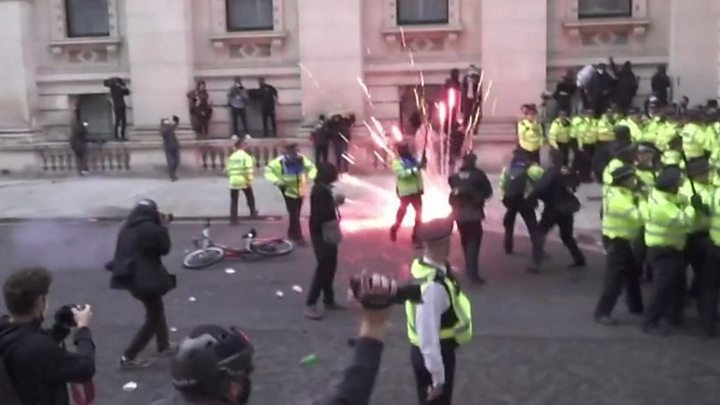
But there were some clashes with police, particularly in the capital.
A police officer received a head injury and a Section 35 dispersal order was issued on Sunday night until 06:00 on Monday.
As darkness fell, lines of police in riot gear took up positions to contain a small group of protesters in Westminster, the BBC's Tom Symonds said.
Bottles were thrown at officers and police issued a dispersal order for the City of Westminster, compelling people to leave the area.
And in Warwickshire, protesters caused the closure of the M6 for around an hour following on from the demonstrations in Coventry city centre.
Slave trader's statue torn down
On Sunday protesters in Bristol used ropes to pull down the bronze statue of Edward Colston, a prominent 17th Century slave trader, who has been a source of controversy in the city for many years - his legacy can still be seen on Bristol's streets, memorials and buildings.
After the statue was toppled, a protester was pictured with his knee on the figure's neck - reminiscent of the video showing George Floyd, the black man who died while being restrained by a Minnesota police officer.
The statue was later dragged through the streets of Bristol and thrown into the harbour. The empty plinth was used as a makeshift stage for protesters.
Elsewhere, in Parliament Square, the statue of Sir Winston Churchill was sprayed with graffiti, and a Black Lives Matter sign attached - an act described as "stupid and counterproductive" by foreign office minister James Cleverly.
Meanwhile, opposition MPs have criticised comments made by Health Secretary Matt Hancock that protests were fuelled by events in America "rather than here".
Shadow justice secretary David Lammy said that racism and prejudice exist in the UK, as well as across the Atlantic, and that to suggest there is only a problem in the US "shows real ignorance".
Mr Lammy tweeted: "People in this country are not only showing solidarity with George Floyd and other African Americans. We must turn this moment into one of change and justice in the UK too."
Prime Minister Boris Johnson has said anti-racism protests at the weekend were "subverted by thuggery" after some demonstrators clashed with police.
Mr Johnson said people had the right to protest but engaging in violence was a "betrayal" to protesters' cause.
Thousands of people attended largely peaceful demonstrations in cities across the UK at the weekend.
But unrest in the capital on Sunday led to eight officers being injured and 12 people being arrested.
The Metropolitan Police's Superintendent Jo Edwards said following a "predominantly peaceful protest", officers were faced with further "scenes of violence and disorder" which were "entirely unacceptable".
The majority of the arrests in London were for public order offences and one for criminal damage.
Mr Johnson condemned the violence, posting on Twitter: "People have a right to protest peacefully & while observing social distancing but they have no right to attack the police. These demonstrations have been subverted by thuggery - and they are a betrayal of the cause they purport to serve. Those responsible will be held to account."
Thousands of protesters gathered on Saturday and Sunday in London, as well as cities across the UK including Bristol, Manchester, Wolverhampton, Nottingham, Glasgow and Edinburgh.
Protests were generally peaceful, with aerial footage showing thousands of demonstrators flooding the roads outside the US embassy in Vauxhall, south London, before marching towards Parliament Square and Downing Street.
But there were some clashes with police, particularly in the capital.
A police officer received a head injury and a Section 35 dispersal order was issued on Sunday night until 06:00 on Monday.
As darkness fell, lines of police in riot gear took up positions to contain a small group of protesters in Westminster, the BBC's Tom Symonds said.
Bottles were thrown at officers and police issued a dispersal order for the City of Westminster, compelling people to leave the area.
And in Warwickshire, protesters caused the closure of the M6 for around an hour following on from the demonstrations in Coventry city centre.
Slave trader's statue torn down
On Sunday protesters in Bristol used ropes to pull down the bronze statue of Edward Colston, a prominent 17th Century slave trader, who has been a source of controversy in the city for many years - his legacy can still be seen on Bristol's streets, memorials and buildings.
After the statue was toppled, a protester was pictured with his knee on the figure's neck - reminiscent of the video showing George Floyd, the black man who died while being restrained by a Minnesota police officer.
The statue was later dragged through the streets of Bristol and thrown into the harbour. The empty plinth was used as a makeshift stage for protesters.
Elsewhere, in Parliament Square, the statue of Sir Winston Churchill was sprayed with graffiti, and a Black Lives Matter sign attached - an act described as "stupid and counterproductive" by foreign office minister James Cleverly.
Meanwhile, opposition MPs have criticised comments made by Health Secretary Matt Hancock that protests were fuelled by events in America "rather than here".
Shadow justice secretary David Lammy said that racism and prejudice exist in the UK, as well as across the Atlantic, and that to suggest there is only a problem in the US "shows real ignorance".
Mr Lammy tweeted: "People in this country are not only showing solidarity with George Floyd and other African Americans. We must turn this moment into one of change and justice in the UK too."
New rules requiring all people arriving in the UK to self-isolate for 14 days have come into effect.
Those arriving by plane, ferry or train - including UK nationals - will have to provide an address where they will self-isolate and face fines of up to £1,000 if they do not follow the rules.
Home Secretary Priti Patel said the laws are designed "to prevent a second wave" of coronavirus.
But some industries have warned they will be severely impacted by the rules.
Anyone arriving from the Republic of Ireland, the Channel Islands or the Isle of Man does not have to complete the form or enter quarantine.
There are also exemptions for workers in some industries such as road haulage and medical professionals who are providing essential care.
All other travellers have to fill in a "public health passenger locator" form on arrival. Failure to do so could lead to a penalty of £100, or travellers may be refused entry.
If they are unable to provide an address, the government will arrange accommodation at the traveller's expense. There will also be checks to see whether the rules are being followed.
The government has faced criticism from the aviation industry and some Tory MPs over the measures, but Ms Patel said the measures were "proportionate" and being implemented "at the right time".
"The science is clear that if we limit the risk of new cases being brought in from abroad, we can help stop a devastating second wave," Ms Patel said.
Those arriving in England and Northern Ireland could face a fine of £1,000 if they fail to self-isolate for the full 14 days, while they face a £480 fine in Scotland. The maximum fine for repeat offenders in Scotland is £5,000. The enforcement rules in Wales are not clear.
People should drive their own car to their destination, where possible, and once at their destination they must not use public transport or taxis.
They must not go to work, school, or public areas, or have visitors - except for essential support.
Passengers in transit, who do not pass through border control, are also among the groups who are exempt from the mandatory isolation.
The travel industry has been vocal in its criticism of the government's quarantine rules, warning that the isolation period will deter visitors and put jobs at risk.
The manufacturing industry has also highlighted that fewer flights will restrict imports and exports, which will have a knock-on effect for the freight industry, as well as hampering the recovery of some businesses.
British Airways, Easyjet and Ryanair have written to Procurator General Sir Jonathan Jones, the government's most senior legal official - the first stage required when taking legal action against the government.
Travel trade body Abta has called on the government to urgently create a roadmap for restarting international travel, while the UK's biggest airport services company, Swissport, has warned it could deliver a "killer blow" to the tourism sector.
'Another blow to our industry'
Industry leaders wrote to Prime Minister Boris Johnson in May asking that the government avoid taking a "blanket approach" to quarantine, suggesting so-called "air bridges" with countries that have low coronavirus rates.
Aviation, maritime and rail industry leaders were invited to discuss the new quarantine plans but British Airways refused to attend the meeting, and aviation bosses told the BBC that they were not impressed by the content of the call.
Media playback is unsupported on your device
BBC's transport correspondent Tom Burridge says relations between the government and Britain's aviation industry are now at "rock bottom".
BA, already under huge financial strain due to the pandemic, is proposing to make 12,000 staff redundant in order to stay afloat. Separately, Heathrow Airport's chief executive has warned that about 25,000 jobs could be at risk at Heathrow Airport.
Government sources have told the BBC that the UK is hoping to secure air bridge agreements with certain countries, such as Portugal, Spain and France, as well as Australia and Singapore.
But the government's position is that the idea is only "under consideration".
In other developments:
Dental practices in England can reopen as long as they have safety measures for staff and patients in place
Larger retailers in Northern Ireland and most shops in the Republic of Ireland are reopening as part of a series of lockdown changes
With each week that passes, the so-called "new normal" evolves again.
Today it's the introduction of 14-day quarantine at the border. Next week it's likely to be the reopening of shops that had been deemed non-essential.
But as each change is made or mooted, the debate over whether the government is moving too quickly, or not quickly enough, evolves with it.
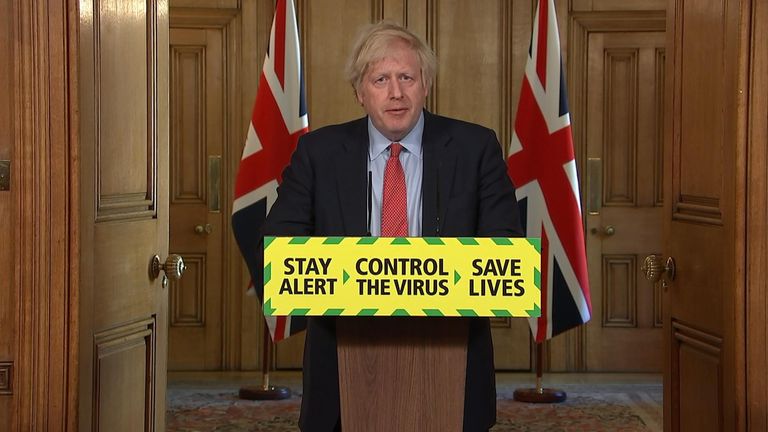
Boris Johnson announces an easing of restrictions
A few weeks ago the narrative was of Boris Johnson's apparent volte-face - the "hawk" prime minister who had been reluctant to impose a lockdown, transformed by his personal experience in hospital to become a "dove" convinced both of its efficacy and on-going necessity.
Now it appears to have changed again, with The Sunday Times reporting that the prospect of 3.5 million imminent job losses in the hospitality sector has prompted the Mr Johnson to order a faster lifting of restrictions on pubs and restaurants.
Advertisement
Asked by Sky's Sophy Ridge whether this account was accurate, the health secretary was insistent the government's approach was not being buffeted by a change of priorities.
"The plan and the strategy hasn't changed," Matt Hancock responded.
More from Covid-19
"We've got a clear plan and we're working through that plan... and of course, always, always doing that with safety front of mind, cautiously progressing."
But if the strategy has not changed, the context certainly has.
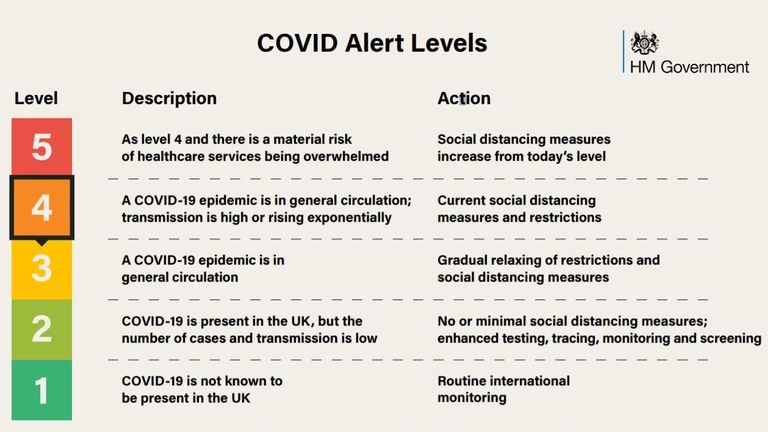
Image:The COVID alert system being used by the government
The government's critics have seized upon what they see as the gaps between what ministers had said would be required for measures to be relaxed, and the current reality.
Weeks ago an effective test and trace system, complimented by a dedicated NHSX tracking app, was presented as the means by which restrictions could be eased safely.
While the test and trace system has now been formally launched and "thousands" of people have been contacted, no data has yet been published to demonstrate whether it is working effectively.
Neither has any evidence been set out from the Isle of Wight pilot to explain why ministers judged that the scheme was ready for a national roll-out.
Then there's the issue of the coronavirus alert level.
In an address on 10 May, the prime minister suggested the shift from level four to three, set by the newly formed Joint Biosecurity Centre, would be at the heart of determining when relaxations were implemented.
"If the alert level won't allow it, we will simply wait and go on until we have got it right," Mr Johnson said.
Although ministers stress that the direction of travel is downward, for now the alert level remains at four - meaning the virus is still in general circulation and there is a high or rising level of transmission.
The government's defence for moving forward with the relaxations is that they have nonetheless satisfied the five tests previously set, which included ensuring the NHS would not be overwhelmed, and seeing a consistent fall in the number of deaths and new cases.
But in his interview on Sky News, Mr Hancock also acknowledged this was an example of a decision based not just on the specifics of the science, but the politics of the pandemic.
"They advise us and we as ministers, democratically elected, make the decisions. That's how it works and the level is clearly moving from four to three and the reason for that is because we can see that the number of new infections is coming down."
That response indicates that even if the government's strategy hasn't changed, the extent to which it is conditionally dependent on the scientists' advice clearly has.
It's the kind of shift which makes far more plausible the idea that the two-metre social distancing rule could be reduced in future, despite advice to the contrary from the government's scientific advisers.
Indeed if the headline statistics continue to show the rate of daily deaths, hospital admissions and new cases lowering, ministers may well become more confident in justifying the apparent evolution in their approach.
How should the UK economy be structured?
But that also means the gradual shift from the "new normal" to something more akin to the old has become far more dependent on the ministerial interpretation of the balance between public health and the economy.
The distinction between the decision-makers and the advisers has always existed, but it is now more pronounced than at any other point in this crisis, as is the degree of responsibility each will ultimately hold.
Prime Minister Boris Johnson has said anti-racism protests at the weekend were "subverted by thuggery" after some demonstrators clashed with police.
Mr Johnson said people had the right to protest but engaging in violence was a "betrayal" to protesters' cause.
Thousands of people attended largely peaceful demonstrations in cities across the UK at the weekend.
But unrest in the capital on Sunday led to eight officers being injured and 12 people being arrested.
The Metropolitan Police's Superintendent Jo Edwards said following a "predominantly peaceful protest", officers were faced with further "scenes of violence and disorder" which were "entirely unacceptable".
The majority of the arrests in London were for public order offences and one for criminal damage.
Mr Johnson condemned the violence, posting on Twitter: "People have a right to protest peacefully & while observing social distancing but they have no right to attack the police. These demonstrations have been subverted by thuggery - and they are a betrayal of the cause they purport to serve. Those responsible will be held to account."
Thousands of protesters gathered on Saturday and Sunday in London, as well as cities across the UK including Bristol, Manchester, Wolverhampton, Nottingham, Glasgow and Edinburgh.
Protests were generally peaceful, with aerial footage showing thousands of demonstrators flooding the roads outside the US embassy in Vauxhall, south London, before marching towards Parliament Square and Downing Street.
But there were some clashes with police, particularly in the capital.
A police officer received a head injury and a Section 35 dispersal order was issued on Sunday night until 06:00 on Monday.
As darkness fell, lines of police in riot gear took up positions to contain a small group of protesters in Westminster, the BBC's Tom Symonds said.
Bottles were thrown at officers and police issued a dispersal order for the City of Westminster, compelling people to leave the area.
And in Warwickshire, protesters caused the closure of the M6 for around an hour following on from the demonstrations in Coventry city centre.
Slave trader's statue torn down
On Sunday protesters in Bristol used ropes to pull down the bronze statue of Edward Colston, a prominent 17th Century slave trader, who has been a source of controversy in the city for many years - his legacy can still be seen on Bristol's streets, memorials and buildings.
After the statue was toppled, a protester was pictured with his knee on the figure's neck - reminiscent of the video showing George Floyd, the black man who died while being restrained by a Minnesota police officer.
The statue was later dragged through the streets of Bristol and thrown into the harbour. The empty plinth was used as a makeshift stage for protesters.
Elsewhere, in Parliament Square, the statue of Sir Winston Churchill was sprayed with graffiti, and a Black Lives Matter sign attached - an act described as "stupid and counterproductive" by foreign office minister James Cleverly.
Meanwhile, opposition MPs have criticised comments made by Health Secretary Matt Hancock that protests were fuelled by events in America "rather than here".
Shadow justice secretary David Lammy said that racism and prejudice exist in the UK, as well as across the Atlantic, and that to suggest there is only a problem in the US "shows real ignorance".
Mr Lammy tweeted: "People in this country are not only showing solidarity with George Floyd and other African Americans. We must turn this moment into one of change and justice in the UK too."