Transport for London (TfL) has secured £1.6bn in emergency funding to keep Tube and bus services running until September.
Under the bailout's terms, London mayor Sadiq Khan is expected to restore a full Underground service as soon as possible.
He is also understood to have offered a 1% above-inflation fare rise in future.
Mr Khan had urged the government to provide support or risk TfL running out of money.
BBC London Political Editor Tim Donovan said other measures agreed include:
Placing Stay Alert advertising on the transport network
Reporting staff absenteeism rates to civil servants
A longer-term review of TfL finances.
The BBC has been told a £500m loan agreed with the Department for Transport forms part of the total.
Speaking at Thursday's Downing Street press briefing before the deal was announced, Transport Secretary Grant Shapps said he was "optimistic" of finding a solution.
"We don't know what the long-term will be.
"But in the short-term trains and buses will continue to run."
TfL had said it would have been forced to issue a Section 114 notice - the equivalent of a public body going bust - if no deal had been reached.
It costs £600m a month to keep the network running on its current reduced service.
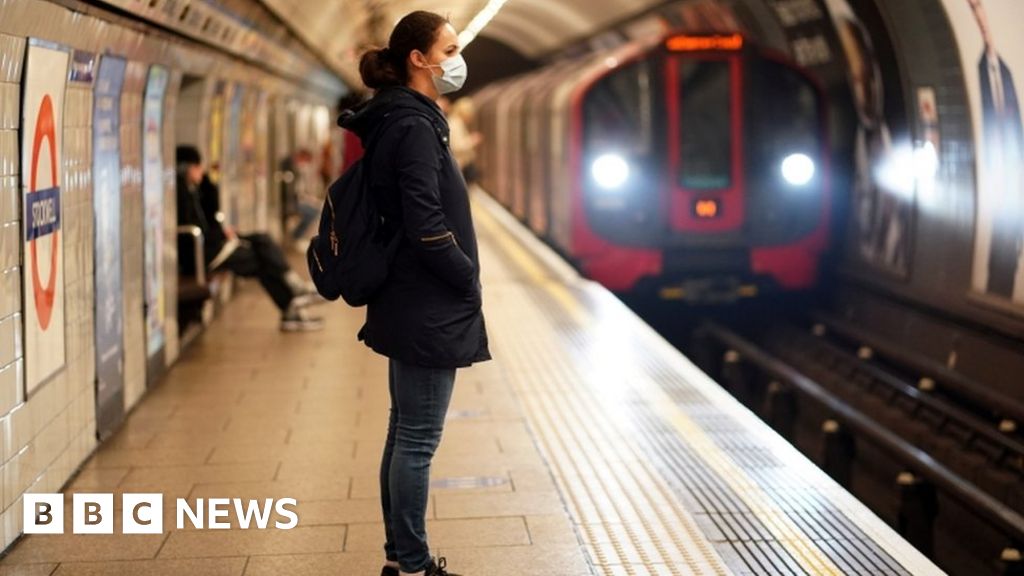
The lockdown has led to a 95% cut in people using the Tube compared to this time last year.
The number of bus passengers has also dropped, by 85%, and customers no longer have to tap-in to pay for rides as part of measures to protect drivers.
Most TfL services are still running, but 7,000 staff - about 25% of the workforce - have been furloughed to cut costs.
Transport Secretary Grant Shapps said the package includes safer measures for drivers, cyclists and pedestrians (Picture: Downing Street/PA)
The Government has announced a £2 billion upgrade to Britain’s roads and railways to take pressure off the public transport system as more return to work.
Speaking during the daily No 10 press briefing, Transport Secretary Grant Shapps said the quiet roads and railways during lockdown have allowed workers to carry out the ‘upgrade programme’ without severely disrupting services.
Mr Shapps added the nation has a ‘civic duty’ to avoid public transport if possible, so it doesn’t become significantly overwhelmed’ as the economy is ‘carefully and cautiously’ restarted. Distancing on public transport will be near impossible, he said, with space for only one in 10 to practice it, he added.
He added that projects which would normally take years have been completed in just weeks and it’s now time to question why the ‘bureaucratic bindweed makes British infrastructure some of the costliest and slowest in Europe to build’.
He said: ‘To make sure Britain is ready to bounce back from Coronavirus, I can announce £2 billion for our roads and railways, to put our transport infrastructure in the best possible shape and to get our economy growing once again.
‘This package includes £17 billion for local roads making journeys smoother and safer for drivers, hauliers, motorcyclists, cyclists, pedestrians and others.
‘By filling millions of dangerous potholes we can make our roads safer and encourage more people to cycle, or even take part in the upcoming E scooter trials, helping more people play our part in relieving public pressure on public transport.’
Mr Shapps said the investment will also help to repair damages from winter flooding, along with repairing bridges and roads across the country.
A network of rapid charging stations for electric cars will also be built, along with an expansion of such facilities at motorway service stations ‘to lock in the dramatic air quality improvements we have experienced during the coronavirus lockdown’.
More rapid charging stations for electric cars will be built (Picture: Shutterstock/Dani Berszt)
The Government has set a target for every motorway service area in England to have a minimum of six ultra-rapid electric vehicle charge points by 2023, with some larger sites having up to a dozen.
These would allow drivers to recharge their cars in around 15 minutes, which is three times quicker than normal.
Mr Shapps said it’s time to ‘exploit’ our new found capacity to respond at pace and apply it to rapidly improve infrastructure.
Advertisement
Advertisement
He said the country has rapidly completed major projects such as building new hospitals and moving public services online, adding: ‘We want to maintain this momentum’.
‘If building a new hospital takes 2 weeks, why should building a new road still take as long as 20 years?’ he questioned. ‘If GP surgeries move online, why are most rail passengers travelling on cardboard tickets?’
Opposition MPs have criticised the Government for ‘papering over the cracks’ (Picture: Reuters)
However, Labour’s Shadow Transport Secretary, Jim McMahon MP, said it was ‘extremely worrying’ that ministers are ‘papering over the cracks’ at the 11th hour to protect Transport for London in the short term.
He said: ‘Rather than patting themselves on the back about road and rail upgrades, ministers need to focus on the chaos on public transport especially on the tube, a mess of their own making.
‘It was right that action was taken in relation to the privately operated bus and rail network,’ he said. ‘The Government must do the same for publicly-owned transport providers, which need long term secure funding for what could be a lengthy period for which they won’t be able to operate at full capacity.’
Mr McMahon said the country needs a ‘comprehensive transport plan’, which includes giving local transport services the funding they need.
Only one in 10 people will be able to practice social distancing on public transport (Picture: Reuters)
He added: ‘Simply saying things will be different on our trains and buses is not a plan for the future.’
The first stage of the plan will be a £250 million package of swift emergency interventions to make cycling and walking safer. That will include pop-up bike lanes, wider pavements and cycle and bus only streets.
In addition, the government will publish fast track statutory guidance requiring councils in England to cater for significantly increased numbers of cyclists and pedestrians, ‘making it easier for them to create safer streets’.
One in 400 people in England has coronavirus, tests suggest - BBC News
Let us know you agree to cookies
We use cookies to give you the best online experience. Please let us know if you agree to all of these cookies.
Image copyright
Getty Images
One in 400 people in England is infected with coronavirus, a survey of 11,000 people in households suggests.
They were asked to carry out swab tests over the two weeks up to 10 May.
This indicates about 148,000 people in England could be currently infected - 0.27% of the population.
The figures could help ministers estimate the transmission rate of the virus, or
R number
, and whether tracking contacts of infected people is feasible or not.
The pilot study of 5,000 households gives a snapshot estimate of how many people could be infected with the virus at a given point in time, with or without symptoms.
It is set to expand over time to test 25,000 people for the virus in private households across all four UK nations.
The households tested in this survey did not include hospital patients or people living in care homes, where rates of Covid-19 are likely to be much higher,
Office for National Statistics figures show
.
Just 33 of the 11,000 people - in 30 households - tested positive in this snapshot survey.
Health or care workers in those households were several times more likely to be infected than workers in other sectors.
'Good news for me, but not enough to race out of lockdown'
This figure suggests my personal chances of getting the virus are quite low at the moment.
It may not be surprising to the experts who have been modelling the data, but to those whose expectations have probably been set by the grim succession of headlines about record numbers of deaths and ever increasing numbers of infections, it might feel surprisingly small.
Remember, the best estimates are that millions have people have had the coronavirus. This study tells us about who has it right now - and so can pass it on.
This estimate of one in 400 people, outside of hospitals and care homes, means that I'm unlikely to meet someone with the virus on a bus, but a tube train probably has a few infected people if there's standing room only.
The figure also underlines the challenge for the government in trying to move out of lockdown.
Testing, contact tracing and isolation is currently our only tool other than social distancing to slow the spread of the virus.
But one in 400 people in a country the size of England translates to 150,000 people.
Imagine trying to trace the contacts of all the infected people in England. And of course, the survey estimates that there are 150,000 infected people out there - but it doesn't tell us who they are.
At the start of March, I had a tight chest and a sore throat.
Nothing to worry about, in the normal run of things - but, boy, did I worry. Was this COVID-19? Was I spreading it? Should I self-isolate?
After the symptoms disappeared, my worry turned to hope. Had I contracted the best kind of coronavirus, the extremely mild kind? Had I won the lottery and acquired immunity at no cost?
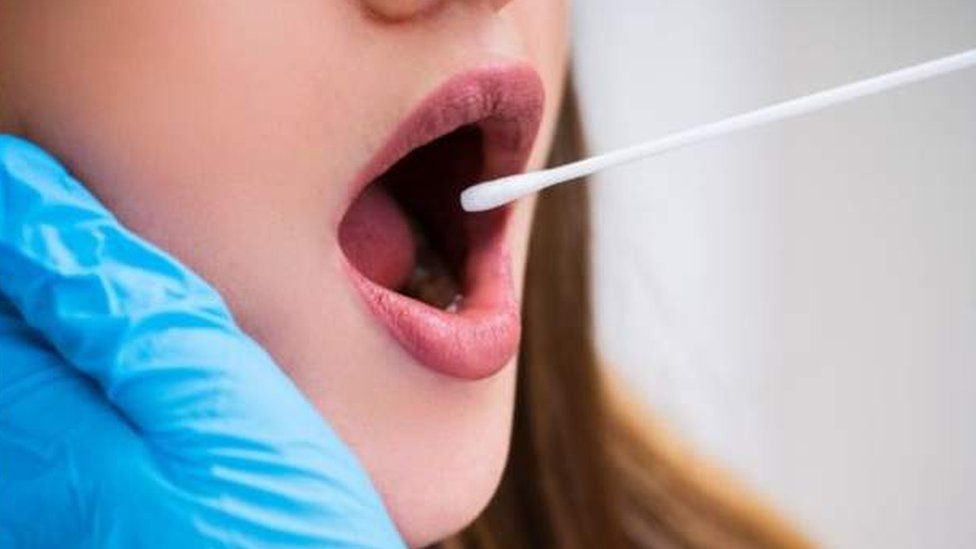
Image:The test is more reliable when done in a laboratory
Since the start of the outbreak, I've spoken to dozens of people who have had similar thoughts, sometimes in the most unlikely circumstances.
My mum is pretty sure she caught it from my sister's partner in late December, at a time when the first cases were emerging in China.
Advertisement
A taxi driver told me he thought he'd had it in July last year.
"Are you sure?" I said.
More from Covid-19
"Absolutely," he replied.
Until recently, these speculations were impossible to check. An infection will leave antibodies that can be detected by a test, but getting an accurate version of those tests has not been easy.
In March, the New York Times reported that the government paid £16m for two million antibody tests from China, only to find out they didn't work.
But those tests were meant to be done at home, making them "as simple as a pregnancy test", as the prime minister put it in March.
Tests done in a lab are much more reliable.
Public Health England has approved an antibody test made by the pharmaceutical company Roche, which it says can reliably pick up whether people have contracted the virus.
Private laboratories are offering similar tests.
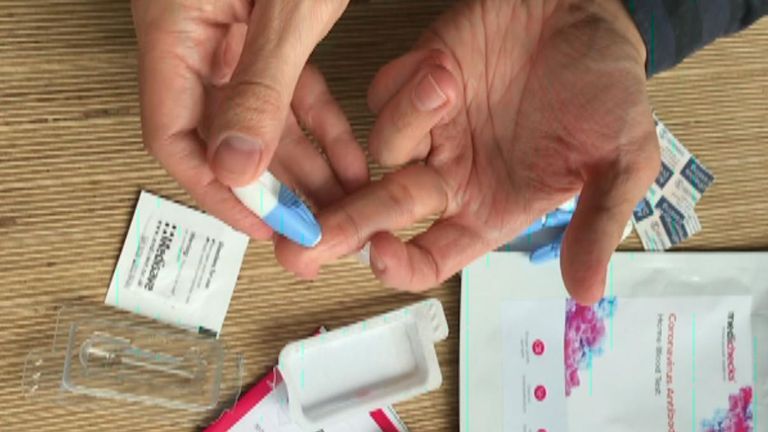
Image:A finger prick is needed to complete the test
Although these aren't approved, they promise high levels of accuracy.
Medichecks, a healthcare testing company in Nottingham, offers lab-based antibody tests at a cost of £90, which it says score very highly on the key measures of accuracy, specificity and sensitivity.
That means they only pick up people who have genuinely had COVID-19, as opposed to another illness, and can detect even mild symptoms.
"If the test is taken 17 days after the onset of symptoms, the latest research I've seen from the University of Washington suggests that it's 100% accurate," says Dr Sam Rodgers, medical director of Medichecks.
However, he stresses that "this is a field that's changing incredibly quickly".
With this guarantee in mind, I decided to see what it was like.
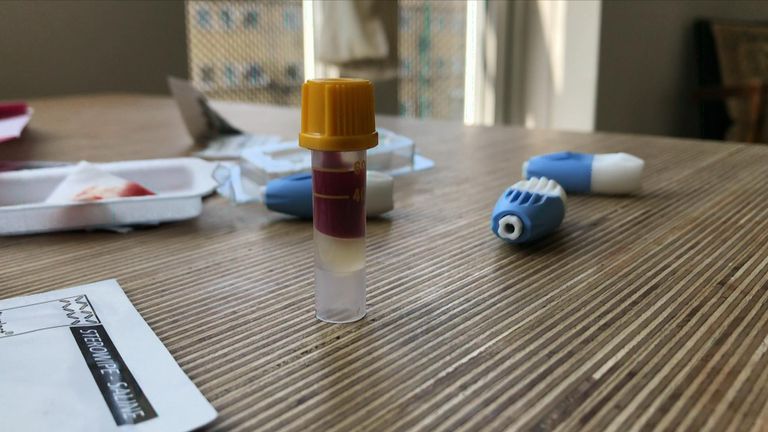
The process was straightforward, if a little awkward. I pricked my fingers with lancets provided by the company, then filled a small vial with my blood.
I put my sample in a bag and sent it off to the lab.
Image:The test had to be sent back to the lab
Four days later, my results arrived. Feeling nervous, I opened the link.
"Your test did not find antibodies to the SARS-CoV-2 coronavirus in your blood sample," I read.
"It is therefore highly unlikely that you have been infected with coronavirus in the past."
I felt gutted. I'd been dreaming of a lottery win. Instead, I had nothing.
But I shouldn't have been - because even a very accurate antibody test can't actually tell us very much at all.
"We simply don't know yet whether the antibodies that we can detect are protective," says Professor Eleanor Riley, from the immunology and infectious disease department at the University of Edinburgh.
"An antibody test tells me that those symptoms I had a few weeks ago were due to coronavirus. It doesn't tell me that I'm immune to reinfection."
Antibody tests can help public health experts track the spread of the infection, but on an individual level, Professor Riley says, they provide little useful information.
"Individual tests at the moment are not a useful public health tool," she says.
"They are a curiosity, I think, for people who can afford to pay £90 or £100 for a test and think they might have had the infection."
I put this to Dr Rodgers of Medichecks. He agreed the tests would not be appropriate to use in clinical practice, and that they couldn't tell anyone whether or not they were immune - something his company makes clear.
"We are very, very careful to make clear that it is not a measure of immunity," he said. "It is simply a sign that someone has had infection."
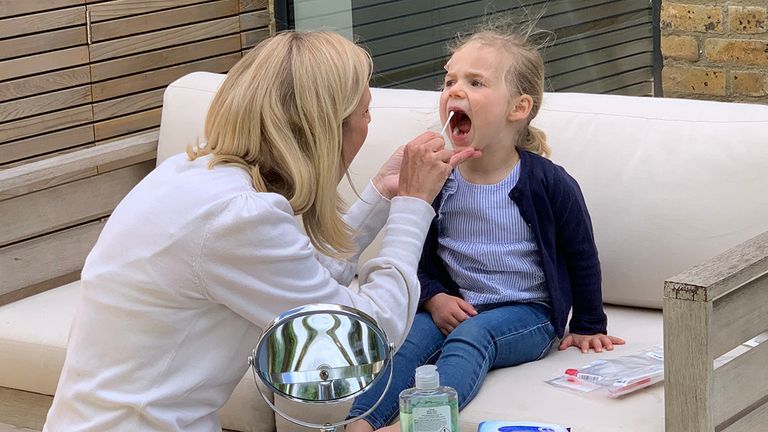
Sky presenter tests daughter for coronavirus
Despite that, he told me, demand was very high.
"Most people just want to know if they've had the infection.
"People like to remove uncertainty from their lives. If they are feeling uncertainty about whether or not they've had the infection, this test will tell them."
Once I'd got over my disappointment, I found that I agreed.
At a time when there is so much uncertainty around, a little bit of clarity can be just the lift we need.
Transport for London will have to axe services if the government does not agree to a financial rescue package by the end of the day, Sadiq Khan warned on Thursday.
The London mayor said the capital’s transport authority was “running out” of money and said he was concerned about the consequences if the Department for Transport failed to step in to plug an anticipated £4bn black hole in TfL’s finances this year.
“Unless the government today gives us confirmation of the grant that we need, the consequences could be quite severe and the implications for all of us will be huge,” the Labour mayor told LBC radio.
“We’ll have to start reducing services. The only way to balance the books is to cut services.”
TfL, which has seen its government grant gradually withdrawn in recent years, now relies almost entirely on fare income — but passenger numbers have plunged to a trickle during the coronavirus pandemic.
The agenda for TfL’s finance committee meeting earlier this week said there was still a gap of £3.2bn in the authority’s emergency budget for this financial year to the end of March 2021.
The authority is still in talks with the DfT and Treasury about a rescue package that is expected to include conditions, including the postponement of several new projects such as proposed Bakerloo Line extension.
Downing Street said talks were ongoing. “It is a commercial discussion. We remain in close contact with the mayor and TfL to look at how we can support them.”
The cabinet was told during a meeting on Thursday morning that talks were at an “advanced stage”.
“Our priority is on reaching an agreement which keeps critical services running for those passengers who must use public transport to get to work,” Downing Street said.
“That means protecting key routes, rapidly increasing the number of services available and protecting the interests of taxpayers in the long term.”
As part of government plans to ease the lockdown, ministers this week urged people working in some sectors to return to work. At the same time the government told those that could work from home to do so to prevent public transport from being swamped with commuters.
Transport officials have warned the Tube can only run at about 15 per cent capacity while strictly adhering to 2m social distancing guidance and there was anecdotal evidence of some trains and buses in the capital being overcrowded.
TfL is not only demanding support for the coming months but also for more long-term support because it does not expect passenger numbers to return to pre-lockdown levels for several years. TfL data show the number of Tube journeys on Wednesday were 94 per cent down on the same day a year earlier albeit with some bottlenecks.
“It is inconceivable that TfL won’t need government funding not only for 2020-21 but also for 21-22,” said Tony Travers, a professor at the school of public policy at LSE. “That means the need for a very significant government grant this year and the year after.”
Mr Khan said the authority was spending £600m a month with hardly any income to cover those costs. “We’re the only transport system in western Europe that gets no government grant,” he said.
“We’re paid for ostensibly by the fares we bring in, the congestion charge and by advertising. Over the past two months, we’ve lost more than 90 per cent of our fares, advertising is down and so is the congestion charge.”
TfL started the crisis with a cash reserve of over £2.1bn but that buffer has rapidly fallen, the mayor said.
Keith Prince, Conservative GLA transport spokesman, accused the mayor of “political gameplay”, saying that the authority still had £1.2bn in reserves. “Sadiq Khan needs to stop playing politics with people’s lives,” he said.
But Mr Khan pointed out that the authority was obliged by law to keep two months’ worth of money in reserve to fund services and has been negotiating with the Conservative government for some time.
“We’ve been involved in weeks and weeks of negotiations with the government and it is really hard to get support from them,” he said. “Being blunt, today is the last day.”
The finance committee paper said there had been a 95 per cent reduction in journeys on the Tube, and an 85 reduction in journeys on buses. This has caused an overall income loss of around 90 per cent including non-passenger incomes.
Yet the authority has continued to run 80 per cent of bus services and half of regular Tube services. Any cuts to service will make it harder for people to return to work in a socially-distanced way.
While the authority has furloughed 7,000 staff — a quarter of the total — and stopped 300 construction projects these savings do not cover the loss from the plunge in revenue.
At the start of March, I had a tight chest and a sore throat.
Nothing to worry about, in the normal run of things - but, boy, did I worry. Was this COVID-19? Was I spreading it? Should I self-isolate?
After the symptoms disappeared, my worry turned to hope. Had I contracted the best kind of coronavirus, the extremely mild kind? Had I won the lottery and acquired immunity at no cost?
Image:The test is more reliable when done in a laboratory
Since the start of the outbreak, I've spoken to dozens of people who have had similar thoughts, sometimes in the most unlikely circumstances.
My mum is pretty sure she caught it from my sister's partner in late December, at a time when the first cases were emerging in China.
Advertisement
A taxi driver told me he thought he'd had it in July last year.
"Are you sure?" I said.
More from Covid-19
"Absolutely," he replied.
Until recently, these speculations were impossible to check. An infection will leave antibodies that can be detected by a test, but getting an accurate version of those tests has not been easy.
In March, the New York Times reported that the government paid £16m for two million antibody tests from China, only to find out they didn't work.
But those tests were meant to be done at home, making them "as simple as a pregnancy test", as the prime minister put it in March.
Tests done in a lab are much more reliable.
Public Health England has approved an antibody test made by the pharmaceutical company Roche, which it says can reliably pick up whether people have contracted the virus.
Private laboratories are offering similar tests.
Image:A finger prick is needed to complete the test
Although these aren't approved, they promise high levels of accuracy.
Medichecks, a private blood testing laboratory based in London, offers antibody tests at a cost of £90, which it says score very highly on the key measures of accuracy, specificity and sensitivity.
That means they only pick up people who have genuinely had COVID-19, as opposed to another illness, and can detect even mild symptoms.
"If the test is taken 17 days after the onset of symptoms, the latest research I've seen from the University of Washington suggests that it's 100% accurate," says Dr Sam Rodgers, medical director of Medichecks.
However, he stresses that "this is a field that's changing incredibly quickly".
With this guarantee in mind, I decided to see what it was like.
The process was straightforward, if a little awkward. I pricked my fingers with lancets provided by the company, then filled a small vial with my blood.
I put my sample in a bag and sent it off to the lab.
Image:The test had to be sent back to the lab
Four days later, my results arrived. Feeling nervous, I opened the link.
"Your test did not find antibodies to the SARS-CoV-2 coronavirus in your blood sample," I read.
"It is therefore highly unlikely that you have been infected with coronavirus in the past."
I felt gutted. I'd been dreaming of a lottery win. Instead, I had nothing.
But I shouldn't have been - because even a very accurate antibody test can't actually tell us very much at all.
"We simply don't know yet whether the antibodies that we can detect are protective," says Professor Eleanor Riley, from the immunology and infectious disease department at the University of Edinburgh.
"An antibody test tells me that those symptoms I had a few weeks ago were due to coronavirus. It doesn't tell me that I'm immune to reinfection."
Antibody tests can help public health experts track the spread of the infection, but on an individual level, Professor Riley says, they provide little useful information.
"Individual tests at the moment are not a useful public health tool," she says.
"They are a curiosity, I think, for people who can afford to pay £90 or £100 for a test and think they might have had the infection."
I put this to Dr Rodgers of Medichecks. He agreed the tests would not be appropriate to use in clinical practice, and that they couldn't tell anyone whether or not they were immune - something his company makes clear.
"We are very, very careful to make clear that it is not a measure of immunity," he said. "It is simply a sign that someone has had infection."
Sky presenter tests daughter for coronavirus
Despite that, he told me, demand was very high.
"Most people just want to know if they've had the infection.
"People like to remove uncertainty from their lives. If they are feeling uncertainty about whether or not they've had the infection, this test will tell them."
Once I'd got over my disappointment, I found that I agreed.
At a time when there is so much uncertainty around, a little bit of clarity can be just the lift we need.
First Minister Nicola Sturgeon announced the latest figures at her daily briefing.
As of 9am 14 May, there have been 2,219,281 tests, with 126,064 tests on 13 May.
1,593,902 people have been tested of which 233,151 tested positive.
As of 5pm on 13 May, of those tested positive for coronavirus, across all settings, 33,614 have sadly died. pic.twitter.com/VrfhlNVWar
— Department of Health and Social Care (@DHSCgovuk) May 14, 2020
British Army personnel man a new mobile coronavirus drive-though self testing station in the car park of Xcite, West Lothian (Picture: SWNS)
The figures were released a day after data published by the National Records of Scotland showed 3,213 people had died with confirmed or suspected coronavirus up to May 10.
Advertisement
Advertisement
Speaking on Thursday, Ms Sturgeon said 14,117 people have tested positive for the virus in Scotland, up by 188 from 13,929 the day before.
There are 71 people in intensive care with coronavirus or coronavirus symptoms, an increase of one on Wednesday, and 1,480 people are in hospital with confirmed or suspected Covid-19, a decrease of 54.
Since March 5, 3,253 people who have tested positive for coronavirus have been able to leave hospital.
Public Health Wales said a further 128 people had tested positive for Covid-19, bringing the total number of confirmed cases to 11,834.
Dr Robin Howe, from Public Health Wales, said: ‘We have been working hard to increase our testing capacity, and in the last week we have more than doubled our capacity to 5,330 tests a day in Wales.
‘We know there is more to do as demand increases, and we will continue to ramp up this capacity.
‘Although we appear to have passed the peak of new cases in Wales, Covid-19 is still circulating in every part of the country.
‘The single most important action we can all take in fighting the virus is to stay at home, and we thank each and every person across Wales for doing their bit to help slow the spread of the virus.’