MPs have approved a motion to declare an environment and climate emergency.
This proposal, which demonstrates the will of the Commons on the issue but does not legally compel the government to act, was approved without a vote.
Labour leader Jeremy Corbyn, who tabled the motion, said it was "a huge step forward".
Environment Secretary Michael Gove acknowledged there was a climate "emergency" but did not back Labour's demands to declare one.
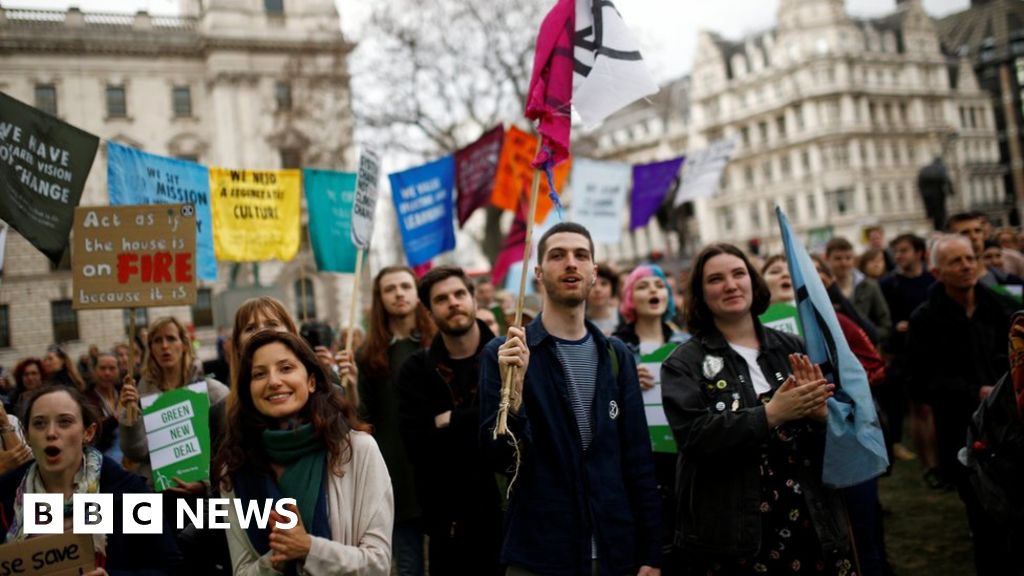
The declaration of an emergency was one of the key demands put to the government by environmental activist group Extinction Rebellion, in a series of protests over recent weeks.
Addressing climate protesters from the top of a fire engine in Parliament Square earlier, Mr Corbyn said: "This can set off a wave of action from parliaments and governments around the globe.
"We pledge to work as closely as possible with countries that are serious about ending the climate catastrophe and make clear to US President Donald Trump that he cannot ignore international agreements and action on the climate crisis."
What is a climate emergency?
Dozens of towns and cities across the UK have already declared "a climate emergency".
There is no single definition of what that means but many local areas say they want to be carbon-neutral by 2030.
Some councils have promised to introduce electric car hubs or build sustainable homes to try to achieve that goal.
It's a much more ambitious target than the UK government's, which is to reduce carbon emissions by 80% (compared to 1990 levels) by 2050.
Labour's motion also calls on the government to aim to achieve net-zero emissions before 2050 and for ministers to outline urgent proposals to restore the UK's natural environment and deliver a "zero waste economy" within the next six months.
The Welsh and Scottish governments have both already declared a climate emergency, along with dozens of towns and cities, including Manchester and London.
MPs have approved a motion to declare an environment and climate emergency.
This proposal, which demonstrates the will of the Commons on the issue but does not legally compel the government to act, was approved without a vote.
Labour leader Jeremy Corbyn, who tabled the motion, said it was "a huge step forward".
Environment Secretary Michael Gove acknowledged there was a climate "emergency" but did not back Labour's demands to declare one.
The declaration of an emergency was one of the key demands put to the government by environmental activist group Extinction Rebellion, in a series of protests over recent weeks.
Addressing climate protesters from the top of a fire engine in Parliament Square earlier, Mr Corbyn said: "This can set off a wave of action from parliaments and governments around the globe.
"We pledge to work as closely as possible with countries that are serious about ending the climate catastrophe and make clear to US President Donald Trump that he cannot ignore international agreements and action on the climate crisis."
What is a climate emergency?
Dozens of towns and cities across the UK have already declared "a climate emergency".
There is no single definition of what that means but many local areas say they want to be carbon-neutral by 2030.
Some councils have promised to introduce electric car hubs or build sustainable homes to try to achieve that goal.
It's a much more ambitious target than the UK government's, which is to reduce carbon emissions by 80% (compared to 1990 levels) by 2050.
Labour's motion also calls on the government to aim to achieve net-zero emissions before 2050 and for ministers to outline urgent proposals to restore the UK's natural environment and deliver a "zero waste economy" within the next six months.
The Welsh and Scottish governments have both already declared a climate emergency, along with dozens of towns and cities, including Manchester and London.
MPs have approved a motion to declare an environment and climate emergency.
This proposal, which demonstrates the will of the Commons on the issue but does not legally compel the government to act, was approved without a vote.
Labour leader Jeremy Corbyn, who tabled the motion, said it was "a huge step forward".
Environment Secretary Michael Gove acknowledged there was a climate "emergency" but did not back Labour's demands to declare one.
The declaration of an emergency was one of the key demands put to the government by environmental activist group Extinction Rebellion, in a series of protests over recent weeks.
Addressing climate protesters from the top of a fire engine in Parliament Square earlier, Mr Corbyn said: "This can set off a wave of action from parliaments and governments around the globe.
"We pledge to work as closely as possible with countries that are serious about ending the climate catastrophe and make clear to US President Donald Trump that he cannot ignore international agreements and action on the climate crisis."
What is a climate emergency?
Dozens of towns and cities across the UK have already declared "a climate emergency".
There is no single definition of what that means but many local areas say they want to be carbon-neutral by 2030.
Some councils have promised to introduce electric car hubs or build sustainable homes to try to achieve that goal.
It's a much more ambitious target than the UK government's, which is to reduce carbon emissions by 80% (compared to 1990 levels) by 2050.
Labour's motion also calls on the government to aim to achieve net-zero emissions before 2050 and for ministers to outline urgent proposals to restore the UK's natural environment and deliver a "zero waste economy" within the next six months.
The Welsh and Scottish governments have both already declared a climate emergency, along with dozens of towns and cities, including Manchester and London.
MPs have approved a motion to declare an environment and climate emergency.
This proposal, which demonstrates the will of the Commons on the issue but does not legally compel the government to act, was approved without a vote.
Labour leader Jeremy Corbyn, who tabled the motion, said it was "a huge step forward".
Environment Secretary Michael Gove acknowledged there was a climate "emergency" but did not back Labour's demands to declare one.
The declaration of an emergency was one of the key demands put to the government by environmental activist group Extinction Rebellion, in a series of protests over recent weeks.
Addressing climate protesters from the top of a fire engine in Parliament Square earlier, Mr Corbyn said: "This can set off a wave of action from parliaments and governments around the globe.
"We pledge to work as closely as possible with countries that are serious about ending the climate catastrophe and make clear to US President Donald Trump that he cannot ignore international agreements and action on the climate crisis."
What is a climate emergency?
Dozens of towns and cities across the UK have already declared "a climate emergency".
There is no single definition of what that means but many local areas say they want to be carbon-neutral by 2030.
Some councils have promised to introduce electric car hubs or build sustainable homes to try to achieve that goal.
It's a much more ambitious target than the UK government's, which is to reduce carbon emissions by 80% (compared to 1990 levels) by 2050.
Labour's motion also calls on the government to aim to achieve net-zero emissions before 2050 and for ministers to outline urgent proposals to restore the UK's natural environment and deliver a "zero waste economy" within the next six months.
The Welsh and Scottish governments have both already declared a climate emergency, along with dozens of towns and cities, including Manchester and London.
The Royal Navy is testing a strikingly steampunk mechanical energy system for its Dragonfire Laser Directed Energy Weapon on its most advanced ships. And the new system’s design originally came from an unlikely source: the Williams Formula 1 team.
The Royal Navy is hoping its new Flywheel Energy Storage System (FESS) will reduce the impact on the rest of the ship when it needs to draw huge amounts of power for the energy weapon — while avoiding safety concerns such as lithium batteries starting fires on board a ship.
“This technology was originally developed by the Williams F1 team,” said U.K. military spokesperson Andrew Tate in a press release. “We saw an attractive option to bolster defence capability through the provision of more robust and futureproof power systems for naval ships.”
Flywheel Energy
The Dragonfire itself is a powerful 50 kW laser that could “protect our maritime and land forces” from “missiles or soldiers from enemy mortars,” according to the Ministry of Defense, as quoted by the UK Defence Journal.
But such a beast of a weapon on board a warship poses an engineering challenge. To meet its energy requirements, a coalition between U.S. and U.K. researchers decided to take advantage of the FESS, a system that “uses innovative high-speed & lightweight flywheels to provide high-power electrical pulses that these future systems require,” according to a press release.
The most common use of a flywheel is inside a car’s transmission. It stores rotational energy when the clutch is disengaged, and can transfer that energy back once its engaged again after a gear change.
In the same way, energy needed to fire a laser could be stored by a number of flywheels.
The Department for Transport is cancelling contracts to provide extra ferry services after Brexit.
Ending the contracts with Brittany Ferries and DFDS could cost the taxpayer more than £50m.
The government bought £89m worth of capacity from the two firms. Some of that capacity might be sold, but millions of pounds could be lost.
The contracts were designed to ease pressure on the port of Dover, by creating extra services at other ports.
In February, the DfT was forced to axe its £13.8m contract with a third company, Seaborne Freight, which the BBC found had never sailed a vessel.
Earlier this year, the National Audit Office estimated that the cancellation costs of all the ferry contracts would be £56.6m.
The cost is likely to only be several million pounds less than this.
A government spokesperson said: "The termination of these contracts has resulted in less cost to the taxpayer than the termination costs reported by the NAO."
The government was also forced to pay £33m to Eurotunnel, to settle a case which challenged the procurement process for the ferry contracts.
In addition, the DfT is now facing legal action from P&O Ferries, which says its rival, Eurotunnel, was given a competitive advantage by the government.
'We needed to be ready'
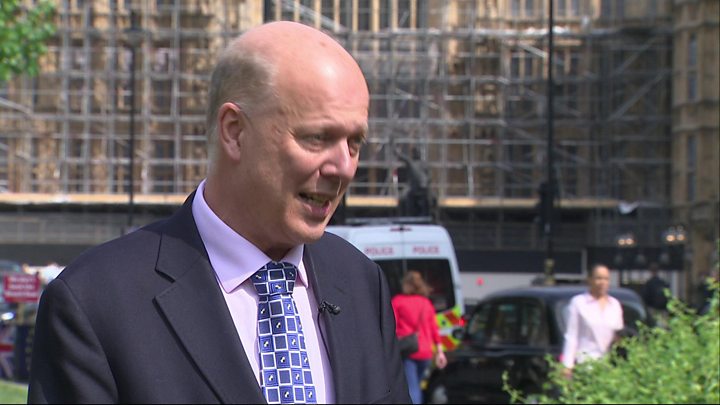
Mr Grayling, the Transport Secretary, said the cancelled contracts were part of a £4bn no-deal "insurance policy" the government had put in place.
"People would expect a responsible government to take out an insurance policy, and that's what we've done, to make sure we can deal with all the challenges in a no-deal Brexit.
"We never wanted it, we never worked for it, but we sure as certain needed to be ready for it," he said.
If extra cross-Channel freight services are needed again in the run-up to the new Brexit deadline in October, the government could have to negotiate a new set of contracts, he said.
Grayling under fire
Labour shadow transport secretary Andy McDonald said the contracts will be "a case study in ministerial incompetence" on the part of Mr Grayling.
"The Transport Secretary's approach to procurement and planning has cost taxpayers tens, if not, hundreds of millions of pounds. His career as a minister has left a trail of scorched earth and billions of pounds of public money wasted.
It is calling on ministers to provide additional funding for older teenagers in education and to extend free childcare to more low income families.
The government said it would take the recommendations seriously.
The findings will come as a setback to Theresa May who promised to tackle the "burning injustice" of social inequality when she entered Downing Street in 2016.
However, the following year all of the commissioners on the Social Mobility Commission - set up in 2010 to monitor and promote social mobility - resigned, saying the government was too focused on Brexit to deal with creating a fairer Britain.
Dame Martina Milburn, who has since been appointed as the new chairwoman, said she sensed there was now "a real commitment" from the government.
However, she said the biggest concern was not stagnation but that the problem might actually get worse.
"There's still a big shift - if you want to be socially mobile - towards London," she told BBC Radio Four's Today programme.
"I think you're three times more likely to move to London if you're from a professional background than if you're from a working class background."
Education Secretary Damian Hinds said he welcomed the "thorough" report - the first since the new commissioners were appointed - but stopped short of saying the government would adopt all of its recommendations.
He told the Today programme that social mobility was "a very difficult thing to move" but he was now focused on improving prospects for the generation currently coming through school.
The report recommends:
a "significant increase" in funding for all 16 to 19-year-olds in education, with a special "student premium" for the disadvantaged
extending the offer of 30 hours of free childcare a week to cover households where one parent is working eight hours a week - currently one parent must work at least 16 hours
the government agreeing to pay the voluntary living wage to all of its employees and contracted workers, including cleaners and catering staff
The report found those from better-off backgrounds were almost 80% more likely to be in a professional job than their working class peers.
It said the proportion of people from professional backgrounds who were in professional jobs was 60% last year.
In contrast, only 34% of those from working class backgrounds had professional jobs last year. And both figures had changed only slightly over the past four years.
"Being born privileged means you are likely to remain privileged," said Dame Martina, who is also chief executive of the Prince's Trust.
"But being born disadvantaged means you may have to overcome a series of barriers to ensure you and your children are not stuck in the same trap."
The commission said an increasing number of students from low-income families were entering university by the age of 19. That proportion has now reached 26%, compared with 43% of better-off peers.
But five years after graduating, those graduates who had been on free school meals at school were in jobs that earned 11.5% less than other graduates, the report said.
Easier for the better-off to grab opportunities
Career progression and better-paid work is more likely if people move regions - particularly if they go to London, the data shows.
Too often provincial towns and cities don't have the employment infrastructure to ensure career progression, notably in professions like law and accountancy.
Those from wealthier backgrounds are more likely to be able to make that kind of move, with the resources and support to grab opportunities wherever they may be.
Poorer people often struggle to afford to leave their home region.
Some believe devolving power and prestige to local government and combined authorities is the way to ensure a more even spread of growth and new jobs - and make the country less reliant on London.
In England, the Northern Powerhouse and Midlands Engine are initiatives to achieve just that within the wider industrial strategy.
But there are concerns that not enough resources are available to achieve significant structural change.
The report found barriers to getting a top job were there from the start - about a half (52%) of disadvantaged teenagers leave school without basic qualifications and many get stuck in low-paid work.
Adult education could help to redress that, said the report, but almost all forms of adult education have been in decline since 2010.
One route to a better-paid job was to move to another part of the country but those from professional backgrounds were more likely to make such a move, the report said.
There were also longer-term concerns that divisions could worsen as low-paid and low-skilled jobs were more likely to become automated in the future.
The education secretary said employment had risen in every UK region under this government, wages were outstripping inflation, the gap between disadvantaged pupils and their peers has narrowed and the proportion of 16 and 17-year-olds in education or apprenticeships was at its highest ever.
Dr John Goldthorpe, from the University of Oxford, said social mobility can be both upward and downward - and the rate of downward mobility was rising.
He explained that from the 1950s to 1980s, the number of professional and managerial jobs increased - meaning there was "more room at the top" for people to move up into. But from the 1990s, the rate of growth in professional jobs has slowed - so there is less room at the top and more competition for those jobs.
"For young people today, the objective chances of upward mobility are less than they were for their parents or grandparents," said Dr Goldthorpe, who co-wrote the book Social Mobility and Education in Britain.