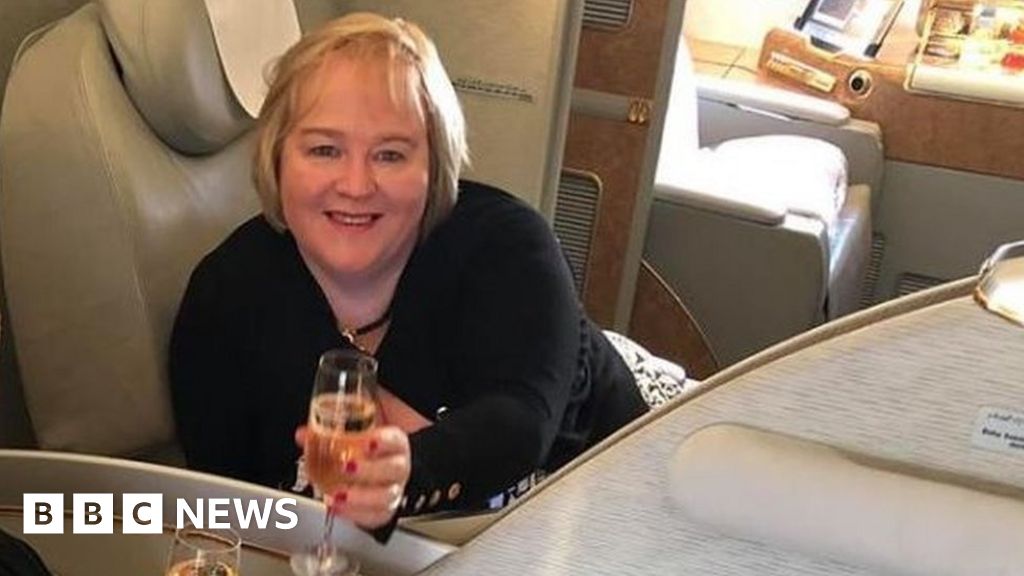
A woman from Manchester has been confirmed as the eighth British victim killed in a wave of bombings in Sri Lanka.
IT director Lorraine Campbell, 55, was staying at Colombo's Cinnamon Grand Hotel on a business trip when she died.
She worked for Dubai-based Al-Futtaim. Her family said her death would leave an "enormous void".
Ms Campbell's husband, Neil Evans, said he had lost his "best friend in the world for all adventures".
Mr Evans said his wife was a "real tour de force" and was a "conduit for bringing people together to both make things happen and make them better."
A senior executive at UAE automotive firm Al-Futtaim emailed staff to say Ms Campbell had "tragically lost her life".
The company said "two of our colleagues" had been caught up in the blasts but gave no further information about the other employee.
'Heavy heart'
The email to staff read: "It is with a heavy heart I inform you that two of our colleagues were caught up in Sunday's terror attacks in Sri Lanka.
"Both were in Sri Lanka on business travel. Lorraine tragically lost her life."
Ms Campbell's son, Mark, said his mother was "inspiring".
"She was very strong, very independent. But the one thing that kind of struck out for me throughout my entire life was she was a leader… she would never leave anyone behind type thing," he added.
He said his stepfather had first been informed she was missing, adding: "He was texting her when she was in the restaurant in the morning and then the texts stopped. Then the report came out, he put two and two together, same hotel."
The Islamic State group (IS) has said it was responsible for the attacks - which targeted churches and high-end hotels - although it has not provided direct evidence of its involvement.
The death toll rose again to 359 on Wednesday, with more than 500 people wounded.
Mark Campbell said he now wanted to "bring my mum home" and give everyone who knew her "an opportunity to come together and celebrate this beautiful woman".
Dr Sally Bradley and Bill Harrop, who had been living in Australia since 2013, were also staying in the Cinnamon Grand Hotel in Colombo when one of the suicide bombers struck.
“‘Former CIA analyst Larry Johnson accuses United Kingdom Intelligence of helping Obama Administration Spy on the 2016 Trump Presidential Campaign.’” @OANN WOW! It is now just a question of time before the truth comes out, and when it does, it will be a beauty!” Trump tweeted early Wednesday morning.
“Former CIA analyst Larry Johnson accuses United Kingdom Intelligence of helping Obama Administration Spy on the 2016 Trump Presidential Campaign.” @OANN WOW! It is now just a question of time before the truth comes out, and when it does, it will be a beauty!
Former CIA analyst Larry Johnson, who has previously argued that the U.K has spied on Trump during the 2016 election, has historically argued that that the CIA, not Russia, could have been responsible for hacking the Democratic National Committee.
Meanwhile, special counsel Robert Mueller’s Russia report, released last Thursday, outlines efforts from Russian military intelligence services to hack into computers and obtain documents from people within the Democratic Party and Hillary Clinton’s presidential campaign. Such documents were shared with DCLeaks and Guccifer 2.0, along with WikiLeaks for publication.
Trump and first lady Melania Trump are slated to visit the U.K. from June 3-5, per the request of Queen Elizabeth II. Trump will also attend a bilateral meeting with British Prime Minister Theresa May, along with a ceremony to commemorate the 75th Anniversary of D-Day.
The UK could one day create a national cyber-defence system built on sharing real-time cybersecurity information between intelligence agencies and business, the head of GCHQ has said.
Today's security threats have expanded in scope and seriousness. There can now be millions -- or even billions -- of dollars at risk when information security isn't handled properly.
Individual internet users shouldn't be forced to hold responsibility for staying safe online in the face of cyber-criminal gangs and advanced hacking groups, but rather it's cooperation between government, internet service providers and technology firms that should be doing the heavy lifting when it comes to cybersecurity, says the director of the UK's intelligence services.
With a recent UK cybersecurity survey suggesting that only 15 percent of people say they know how to protect themselves online, it's time "to do more to take the burden of cybersecurity away from the individual," Jeremy Fleming, director of GCHQ will tell a security conference today.
Fleming's address is the keynote address at CYBERUK 19, a conference set up and run by the National Cyber Security Centre (NCSC) – the cybersecurity arm of GCHQ.
"This technological revolution is providing extraordinary opportunity, innovation and progress – but it's also exposing us to increasing complexity, uncertainty and risk," he will tell the audience at the Scottish Event Campus in Glasgow, adding how it also "brings new and unprecedented challenges for policymakers as we seek to protect our citizens, judicial systems, businesses - and even societal norms."
Malicious cyber operations pose a threat to everyone from individuals and SMBs, to large organisations, critical national infrastructure and even governments, but the NCSC's mission is to use "unique insights into the structural vulnerabilities of the internet in partnership with business to detect, disrupt and fix malicious online behaviour," said Fleming.
One way the UK's 'Active Cyber Defence' programme has already achieved success is by reducing the number of phishing websites from cyber attackers that are hosted in the UK: as of last month, under two percent of global phishing websites are hosted in the UK, down from over five percent when the programme began in 2016.
GCHQ has achieved this by working in partnership with ISPs and cybersecurity firms, and Fleming pointed to a particular success around phishing emails claiming to come from the tax office in an effort to steal banking credentials and other personal data.
"HMRC is an excellent case study of a department leading the way in protecting its customers. In 2016, HMRC was the 16th most phished brand globally, accounting for 1.25% of all phishing emails sent. Today it is ranked 146th and accounts for less than 0.1% of all phishing emails," he said.
A protective DNS system for the public sector has also blocked malware attacks – such as the Conficker worm, which has been active since 2008 – on public sector networks. Fleming argued that private sector organisations should work with GCHQ in the same way as the public sector does in order to protect against attacks using automated services.
Fleming will describe how the agency is now sharing time-critical information in a matter of seconds to allow business to take action.
"With just one click, this information can be shared and action taken. In the coming year, we will continue to scale this capability – so whether it's indicators of a nation-state cyber actor, details of malware used by cyber criminals, or credit cards being sold on the Dark Web, we will declassify this information and get it back to those who can act on it," he will say.
"If enough do, the results could be truly transformational – a whole-of-nation, automated cyber-defence system," Fleming will say. However, he also warned that improving cybersecurity in this way is only achievable if all parties work to "build a genuinely national effort – with more connections and deeper cooperation with the private sector, and even closer working with our partners and allies."
For this to happen, government, private sector and academia all need to work together by applying expertise to bolster cybersecurity for individual consumers – and to help protect them against both current and future cyber threats.
"To make this a success, our strongest defence and most powerful weapon will be our ingenuity – our ability to imagine what has yet to be imagined. To see further into the future than anyone else. Our vision for the next stage of the UK's cybersecurity strategy aims to do just that. The prize is great – a safer, more successful UK," Fleming is due to say.
The government has given Chinese telecoms giant Huawei the go-ahead to supply equipment for the UK 5G data network despite senior ministers warning it poses a security risk.
The plan was said to have worried the home, defence and foreign secretaries.
The US also wants its allies in the "Five Eyes" intelligence grouping - the UK, Canada, Australia and New Zealand - to exclude Huawei.
Cyber-threats are among the issues set to be discussed later by the once-secret alliance, at a security conference in Glasgow.
Australia has already said it is siding with Washington - which has spoken of "serious concerns over Huawei's obligations to the Chinese government and the danger that poses to the integrity of telecommunications networks in the US and elsewhere".
Huawei, which already supplies equipment used in the UK's existing mobile networks, has always denied being controlled by the Chinese government, or that its work poses any risks of espionage and sabotage.
It said it was awaiting a formal government announcement on the UK's 5G plans, but was "pleased that the UK is continuing to take an evidence-based approach to its work, and we will continue to work cooperatively with the government, and the industry".
5G is the next (fifth) generation of mobile internet connectivity, promising much faster data download and upload speeds, wider coverage and more stable connections.
According to the Daily Telegraph, Huawei's involvement in the 5G network would include helping to build parts of antennas or other non-critical infrastructure.
A spokesman for the Department of Digital, Culture, Media and Sport said its review of the issue would report in due course.
BBC security correspondent Gordon Corera says it is believed the decision to involve Huawei was taken by ministers at a meeting of the government's national security council on Tuesday.
Although Huawei will only be allowed to work on non-sensitive parts of the network, he says it is still a very contentious move because 5G is set to play such an important role in the lives of Britons in the future.
Media playback is unsupported on your device
Ciaran Martin, the head of the National Cyber Security Centre - which oversees Huawei's current work in the UK - told BBC Radio 4's Today programme that a framework would be put in place to ensure the 5G network was "sufficiently safe".
Asked about the potential of a conflict in the position among members of the Five Eyes alliance, he added: "In the past decade there have been different approaches across the Five Eyes and across the allied wider Western alliance towards Huawei and towards other issues as well."
But Foreign Affairs Committee chairman Tom Tugendhat tweeted that allowing Huawei to build some of the UK's 5G infrastructure would "cause allies to doubt our ability to keep data secure and erode the trust essential to #FiveEyes cooperation".
Speaking on the Today programme, Mr Tugendhat maintained it was difficult to distinguish between the core and non-core in a 5G network.
He said the proposals still raised concerns, adding that 5G involved an "internet system that can genuinely connect everything, and therefore the distinction between non-core and core is much harder to make".
The government has given Chinese telecoms giant Huawei the go-ahead to supply equipment for the UK 5G data network despite senior ministers warning it poses a security risk.
The plan was said to have concerned the home, defence and foreign secretaries.
The US also wants its allies in the "Five Eyes" intelligence grouping - the UK, Canada, Australia and New Zealand - to exclude Huawei.
Cyber-threats are among the issues set to be discussed later by the once-secret alliance, at a security conference in Glasgow.
Australia has already said it is siding with Washington - which has spoken of "serious concerns over Huawei's obligations to the Chinese government and the danger that poses to the integrity of telecommunications networks in the US and elsewhere".
Huawei has always denied being controlled by the Chinese government, or that its work poses any risks of espionage and sabotage.
It said it was awaiting a formal government announcement on the UK's 5G plans, but was "pleased that the UK is continuing to take an evidence-based approach to its work, and we will continue to work cooperatively with the government, and the industry".
According to the Daily Telegraph, Huawei's involvement in the 5G network would include helping to build parts of antennas or other non-critical infrastructure.
A spokesman for the Department of Digital, Culture, Media and Sport said its review of the issue would report in due course.
Media playback is unsupported on your device
Responding to the reports, Foreign Affairs Committee chairman Tom Tugendhat tweeted that allowing Huawei to build some of the UK's 5G infrastructure would "cause allies to doubt our ability to keep data secure and erode the trust essential to #FiveEyes cooperation".
"There's a reason others have said no," he added.
Speaking on BBC Radio 4's Today programme, Mr Tugendhat maintained it was difficult to distinguish between the core and non-core in a 5G network.
He said the proposals still raised concerns, adding that 5G involved an "internet system that can genuinely connect everything, and therefore the distinction between non-core and core is much harder to make".
Later, the director of the UK's monitoring agency, GCHQ, Jeremy Fleming, will open the CyberUK conference in Glasgow by warning that a technological revolution "brings new and unprecedented challenges for policymakers, as they seek to protect citizens, judicial systems, businesses - and even societal norms".
He will say that the government wants to do more to take the burden of cyber-security away from the individual and to work with manufacturers and online companies to ensure they build security into their products and services at the design stage.
Mr Fleming will also make the case that improving the cyber-security of the UK is only achievable if "we build a genuinely national effort - with more connections and deeper cooperation with the private sector and even closer working with our partners and allies".
Back in 1846, a British woman could reasonably expect to be married before her 25th birthday, most likely to a man not much older: The average age of nuptials for a single woman was 24.7 and for a single man, 25.7.
But marriage is no longer the province of twentysomethings in Western countries.
Since the 1970s there’s been a clear trend in the UK for rising age at first marriage—which excludes people who were previously married and have divorced or lost a spouse—according to data from the UK’s Office for National Statistics (which has data back to the mid-19th century.) The average age for single men to marry passed 30 in 1999. For women, it was 2010:
The data to 2016, the most recent available, were released in March 2019. The ONS noted that in heterosexual unions, the age at first marriage in 2016 for men was 33.4 and for women was 31.5, part of a trend of rising age since the 1970s. For marriages between same-sex couples the average age was higher: 40.8 for men and 37.4 for women. (Same-sex marriage data goes back to 2014, when it became legal in the UK.)
The UK numbers reflect a growing trend in wealthy Western countries towards getting hitched later. In the rest of Europe, mean age at first marriage is higher then 30 in Germany, France, Spain, and many more of the regions most-developed economies. The US, meanwhile, has seen its median age at first marriage (which the United States Census Bureau estimates, rather than releasing a mean), creep up from around 20 for women in the 1970s to 27.8 in 2018. Men’s age at first marriage that year was 29.8.
Shifting social norms around cohabitation are a factor. “The major move towards living together before marriage may well help to explain many of the relationship trends we see today,” writes Nick Stripe, head of life events (that includes births, deaths, and baby names) at the ONS, in a blog accompanying the data. Almost 90% of couples marrying in 2016 had lived together beforehand.
Many people are also waiting longer to have kids. In 2017, for the first time, more UK women became pregnant over the age of 30 than in their 20s. Not all pregnancies lead to childbirth—in fact, the average British women’s age at the birth of their first child in 2017 was 28.8. But that number has been rising steadily since the 1970s, when the average dipped below 24.
Tributes are being paid to members of three British families who were among more than 300 people killed in Easter Sunday's bombings in Sri Lanka.
The deaths of London siblings Daniel and Amelie Linsey have "shocked" their schools, staff said.
Eight Britons are known to have died in the attacks, including Dr Sally Bradley and Bill Harrop, both from Manchester, who were described as "soulmates".
Anita Nicholson and her two children also died in a blast at a hotel.
The death toll from the wave of attacks on churches and hotels in the Sri Lankan capital Colombo, Negombo and Batticaloa has now risen to 321, with about 500 injured, police say.
Foreign Secretary Jeremy Hunt said the attack was "complex, highly co-ordinated and designed to cause maximum chaos, damage and heartbreak".
A team of family liaison officers has been sent to Sri Lanka to support the families of British victims and help repatriate the deceased, Mr Hunt said.
Amelie Linsey's school - Godolphin and Latymer School in west London - issued a statement on behalf of staff and pupils which said: "We're obviously devastated and shocked and digesting the news at the moment.
"Our priority is supporting her family and the students here," staff said.
And Westminster Kingsway College, where her brother Daniel was studying business, said it was "shocked and saddened", adding that it was offering counselling and support to students and staff who knew him.
Dr Bradley and her husband Mr Harrop, a retired firefighter, were on holiday in Sri Lanka when they were killed.
The couple, who had lived in Western Australia since Mr Harrop's retirement, were soulmates who "just lived for each other", a former colleague of Dr Bradley said.
"She absolutely loved living in Australia. She felt very at home here," executive director Kathleen Smith told 6PR radio.
She said Dr Bradley, who was director of clinical services at Rockingham Peel Group in Perth, talked of Mr Harrop's two sons as if they were her own.
A team from North Manchester General Hospital, where Sally had previously worked, said: "Sally was a lovely, kind individual, extremely approachable and gave so much to the NHS in Manchester during her career."
Mr Harrop had been in the fire service for 30 years before retiring in 2012, said Assistant County Fire Officer Dave Keelan, of Greater Manchester Fire Service.
"He was a much-loved and respected colleague and friend. He will be greatly missed."
It is not currently known which explosion killed the couple.
Anita Nicholson and her children Annabel, 11, and Alex, 14, were visiting Sri Lanka on holiday from their home in Singapore where Mrs Nicholson worked as a lawyer.
Her husband, Ben Nicholson, who survived the blast, said his family were killed as they ate breakfast in the Shangri-La Hotel in Colombo.
"Mercifully all three of them died instantly and with no pain or suffering," said Mr Nicholson, who is a partner with law firm Kennedys.
He paid tribute to his "wonderful, perfect wife", a lawyer for mining firm Anglo American.
She was "a brilliant, loving and inspirational mother to our two wonderful children", he said.
"Alex and Annabel were the most amazing, intelligent, talented and thoughtful children, and Anita and I were immensely proud of them both and looking forward to seeing them develop into adulthood," he added.
"They shared with their mother the priceless ability to light up any room they entered and bring joy to the lives of all they came into contact with."
Chancellor Phillip Hammond said Anita Nicholson was a former legal adviser at the Treasury and would be remembered by colleagues there as "a brilliant and dedicated lawyer".
Details of the eighth British victim have not yet emerged.
The Foreign Office has updated its travel advice for Sri Lanka.
It warns tourists to avoid crowded public areas, plan any movements carefully and not to travel during the newly-implemented nationwide curfew.
The Metropolitan Police are appealing for anyone who has returned to the UK from Sri Lanka to share any video or photos taken before, during or after the bombings - and have set up a secure website for people to do so.
How the Sri Lanka attacks unfolded
Sri Lanka is GMT+5.5
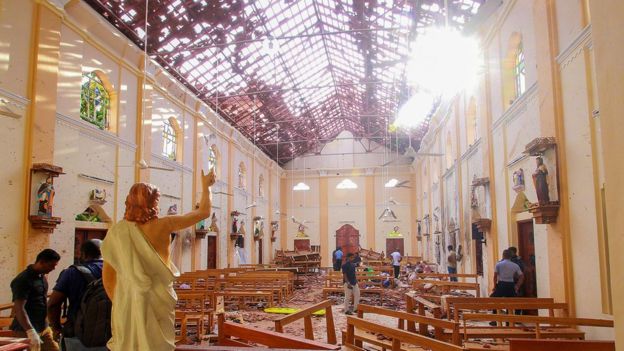
Three churches in Negombo, Batticaloa and Colombo's Kochchikade district are targeted during Easter services and blasts also rock the Shangri-La, Kingsbury and Cinnamon Grand hotels in the country's capital.
At least 290 people, including many foreigners, are now confirmed to have died. More than 500 are injured.
Video footage from St Anthony's Shrine, shared by Guardian journalist Michael Safi, showed people running from the area in panic. According to BBC Sinhala's Azzam Ameen, the blast happened while "security forces personnel... tried to defuse a newly discovered explosives in a vehicle".
As Sri Lanka held its first mass funeral for 30 victims on Tuesday, the Islamic State (IS) group claimed responsibility for the attack via its news outlet.
A BBC correspondent in Sri Lanka, however, has said that claim should be treated with caution.
Sri Lanka's government had earlier blamed the blasts on local Islamist group National Thowheed Jamath (NTJ).
On Tuesday, Labour leader Jeremy Corbyn said: "An attack like this on a hotel or a church or any other place is an indiscriminate attack on all of us."
He urged people not to "jump to conclusions about the perpetrators", rather to make sure people were safe and secure and given a "proper period of mourning".
The Foreign Office has directed British citizens to two helplines:
Those in Sri Lanka can call the Embassy in Colombo: +94 11 5390639
Those in the UK who are concerned for British friends or family in Sri Lanka can call: 020 7008 1500